 Add to Chrome
 Add to Firefox
 Add to Edge
Imitation learning-based spacecraft rendezvous and docking method with Expert Demonstration
Jan 19, 2026
Existing spacecraft rendezvous and docking control methods largely rely on predefined dynamic models and often exhibit limited robustness in realistic on-orbit environments. To address this issue, this paper proposes an Imitation Learning-based spacecraft rendezvous and docking control framework (IL-SRD) that directly learns control policies from expert demonstrations, thereby reducing dependence on accurate modeling. We propose an anchored decoder target mechanism, which conditions the decoder queries on state-related anchors to explicitly constrain the control generation process. This mechanism enforces physically consistent control evolution and effectively suppresses implausible action deviations in sequential prediction, enabling reliable six-degree-of-freedom (6-DOF) rendezvous and docking control. To further enhance stability, a temporal aggregation mechanism is incorporated to mitigate error accumulation caused by the sequential prediction nature of Transformer-based models, where small inaccuracies at each time step can propagate and amplify over long horizons. Extensive simulation results demonstrate that the proposed IL-SRD framework achieves accurate and energy-efficient model-free rendezvous and docking control. Robustness evaluations further confirm its capability to maintain competitive performance under significant unknown disturbances. The source code is available at https://github.com/Dongzhou-1996/IL-SRD.

Multimodal Spiking Neural Network for Space Robotic Manipulation
Aug 10, 2025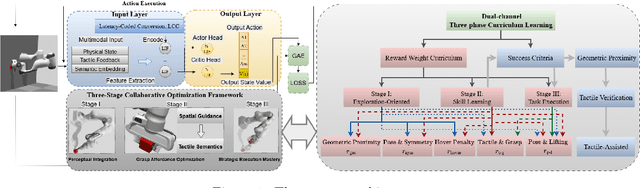


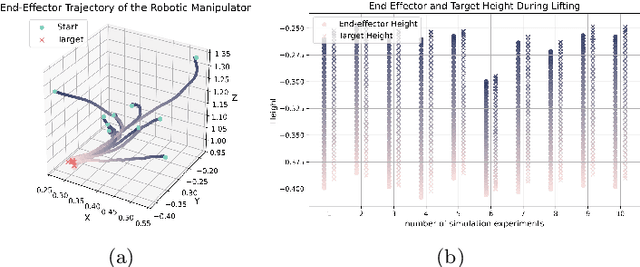
This paper presents a multimodal control framework based on spiking neural networks (SNNs) for robotic arms aboard space stations. It is designed to cope with the constraints of limited onboard resources while enabling autonomous manipulation and material transfer in space operations. By combining geometric states with tactile and semantic information, the framework strengthens environmental awareness and contributes to more robust control strategies. To guide the learning process progressively, a dual-channel, three-stage curriculum reinforcement learning (CRL) scheme is further integrated into the system. The framework was tested across a range of tasks including target approach, object grasping, and stable lifting with wall-mounted robotic arms, demonstrating reliable performance throughout. Experimental evaluations demonstrate that the proposed method consistently outperforms baseline approaches in both task success rate and energy efficiency. These findings highlight its suitability for real-world aerospace applications.