 Add to Chrome
 Add to Firefox
 Add to Edge
Foundation Models in Biomedical Imaging: Turning Hype into Reality
Dec 17, 2025
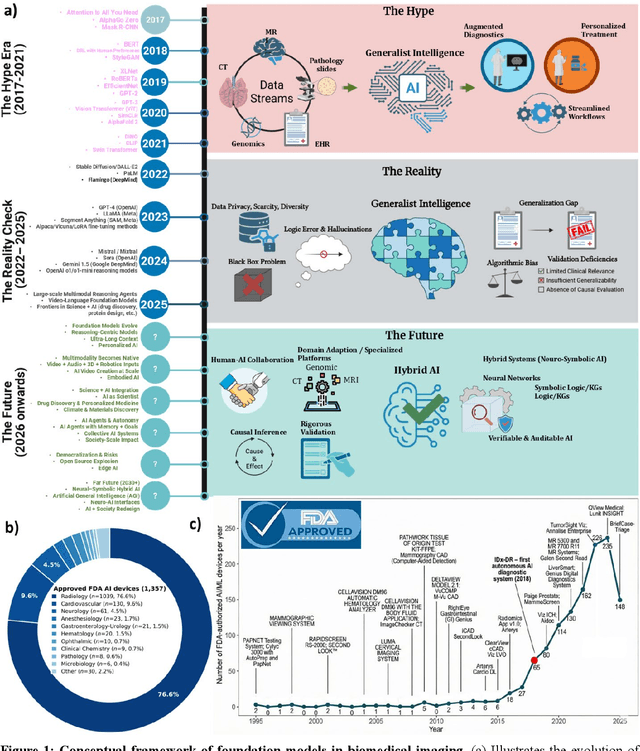
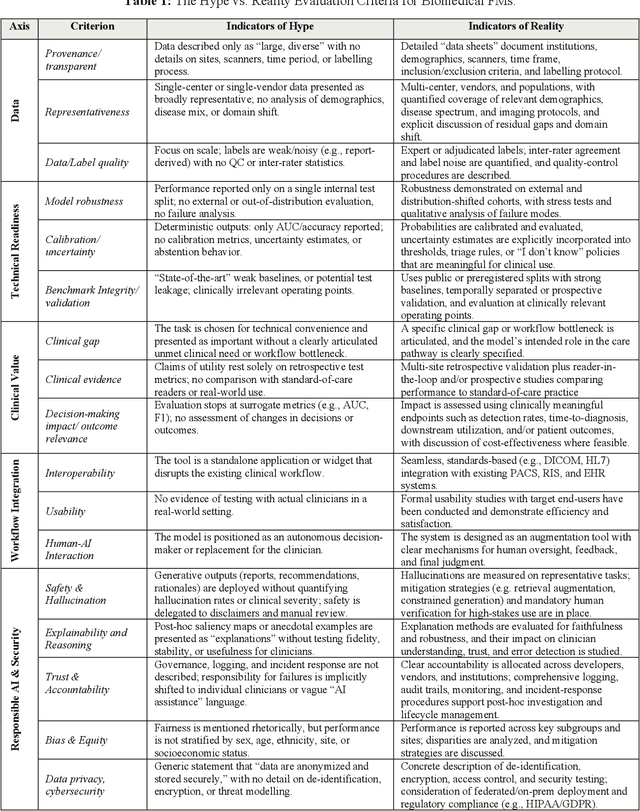
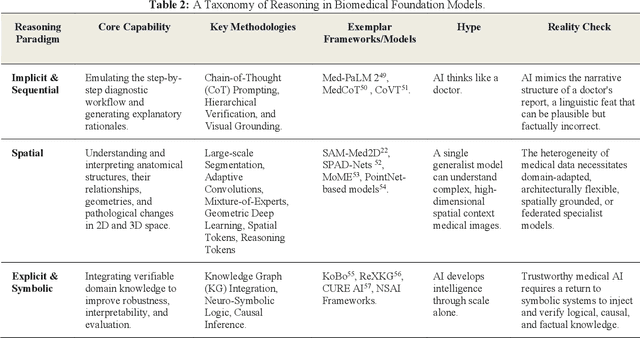
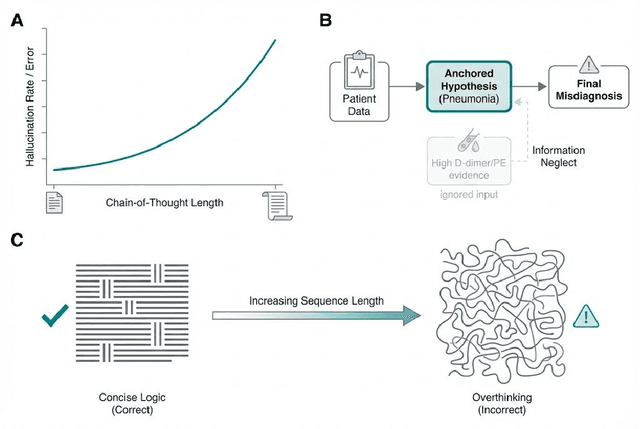
Foundation models (FMs) are driving a prominent shift in artificial intelligence across different domains, including biomedical imaging. These models are designed to move beyond narrow pattern recognition towards emulating sophisticated clinical reasoning, understanding complex spatial relationships, and integrating multimodal data with unprecedented flexibility. However, a critical gap exists between this potential and the current reality, where the clinical evaluation and deployment of FMs are hampered by significant challenges. Herein, we critically assess the current state-of-the-art, analyzing hype by examining the core capabilities and limitations of FMs in the biomedical domain. We also provide a taxonomy of reasoning, ranging from emulated sequential logic and spatial understanding to the integration of explicit symbolic knowledge, to evaluate whether these models exhibit genuine cognition or merely mimic surface-level patterns. We argue that a critical frontier lies beyond statistical correlation, in the pursuit of causal inference, which is essential for building robust models that understand cause and effect. Furthermore, we discuss the paramount issues in deployment stemming from trustworthiness, bias, and safety, dissecting the challenges of algorithmic bias, data bias and privacy, and model hallucinations. We also draw attention to the need for more inclusive, rigorous, and clinically relevant validation frameworks to ensure their safe and ethical application. We conclude that while the vision of autonomous AI-doctors remains distant, the immediate reality is the emergence of powerful technology and assistive tools that would benefit clinical practice. The future of FMs in biomedical imaging hinges not on scale alone, but on developing hybrid, causally aware, and verifiably safe systems that augment, rather than replace, human expertise.

Transfer Learning Approach for Detecting Psychological Distress in Brexit Tweets
Jan 25, 2021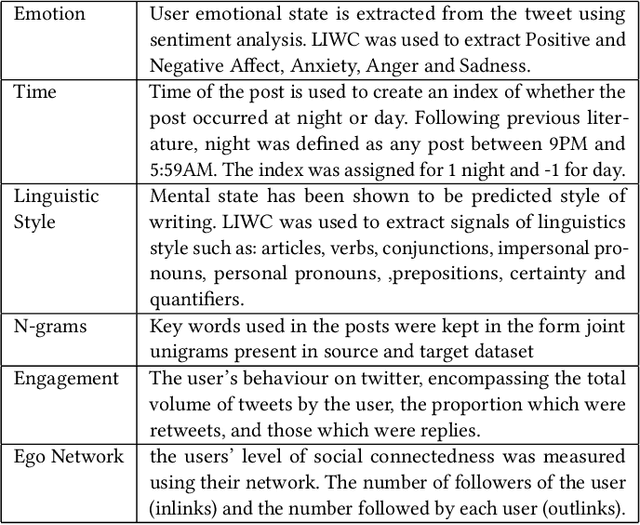
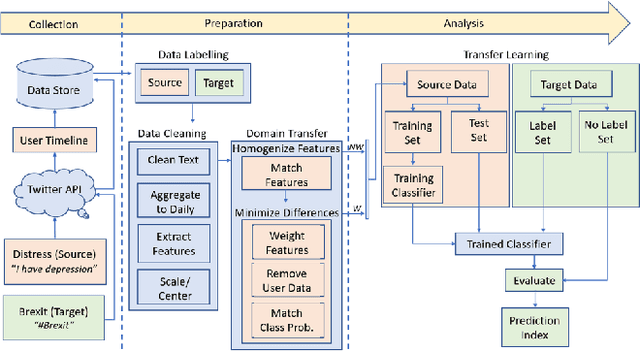
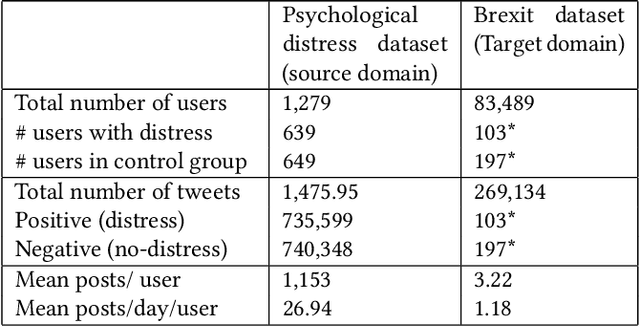
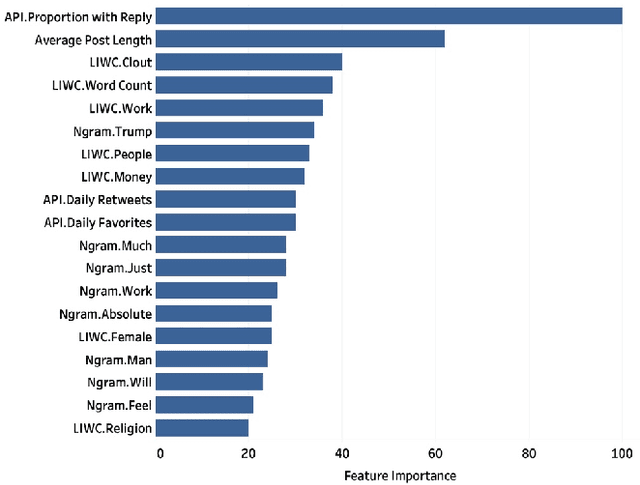
In 2016, United Kingdom (UK) citizens voted to leave the European Union (EU), which was officially implemented in 2020. During this period, UK residents experienced a great deal of uncertainty around the UK's continued relationship with the EU. Many people have used social media platforms to express their emotions about this critical event. Sentiment analysis has been recently considered as an important tool for detecting mental well-being in Twitter contents. However, detecting the psychological distress status in political-related tweets is a challenging task due to the lack of explicit sentences describing the depressive or anxiety status. To address this problem, this paper leverages a transfer learning approach for sentiment analysis to measure the non-clinical psychological distress status in Brexit tweets. The framework transfers the knowledge learnt from self-reported psychological distress tweets (source domain) to detect the distress status in Brexit tweets (target domain). The framework applies a domain adaptation technique to decrease the impact of negative transfer between source and target domains. The paper also introduces a Brexit distress index that can be used to detect levels of psychological distress of individuals in Brexit tweets. We design an experiment that includes data from both domains. The proposed model is able to detect the non-clinical psychological distress status in Brexit tweets with an accuracy of 66% and 62% on the source and target domains, respectively.