 Add to Chrome
 Add to Firefox
 Add to Edge
SatBLIP: Context Understanding and Feature Identification from Satellite Imagery with Vision-Language Learning
Apr 15, 2026
Rural environmental risks are shaped by place-based conditions (e.g., housing quality, road access, land-surface patterns), yet standard vulnerability indices are coarse and provide limited insight into risk contexts. We propose SatBLIP, a satellite-specific vision-language framework for rural context understanding and feature identification that predicts county-level Social Vulnerability Index (SVI). SatBLIP addresses limitations of prior remote sensing pipelines-handcrafted features, manual virtual audits, and natural-image-trained VLMs-by coupling contrastive image-text alignment with bootstrapped captioning tailored to satellite semantics. We use GPT-4o to generate structured descriptions of satellite tiles (roof type/condition, house size, yard attributes, greenery, and road context), then fine-tune a satellite-adapted BLIP model to generate captions for unseen images. Captions are encoded with CLIP and fused with LLM-derived embeddings via attention for SVI estimation under spatial aggregation. Using SHAP, we identify salient attributes (e.g., roof form/condition, street width, vegetation, cars/open space) that consistently drive robust predictions, enabling interpretable mapping of rural risk environments.

SRVAU-R1: Enhancing Video Anomaly Understanding via Reflection-Aware Learning
Feb 01, 2026Multi-modal large language models (MLLMs) have demonstrated significant progress in reasoning capabilities and shown promising effectiveness in video anomaly understanding (VAU) tasks. However, existing MLLM-based approaches remain largely focused on surface-level descriptions of anomalies, lacking deep reasoning over abnormal behaviors like explicit self-reflection and self-correction. To address that, we propose Self-Reflection-Enhanced Reasoning for Video Anomaly Understanding (SRVAU-R1), a reflection-aware learning framework that incorporates reflection in MLLM reasoning. Specifically, SRVAU-R1 introduces the first reflection-oriented Chain-of-Thought dataset tailored for VAU, providing structured supervision with initial reasoning, self-reflection, and revised reasoning. Based on that, it includes a novel reflection-aware learning paradigm with supervised fine-tuning and reinforcement fine-tuning to enhance multi-modal reasoning for VAU. Extensive experiments on multiple video anomaly benchmarks demonstrate that SRVAU-R1 consistently outperforms existing methods, achieving significant improvements in both temporal anomaly localization accuracy and reasoning quality.
Multi-scale reconstruction of undersampled spectral-spatial OCT data for coronary imaging using deep learning
Apr 25, 2022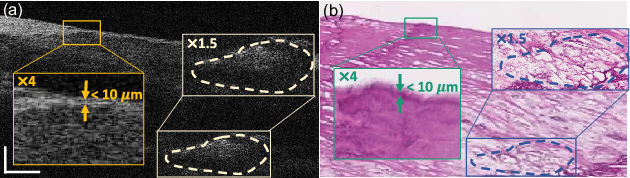
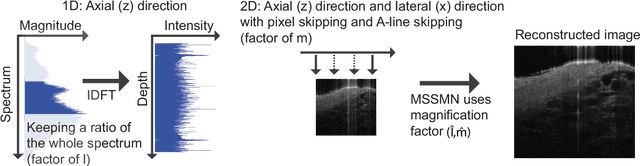
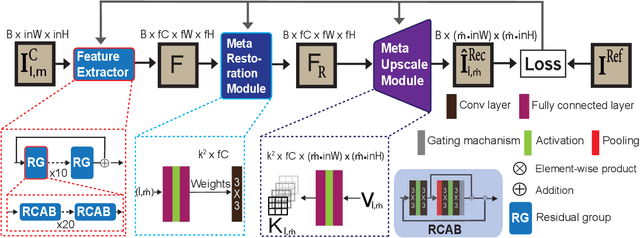
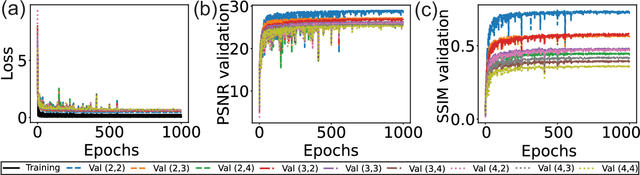
Coronary artery disease (CAD) is a cardiovascular condition with high morbidity and mortality. Intravascular optical coherence tomography (IVOCT) has been considered as an optimal imagining system for the diagnosis and treatment of CAD. Constrained by Nyquist theorem, dense sampling in IVOCT attains high resolving power to delineate cellular structures/ features. There is a trade-off between high spatial resolution and fast scanning rate for coronary imaging. In this paper, we propose a viable spectral-spatial acquisition method that down-scales the sampling process in both spectral and spatial domain while maintaining high quality in image reconstruction. The down-scaling schedule boosts data acquisition speed without any hardware modifications. Additionally, we propose a unified multi-scale reconstruction framework, namely Multiscale- Spectral-Spatial-Magnification Network (MSSMN), to resolve highly down-scaled (compressed) OCT images with flexible magnification factors. We incorporate the proposed methods into Spectral Domain OCT (SD-OCT) imaging of human coronary samples with clinical features such as stent and calcified lesions. Our experimental results demonstrate that spectral-spatial downscaled data can be better reconstructed than data that is downscaled solely in either spectral or spatial domain. Moreover, we observe better reconstruction performance using MSSMN than using existing reconstruction methods. Our acquisition method and multi-scale reconstruction framework, in combination, may allow faster SD-OCT inspection with high resolution during coronary intervention.