 Add to Chrome
 Add to Firefox
 Add to Edge
PhyEditBench: A Real-World Multi-Stage Benchmark for Physics-Aware Image Editing
Jun 25, 2026
While instruction-based image editing, enabled by multi-modal generative models, has advanced significantly, existing benchmarks lack a comprehensive evaluation of physics-based reasoning, a critical capability for handling real-world scenarios. To address this, we introduce PhyEditBench, a benchmark designed to assess the physical understanding of editing models. Guided by a hierarchical taxonomy, we establish 4 primary classes and 12 subclasses. It comprises 238 high-quality, high-resolution, real-world instances meticulously extracted from videos to capture authentic physical dynamics, alongside 35 synthetic Anti-Physics instances. Our empirical analysis of current SOTA editing methods exposes substantial limitations in their physics-based reasoning. We further propose a training-free baseline named PhyWorld that uses test-time scaling and a latent reduction strategy. PhyWorld outperforms comparable models and suggests that the video generation process can effectively serve as a reasoning mechanism for image editing. The project page is available at https://github.com/Previsior/PhyEditBench.

Generalizable AI-Generated Image Detection Based on Fractal Self-Similarity in the Spectrum
Mar 11, 2025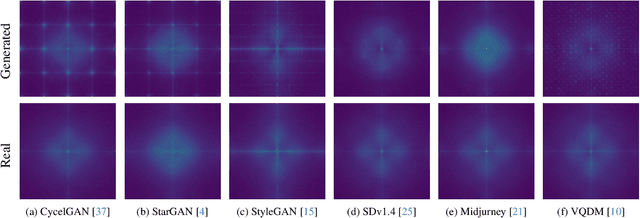
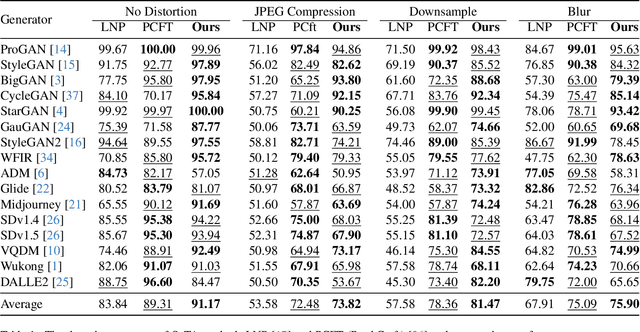
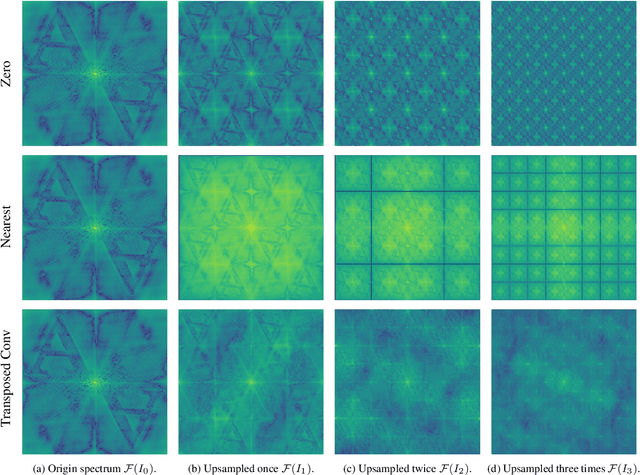
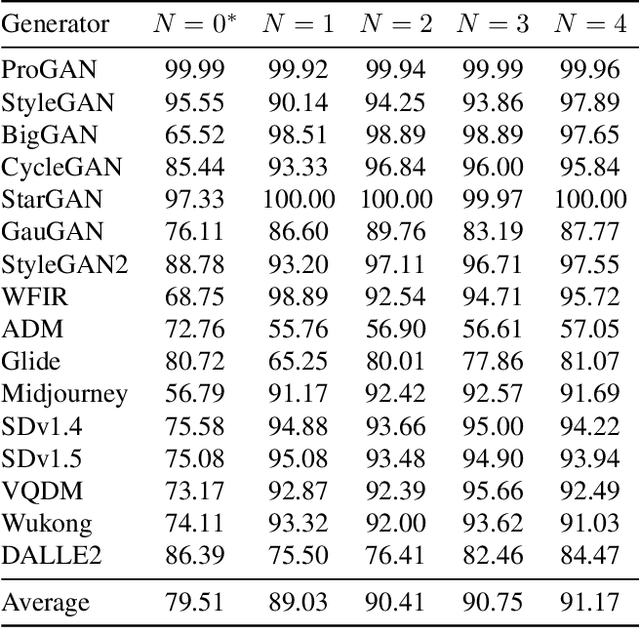
The generalization performance of AI-generated image detection remains a critical challenge. Although most existing methods perform well in detecting images from generative models included in the training set, their accuracy drops significantly when faced with images from unseen generators. To address this limitation, we propose a novel detection method based on the fractal self-similarity of the spectrum, a common feature among images generated by different models. Specifically, we demonstrate that AI-generated images exhibit fractal-like spectral growth through periodic extension and low-pass filtering. This observation motivates us to exploit the similarity among different fractal branches of the spectrum. Instead of directly analyzing the spectrum, our method mitigates the impact of varying spectral characteristics across different generators, improving detection performance for images from unseen models. Experiments on a public benchmark demonstrated the generalized detection performance across both GANs and diffusion models.