 Add to Chrome
 Add to Firefox
 Add to Edge
AutoPref: Automatic Discovery of Task-Specific Preference Objectives for Neural Combinatorial Optimization
Jul 30, 2026
Combinatorial optimization problems (COPs) underpin many real-world decisions, but their exponentially large search spaces make high-quality solutions costly to obtain. Neural combinatorial optimization (NCO) learns fast construction policies, typically with reinforcement learning (RL), while preference-based NCO improves sample efficiency by learning from relative solution quality. However, existing preference objectives combine two distinct design choices in manually specified, one-size-fits-all formulations: what learning signal to extract from each solution pair and how to weight each pair relative to the sampled set. We present AutoPref, the first LLM-guided framework for automated preference-objective discovery in NCO. AutoPref factorizes the objective into a pairwise loss program, which defines the learning signal, and a set-aware weighting program, which determines each pair's relative contribution. Their composition forms a unified programmatic objective space containing existing preference objectives as special cases. To make its search tractable, we introduce a staged conditional search strategy with behavioral gates that filter inadmissible programs before short-horizon training and evaluation. Across TSP, CVRP, FFSP, and JSSP, AutoPref consistently outperforms strong hand-designed baselines across problem scales, demonstrating the benefits and scalability of automated objective discovery for NCO.

Synergizing Reinforcement Learning and Genetic Algorithms for Neural Combinatorial Optimization
Jun 11, 2025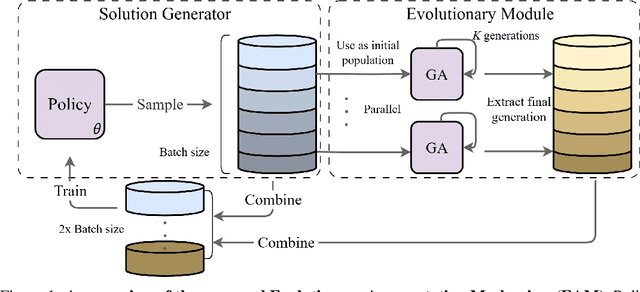
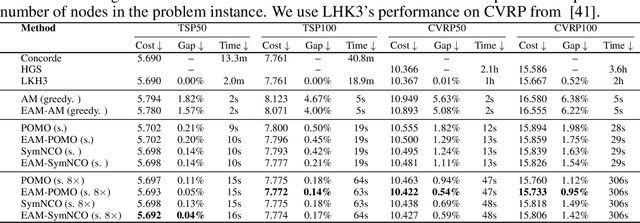
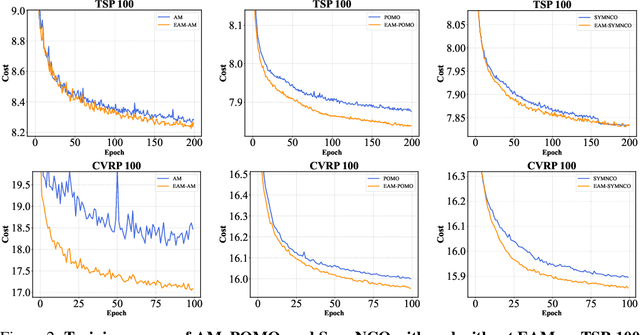
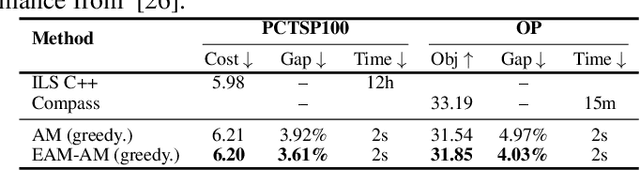
Combinatorial optimization problems are notoriously challenging due to their discrete structure and exponentially large solution space. Recent advances in deep reinforcement learning (DRL) have enabled the learning heuristics directly from data. However, DRL methods often suffer from limited exploration and susceptibility to local optima. On the other hand, evolutionary algorithms such as Genetic Algorithms (GAs) exhibit strong global exploration capabilities but are typically sample inefficient and computationally intensive. In this work, we propose the Evolutionary Augmentation Mechanism (EAM), a general and plug-and-play framework that synergizes the learning efficiency of DRL with the global search power of GAs. EAM operates by generating solutions from a learned policy and refining them through domain-specific genetic operations such as crossover and mutation. These evolved solutions are then selectively reinjected into the policy training loop, thereby enhancing exploration and accelerating convergence. We further provide a theoretical analysis that establishes an upper bound on the KL divergence between the evolved solution distribution and the policy distribution, ensuring stable and effective policy updates. EAM is model-agnostic and can be seamlessly integrated with state-of-the-art DRL solvers such as the Attention Model, POMO, and SymNCO. Extensive results on benchmark problems (e.g., TSP, CVRP, PCTSP, and OP) demonstrate that EAM significantly improves both solution quality and training efficiency over competitive baselines.