 Add to Chrome
 Add to Firefox
 Add to Edge
Reconstruction: A Blind Benchmark for Recovering Research Ideas from Pre-Publication Bibliographies
Aug 17, 2026
Can a language model recover the true research idea of a published paper when given only that paper's pre-publication bibliography? We introduce Reconstruction, a blind idea-recovery benchmark that withholds the seed paper and all contemporaneous or future literature, and asks models to propose hypotheses that an independent large language model judge matches against the held-out ground-truth idea. A strict anti-leakage protocol-temporal citation cutoff, anonymous reference IDs, and frozen per-paper bibliographies, which prevents prompt-time leakage of the seed idea. Across six scientific domains and 643 evaluated papers, seven frontier models achieve only modest Match rates (approx. 3-15%). We then evaluate a reference-only multi-agent (top 4) pipeline that combines cross-model review with a Swiss tournament over aligned hypothesis slots, without external web search. Cross-model review plus tournament selection raises Match rates to approx. 23-42% across all six domains, which is an observed approx. 2.4x lift over the best single-model baseline. This draft reports the protocol, anti-leakage design, and current results as an arXiv timestamp.

How Do Agents Fail on AutoResearch: End-to-End Diagnostic Evaluation on 100 Real-World Frontier Research Tasks
Aug 14, 2026AI has long assisted scientific research, but the rapid advance of LLMs and agentic scaffolds is reshaping the landscape; a single system can now carry whole-stage research from an initial hypothesis all the way to final published paper, which is a paradigm now referred to as AutoResearch. Existing evaluations reveal little about how these agents operate or where they break down. Tasks are narrowly-scoped, evaluation measures performance but not process, and failure diagnoses lack systematic coverage or artifact-level visibility. To address this gap, we introduce AutoResearchEval, featuring 100 tasks grounded in published frontier science across 7 scientific domains and the full research lifecycle, including ideation, retrieval, execution, analysis, writing, and review. Evaluating 8 harness-model combinations yields 800 autoresearch agent trajectories, with process-level annotation. We organize these insights into AutoResearch Failure Taxonomy or ARFT, a framework of 45 empirically-grounded failure patterns. To enable scalable fine-grained attribution, we leverage a human-calibrated agent-as-a-judge pipeline to inspect complete trajectories and intermediate artifacts. Failure patterns converge on a single overarching limitation, namely that current agents lack a metacognitive loop, which entails the ability to check what they produced against what they found, revise when it does not hold up, and question whether the path they took was sound. The same patterns recur across all 8 harness-model combinations, including the strongest models tested, locating the deficit at the model level rather than in any particular scaffold; whether orchestration-level interventions can close it is an open question this work does not test. We publicly release AutoResearchEval and ARFT to facilitate continued research and development in autonomous scientific discovery.
AdaDPO: Self-Adaptive Direct Preference Optimization with Balanced Gradient Updates
May 27, 2026DPO has become a widely adopted alternative to RLHF for aligning LLMs with human preferences, eliminating the need for a separate reward model or RL loop. Recent theoretical analysis uncovers an asymmetric gradient behavior in DPO: the loss suppresses dispreferred responses substantially faster than it promotes preferred ones, causing the model to learn to avoid bad answers rather than to generate good ones. We propose AdaDPO, a Self-Adaptive variant of the DPO algorithm that introduces per-preference-pair, stop-gradient-based coefficients derived directly from the policy model's generation probabilities, with the reference model's probabilities as an optional component. AdaDPO is constructed to enforce equality of gradient magnitudes between preferred and dispreferred probabilities; the practical implementation balances per-token gradients and applies a numerical clipping bound for stability, while retaining DPO's original hyperparameter structure. On Llama-3-8B-Instruct trained on UltraFeedback under a SimPO similar setup, AdaDPO consistently outperforms DPO on AlpacaEval 2: it achieves higher length-controlled win rates (LC) in 81% of hyperparameter combinations, attains the global best LC (48.3%) and raw win rate (46.1%), and enlarges the LC-over-WR margin in 88% of combinations, indicating effective mitigation of length bias. Additional analyses on KL divergence, reward margin, and reward accuracy confirm that AdaDPO rectifies the gradient imbalance and yields more efficient optimization. Because it operates purely at the loss level, AdaDPO can be dropped into existing preference-based alignment pipelines without changing data collection or model architectures. The method requires only a few lines of code, and the same self-adaptive principle generalizes to a broad family of pairwise contrastive preference losses including SimPO, R-DPO, IPO, CPO, and ORPO.
An atrium segmentation network with location guidance and siamese adjustment
Jan 11, 2023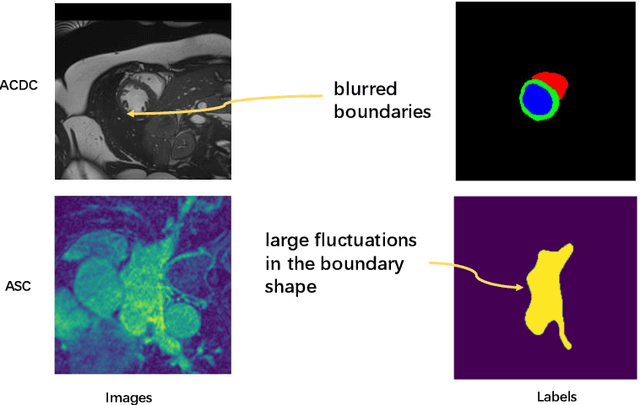
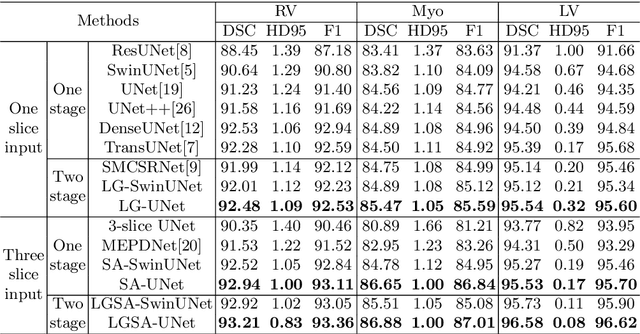
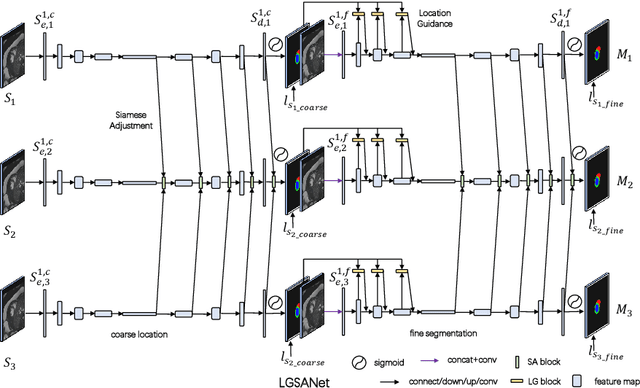
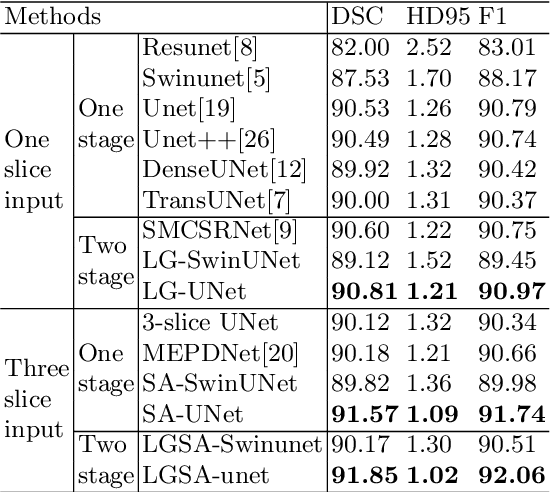
The segmentation of atrial scan images is of great significance for the three-dimensional reconstruction of the atrium and the surgical positioning. Most of the existing segmentation networks adopt a 2D structure and only take original images as input, ignoring the context information of 3D images and the role of prior information. In this paper, we propose an atrium segmentation network LGSANet with location guidance and siamese adjustment, which takes adjacent three slices of images as input and adopts an end-to-end approach to achieve coarse-to-fine atrial segmentation. The location guidance(LG) block uses the prior information of the localization map to guide the encoding features of the fine segmentation stage, and the siamese adjustment(SA) block uses the context information to adjust the segmentation edges. On the atrium datasets of ACDC and ASC, sufficient experiments prove that our method can adapt to many classic 2D segmentation networks, so that it can obtain significant performance improvements.
Automatic segmentation of meniscus based on MAE self-supervision and point-line weak supervision paradigm
May 07, 2022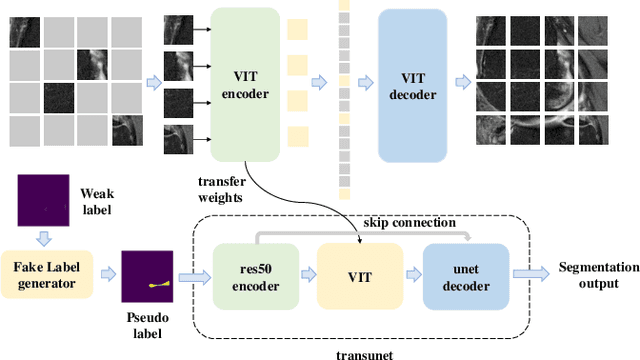
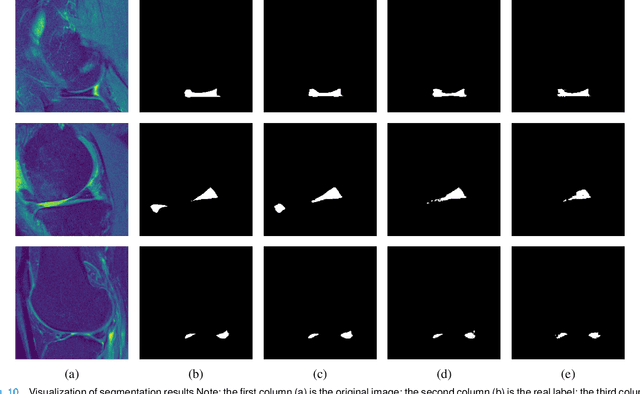
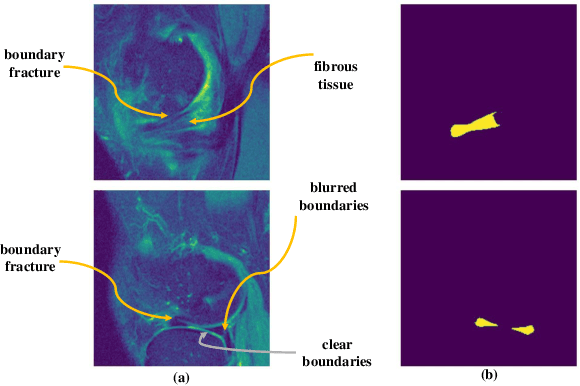
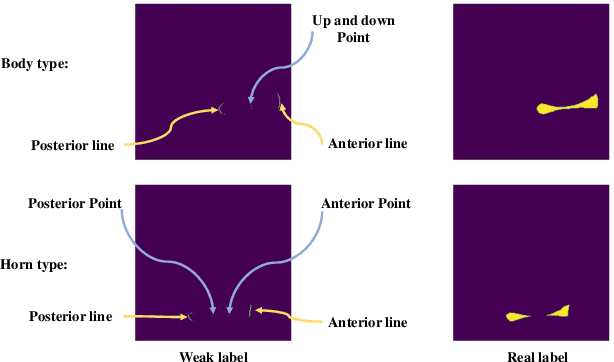
Medical image segmentation based on deep learning is often faced with the problems of insufficient datasets and long time-consuming labeling. In this paper, we introduce the self-supervised method MAE(Masked Autoencoders) into knee joint images to provide a good initial weight for the segmentation model and improve the adaptability of the model to small datasets. Secondly, we propose a weakly supervised paradigm for meniscus segmentation based on the combination of point and line to reduce the time of labeling. Based on the weak label ,we design a region growing algorithm to generate pseudo-label. Finally we train the segmentation network based on pseudo-labels with weight transfer from self-supervision. Sufficient experimental results show that our proposed method combining self-supervision and weak supervision can almost approach the performance of purely fully supervised models while greatly reducing the required labeling time and dataset size.