 Add to Chrome
 Add to Firefox
 Add to Edge
Decoy Images Amplify Caption-Mediated Defenses Against Encoded Jailbreaks
Aug 02, 2026
We report a counter-intuitive interaction between image inputs and existing black-box defenses on Vision--Language Models (VLMs): pairing an encoded jailbreak prompt with an unrelated decoy image can sharply lower attack success rate (ASR). The operative change is in the defense pipeline, not in the image. Across five frontier VLMs, two encoded-attack families, and three black-box defenses, a caption-mediated defense (ECSO) that leaves ASR essentially unchanged on text-only encoded input drops it by up to $73$pp once a content-free decoy is attached; every non-saturated contrast is significant under exact McNemar tests. We advance two hypotheses for this pattern, supported by indirect evidence rather than pipeline introspection, since a black-box threat model precludes inspecting vendor internals: caption-mediated defenses branch on image presence, and intrinsic image-side safety engages on image-resident content. Three controls constrain the explanation. Blank-canvas and natural-photograph decoys reproduce the effect on every model, implicating image presence rather than content; the effect replicates on three open-weight VLMs served with no moderation layer, so it is not a vendor-filtering artifact; and a non-symbolic, meaning-based encoder reproduces it, so it is not specific to symbolic obfuscation. Attaching a decoy unconditionally is not deployable --- it raises benign refusal to $20$--$79\%$, an inflation of $+10$ to $+67$pp --- but gating attachment on a lightweight encoded-input detector returns benign refusal to the text baseline while preserving the safety gain wherever the detector fires, making detector recall the binding constraint. Under adaptive attacks that target the caption-mediated re-check, the effect degrades but holds. We frame this as an observation about pipeline interaction, not as a robust defense.

Recover, Decode, Reguard: Guard-Agnostic Defense Amplification againstEncoded VLM Jailbreaks
Jul 29, 2026Safety classifiers ("guards") are the dominant black-box defense for vision-language models, yet they judge an input's surface form, not its meaning: a harmful request re-encoded as set theory, formal logic, a rare language, code, or an image of text slips past a guard that would block it in plain language -- the decode gap. The natural fix is a guard-agnostic recover-and-decode amplifier that transcribes image content and restates encoded text into its plain payload before the guard, so any off-the-shelf classifier can screen the true request. We build this amplifier and evaluate it against the attacker's best case: an ensemble of eleven attacks, scoring a behavior as broken if any succeeds (best-of-suite, following AutoAttack) -- rarely reported for jailbreak defenses, yet ~3.5x the per-attack mean. This exposes our central finding: an empirical safety-utility ceiling for the non-iterative recovery defenses we evaluate, across five guards and two target VLMs. The amplifier only partly closes the gap -- the undefended ensemble breaks 89-91% of behaviors, and the best guard-plus-amplifier still leaves 63-65% -- and its gain over the guard alone is significant in only four of ten guard-target pairs. It is guard-agnostic at the interface, but not uniformly so in effect. A modular reguard layer closes much of the residual, yet drives benign over-refusal to 81-92% for well-calibrated guards; the one laxer guard that stays usable never reaches deployable safety (48% ensemble ASR). No configuration we evaluate reaches both low attack-success and low over-refusal, for the pipeline we study and for representation-shifting attacks -- encodings and cross-modal renders that leave a legible payload, not pixel- or embedding-space attacks. We contribute the amplifier, an ensemble evaluation that makes the trade-off visible, and a map of where recovery-based VLM defense works and where it does not.
Borrowed Strength: Best-of-N Search over a Code EncodingBreaks Self-Check Jailbreak Defenses
Jul 29, 2026A self-check defense asks the target model to assess a request before answering it; SAGE, the strongest published instance, reports an average 99% defense success rate. We show it can be breached by composing two attacks that are individually harmless against it: an established code-completion encoding and an established best-of-N search, neither of which exceeds 4.7% of behaviors alone. Composed, with the search budget spent on the encoding, they reach 67/22/15% across three open targets, and the effect persists on a 70B target. We then explain the composition rather than only reporting it. First, a self-check defense borrows its strength from the target: SAGE does not detect the attack, it asks the model to, and the four targets convert that request into an explicit refusal between 32% and 97% of the time, which orders the spread in defended coverage even though undefended reach is near-identical. Second, which attack survives is decided by the type of defense, and it inverts: against transform defenses the code encoding retains far more of its undefended reach than the character search, while against gate defenses the ordering flips. We account for this with the number of independent probes an attack delivers to a defense's decision boundary. Finally, we report a validity defect we found and repaired in our own pipeline, a deterministic attack under greedy decoding has no best-of-N variation channel at all, and give the one-line diagnostic that detects it. All claims rest on 310,000 generations scored by a human-validated judge.
Exposing LLM Safety Gaps Through Mathematical Encoding:New Attacks and Systematic Analysis
May 05, 2026Large language models (LLMs) employ safety mechanisms to prevent harmful outputs, yet these defenses primarily rely on semantic pattern matching. We show that encoding harmful prompts as coherent mathematical problems -- using formalisms such as set theory, formal logic, and quantum mechanics -- bypasses these filters at high rates, achieving 46%--56% average attack success across eight target models and two established benchmarks. Crucially, the effectiveness depends not on mathematical notation itself, but on whether a helper LLM deeply reformulates the harmful content into a genuine mathematical problem: rule-based encodings that apply mathematical formatting without such reformulation perform no better than unencoded baselines. We introduce a novel Formal Logic encoding that achieves attack success comparable to Set Theory, demonstrating that this vulnerability generalizes across mathematical formalisms. Additional experiments with repeat post-processing confirm that these attacks are robust to simple prompt augmentation. Notably, newer models (GPT-5, GPT-5-Mini) show substantially greater robustness than older models, though they remain vulnerable. Our findings highlight fundamental gaps in current safety frameworks and motivate defenses that reason about mathematical structure rather than surface-level semantics.
Temporal Flattening in LLM-Generated Text: Comparing Human and LLM Writing Trajectories
Apr 13, 2026Large language models (LLMs) are increasingly used in daily applications, from content generation to code writing, where each interaction treats the model as stateless, generating responses independently without memory. Yet human writing is inherently longitudinal: authors' styles and cognitive states evolve across months and years. This raises a central question: can LLMs reproduce such temporal structure across extended time periods? We construct and publicly release a longitudinal dataset of 412 human authors and 6,086 documents spanning 2012--2024 across three domains (academic abstracts, blogs, news) and compare them to trajectories generated by three representative LLMs under standard and history-conditioned generation settings. Using drift and variance-based metrics over semantic, lexical, and cognitive-emotional representations, we find temporal flattening in LLM-generated text. LLMs produce greater lexical diversity but exhibit substantially reduced semantic and cognitive-emotional drift relative to humans. These differences are highly predictive: temporal variability patterns alone achieve 94% accuracy and 98% ROC-AUC in distinguishing human from LLM trajectories. Our results demonstrate that temporal flattening persists regardless of whether LLMs generate independently or with access to incremental history, revealing a fundamental property of current deployment paradigms. This gap has direct implications for applications requiring authentic temporal structure, such as synthetic training data and longitudinal text modeling.
MUGC: Machine Generated versus User Generated Content Detection
Mar 28, 2024
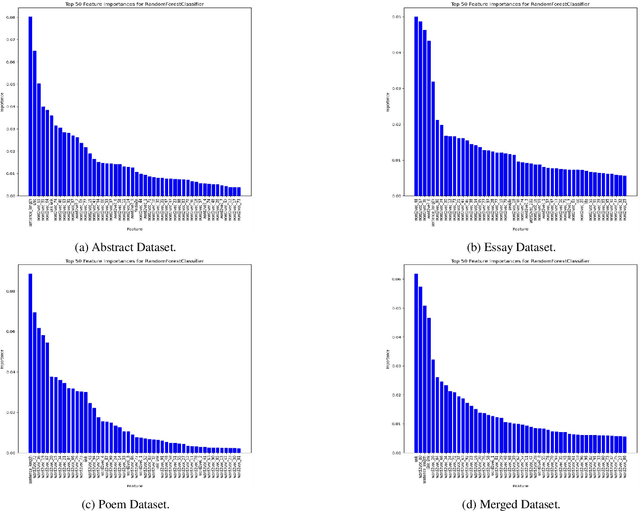
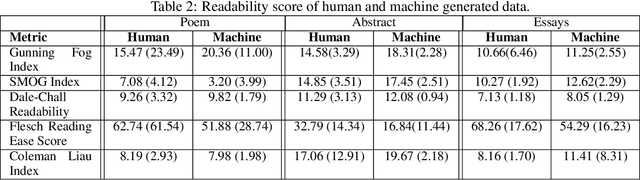
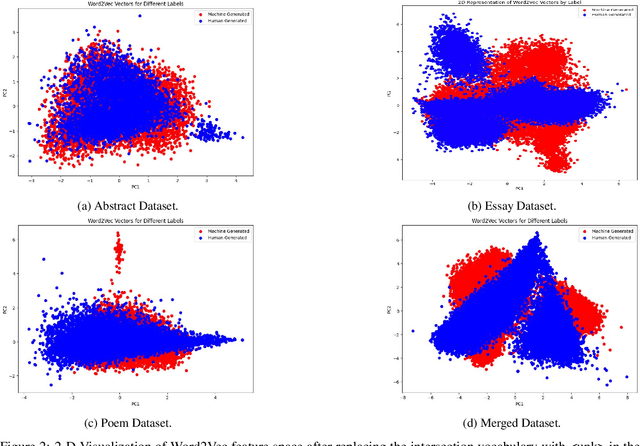
As advanced modern systems like deep neural networks (DNNs) and generative AI continue to enhance their capabilities in producing convincing and realistic content, the need to distinguish between user-generated and machine generated content is becoming increasingly evident. In this research, we undertake a comparative evaluation of eight traditional machine-learning algorithms to distinguish between machine-generated and human-generated data across three diverse datasets: Poems, Abstracts, and Essays. Our results indicate that traditional methods demonstrate a high level of accuracy in identifying machine-generated data, reflecting the documented effectiveness of popular pre-trained models like RoBERT. We note that machine-generated texts tend to be shorter and exhibit less word variety compared to human-generated content. While specific domain-related keywords commonly utilized by humans, albeit disregarded by current LLMs (Large Language Models), may contribute to this high detection accuracy, we show that deeper word representations like word2vec can capture subtle semantic variances. Furthermore, readability, bias, moral, and affect comparisons reveal a discernible contrast between machine-generated and human generated content. There are variations in expression styles and potentially underlying biases in the data sources (human and machine-generated). This study provides valuable insights into the advancing capacities and challenges associated with machine-generated content across various domains.