 Add to Chrome
 Add to Firefox
 Add to Edge
TimeMark: A Trustworthy Time Watermarking Framework for Exact Generation-Time Recovery from AIGC
Apr 14, 2026
The widespread use of Large Language Models (LLMs) in text generation has raised increasing concerns about intellectual property disputes. Watermarking techniques, which embed meta information into AI-generated content (AIGC), have the potential to serve as judicial evidence. However, existing methods rely on statistical signals in token distributions, leading to inherently probabilistic detection and reduced reliability, especially in multi-bit encoding (e.g., timestamps). Moreover, such methods introduce detectable statistical patterns, making them vulnerable to forgery attacks and enabling model providers to fabricate arbitrary watermarks. To address these issues, we propose the concept of trustworthy watermark, which achieves reliable recovery with 100% identification accuracy while resisting both user-side statistical attacks and provider-side forgery. We focus on trustworthy time watermarking for use as judicial evidence. Our framework integrates cryptographic techniques and encodes time information into time-dependent secret keys under regulatory supervision, preventing arbitrary timestamp fabrication. The watermark payload is decoupled from time and generated as a random, non-stored bit sequence for each instance, eliminating statistical patterns. To ensure verifiability, we design a two-stage encoding mechanism, which, combined with error-correcting codes, enables reliable recovery of generation time with theoretically perfect accuracy. Both theoretical analysis and experiments demonstrate that our framework satisfies the reliability requirements for judicial evidence and offers a practical solution for future AIGC-related intellectual property disputes.

Enhancing Investment Analysis: Optimizing AI-Agent Collaboration in Financial Research
Nov 07, 2024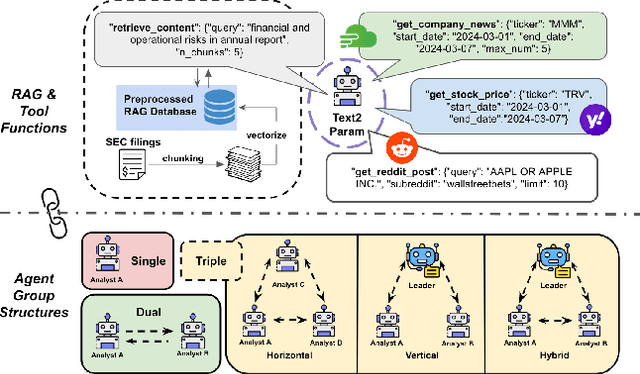
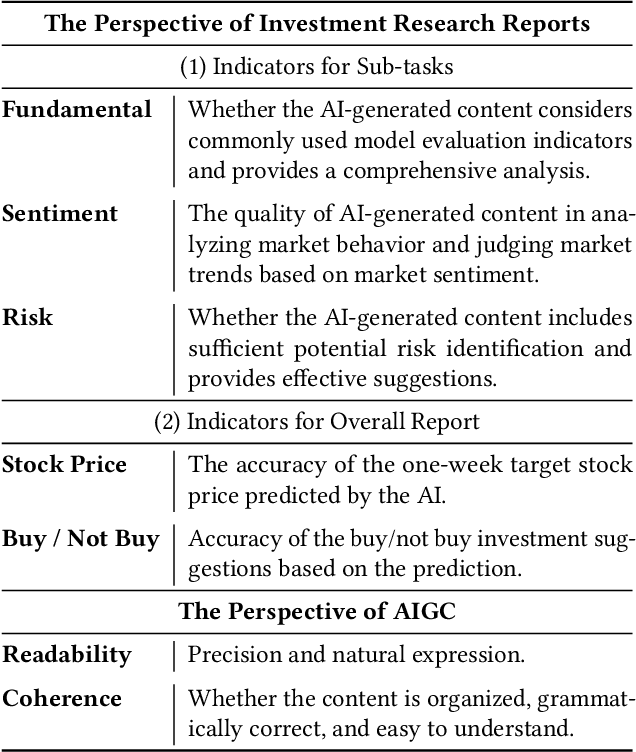
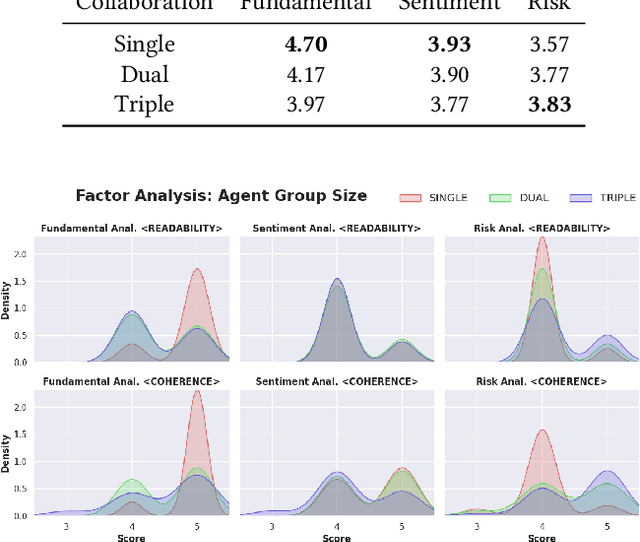
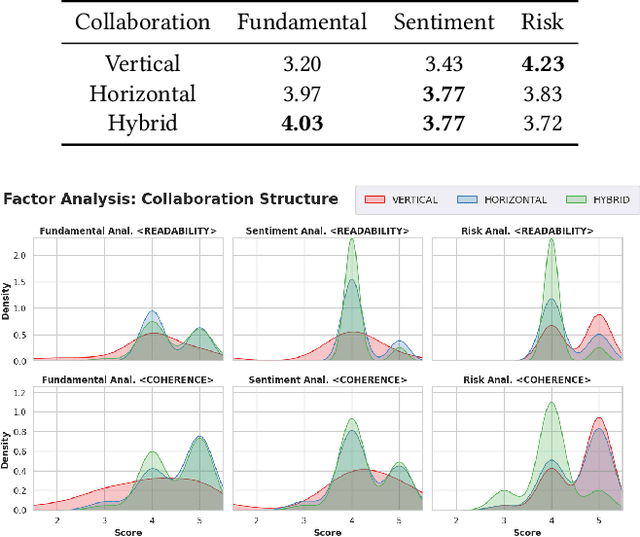
In recent years, the application of generative artificial intelligence (GenAI) in financial analysis and investment decision-making has gained significant attention. However, most existing approaches rely on single-agent systems, which fail to fully utilize the collaborative potential of multiple AI agents. In this paper, we propose a novel multi-agent collaboration system designed to enhance decision-making in financial investment research. The system incorporates agent groups with both configurable group sizes and collaboration structures to leverage the strengths of each agent group type. By utilizing a sub-optimal combination strategy, the system dynamically adapts to varying market conditions and investment scenarios, optimizing performance across different tasks. We focus on three sub-tasks: fundamentals, market sentiment, and risk analysis, by analyzing the 2023 SEC 10-K forms of 30 companies listed on the Dow Jones Index. Our findings reveal significant performance variations based on the configurations of AI agents for different tasks. The results demonstrate that our multi-agent collaboration system outperforms traditional single-agent models, offering improved accuracy, efficiency, and adaptability in complex financial environments. This study highlights the potential of multi-agent systems in transforming financial analysis and investment decision-making by integrating diverse analytical perspectives.
Bias of AI-Generated Content: An Examination of News Produced by Large Language Models
Sep 19, 2023Large language models (LLMs) have the potential to transform our lives and work through the content they generate, known as AI-Generated Content (AIGC). To harness this transformation, we need to understand the limitations of LLMs. Here, we investigate the bias of AIGC produced by seven representative LLMs, including ChatGPT and LLaMA. We collect news articles from The New York Times and Reuters, both known for their dedication to provide unbiased news. We then apply each examined LLM to generate news content with headlines of these news articles as prompts, and evaluate the gender and racial biases of the AIGC produced by the LLM by comparing the AIGC and the original news articles. We further analyze the gender bias of each LLM under biased prompts by adding gender-biased messages to prompts constructed from these news headlines. Our study reveals that the AIGC produced by each examined LLM demonstrates substantial gender and racial biases. Moreover, the AIGC generated by each LLM exhibits notable discrimination against females and individuals of the Black race. Among the LLMs, the AIGC generated by ChatGPT demonstrates the lowest level of bias, and ChatGPT is the sole model capable of declining content generation when provided with biased prompts.