 Add to Chrome
 Add to Firefox
 Add to Edge
SeBERTis: A Framework for Producing Classifiers of Security-Related Issue Reports
Dec 17, 2025
Monitoring issue tracker submissions is a crucial software maintenance activity. A key goal is the prioritization of high risk, security-related bugs. If such bugs can be recognized early, the risk of propagation to dependent products and endangerment of stakeholder benefits can be mitigated. To assist triage engineers with this task, several automatic detection techniques, from Machine Learning (ML) models to prompting Large Language Models (LLMs), have been proposed. Although promising to some extent, prior techniques often memorize lexical cues as decision shortcuts, yielding low detection rate specifically for more complex submissions. As such, these classifiers do not yet reach the practical expectations of a real-time detector of security-related issues. To address these limitations, we propose SEBERTIS, a framework to train Deep Neural Networks (DNNs) as classifiers independent of lexical cues, so that they can confidently detect fully unseen security-related issues. SEBERTIS capitalizes on fine-tuning bidirectional transformer architectures as Masked Language Models (MLMs) on a series of semantically equivalent vocabulary to prediction labels (which we call Semantic Surrogates) when they have been replaced with a mask. Our SEBERTIS-trained classifier achieves a 0.9880 F1-score in detecting security-related issues of a curated corpus of 10,000 GitHub issue reports, substantially outperforming state-of-the-art issue classifiers, with 14.44%-96.98%, 15.40%-93.07%, and 14.90%-94.72% higher detection precision, recall, and F1-score over ML-based baselines. Our classifier also substantially surpasses LLM baselines, with an improvement of 23.20%-63.71%, 36.68%-85.63%, and 39.49%-74.53% for precision, recall, and F1-score.

Revisiting the Performance of Deep Learning-Based Vulnerability Detection on Realistic Datasets
Jul 03, 2024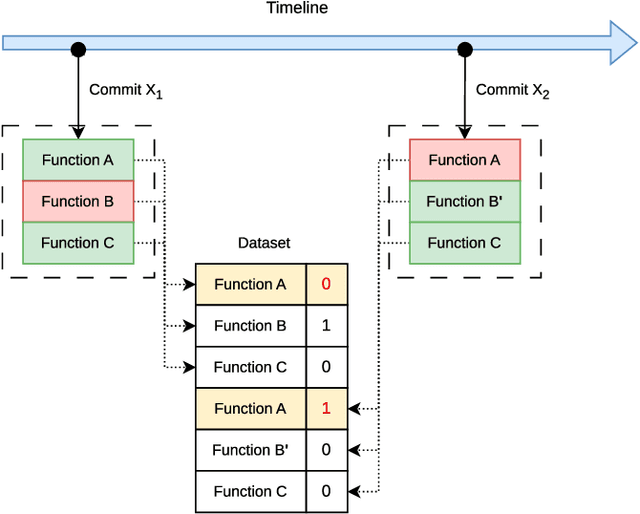
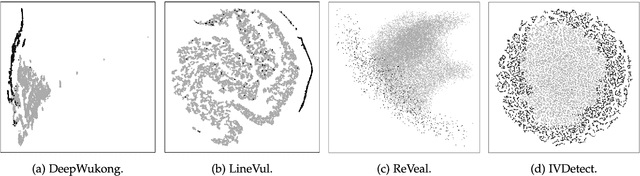
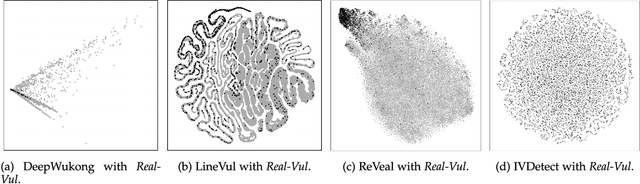
The impact of software vulnerabilities on everyday software systems is significant. Despite deep learning models being proposed for vulnerability detection, their reliability is questionable. Prior evaluations show high recall/F1 scores of up to 99%, but these models underperform in practical scenarios, particularly when assessed on entire codebases rather than just the fixing commit. This paper introduces Real-Vul, a comprehensive dataset representing real-world scenarios for evaluating vulnerability detection models. Evaluating DeepWukong, LineVul, ReVeal, and IVDetect shows a significant drop in performance, with precision decreasing by up to 95 percentage points and F1 scores by up to 91 points. Furthermore, Model performance fluctuates based on vulnerability characteristics, with better F1 scores for information leaks or code injection than for path resolution or predictable return values. The results highlight a significant performance gap that needs addressing before deploying deep learning-based vulnerability detection in practical settings. Overfitting is identified as a key issue, and an augmentation technique is proposed, potentially improving performance by up to 30%. Contributions include a dataset creation approach for better model evaluation, Real-Vul dataset, and empirical evidence of deep learning models struggling in real-world settings.
LLbezpeky: Leveraging Large Language Models for Vulnerability Detection
Jan 02, 2024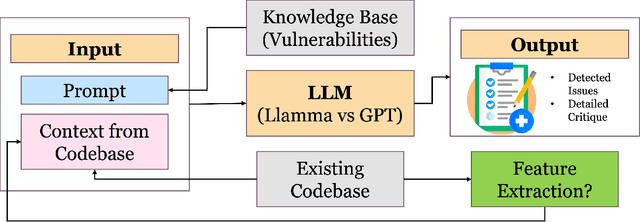
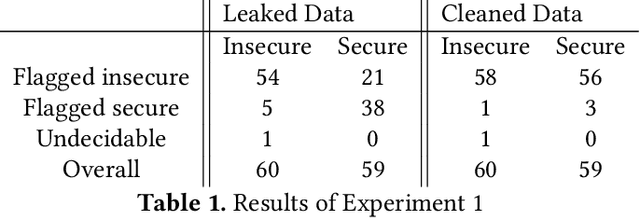
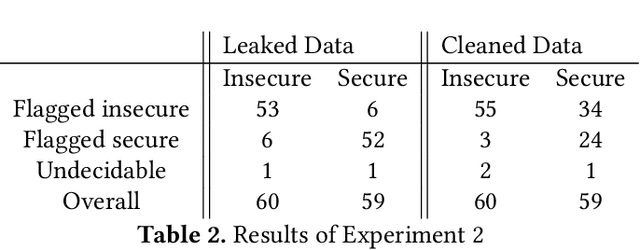
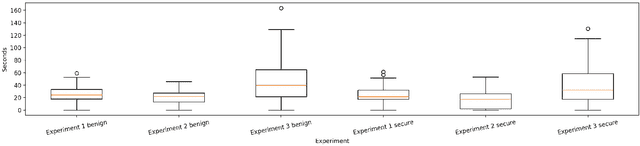
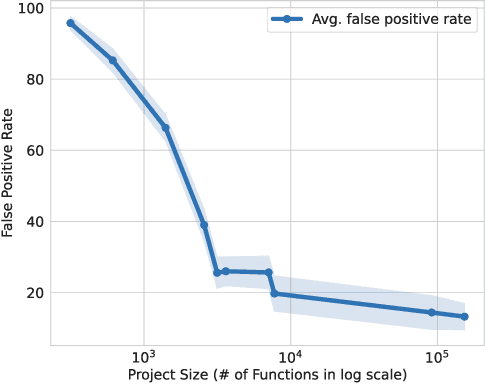
Despite the continued research and progress in building secure systems, Android applications continue to be ridden with vulnerabilities, necessitating effective detection methods. Current strategies involving static and dynamic analysis tools come with limitations like overwhelming number of false positives and limited scope of analysis which make either difficult to adopt. Over the past years, machine learning based approaches have been extensively explored for vulnerability detection, but its real-world applicability is constrained by data requirements and feature engineering challenges. Large Language Models (LLMs), with their vast parameters, have shown tremendous potential in understanding semnatics in human as well as programming languages. We dive into the efficacy of LLMs for detecting vulnerabilities in the context of Android security. We focus on building an AI-driven workflow to assist developers in identifying and rectifying vulnerabilities. Our experiments show that LLMs outperform our expectations in finding issues within applications correctly flagging insecure apps in 91.67% of cases in the Ghera benchmark. We use inferences from our experiments towards building a robust and actionable vulnerability detection system and demonstrate its effectiveness. Our experiments also shed light on how different various simple configurations can affect the True Positive (TP) and False Positive (FP) rates.