 Add to Chrome
 Add to Firefox
 Add to Edge
TornadoNet: Real-Time Building Damage Detection with Ordinal Supervision
Mar 12, 2026
We present TornadoNet, a comprehensive benchmark for automated street-level building damage assessment evaluating how modern real-time object detection architectures and ordinal-aware supervision strategies perform under realistic post-disaster conditions. TornadoNet provides the first controlled benchmark demonstrating how architectural design and loss formulation jointly influence multi-level damage detection from street-view imagery, delivering methodological insights and deployable tools for disaster response. Using 3,333 high-resolution geotagged images and 8,890 annotated building instances from the 2021 Midwest tornado outbreak, we systematically compare CNN-based detectors from the YOLO family against transformer-based models (RT-DETR) for multi-level damage detection. Models are trained under standardized protocols using a five-level damage classification framework based on IN-CORE damage states, validated through expert cross-annotation. Baseline experiments reveal complementary architectural strengths. CNN-based YOLO models achieve highest detection accuracy and throughput, with larger variants reaching 46.05% mAP@0.5 at 66-276 FPS on A100 GPUs. Transformer-based RT-DETR models exhibit stronger ordinal consistency, achieving 88.13% Ordinal Top-1 Accuracy and MAOE of 0.65, indicating more reliable severity grading despite lower baseline mAP. To align supervision with the ordered nature of damage severity, we introduce soft ordinal classification targets and evaluate explicit ordinal-distance penalties. RT-DETR trained with calibrated ordinal supervision achieves 44.70% mAP@0.5, a 4.8 percentage-point improvement, with gains in ordinal metrics (91.15% Ordinal Top-1 Accuracy, MAOE = 0.56). These findings establish that ordinal-aware supervision improves damage severity estimation when aligned with detector architecture. Model & Data: https://github.com/crumeike/TornadoNet

Architectural Insights for Post-Tornado Damage Recognition
Feb 16, 2026Rapid and accurate building damage assessment in the immediate aftermath of tornadoes is critical for coordinating life-saving search and rescue operations, optimizing emergency resource allocation, and accelerating community recovery. However, current automated methods struggle with the unique visual complexity of tornado-induced wreckage, primarily due to severe domain shift from standard pre-training datasets and extreme class imbalance in real-world disaster data. To address these challenges, we introduce a systematic experimental framework evaluating 79 open-source deep learning models, encompassing both Convolutional Neural Networks (CNNs) and Vision Transformers, across over 2,300 controlled experiments on our newly curated Quad-State Tornado Damage (QSTD) benchmark dataset. Our findings reveal that achieving operational-grade performance hinges on a complex interaction between architecture and optimization, rather than architectural selection alone. Most strikingly, we demonstrate that optimizer choice can be more consequential than architecture: switching from Adam to SGD provided dramatic F1 gains of +25 to +38 points for Vision Transformer and Swin Transformer families, fundamentally reversing their ranking from bottom-tier to competitive with top-performing CNNs. Furthermore, a low learning rate of 1x10^(-4) proved universally critical, boosting average F1 performance by +10.2 points across all architectures. Our champion model, ConvNeXt-Base trained with these optimized settings, demonstrated strong cross-event generalization on the held-out Tuscaloosa-Moore Tornado Damage (TMTD) dataset, achieving 46.4% Macro F1 (+34.6 points over baseline) and retaining 85.5% Ordinal Top-1 Accuracy despite temporal and sensor domain shifts.
Accelerating Post-Tornado Disaster Assessment Using Advanced Deep Learning Models
Dec 24, 2024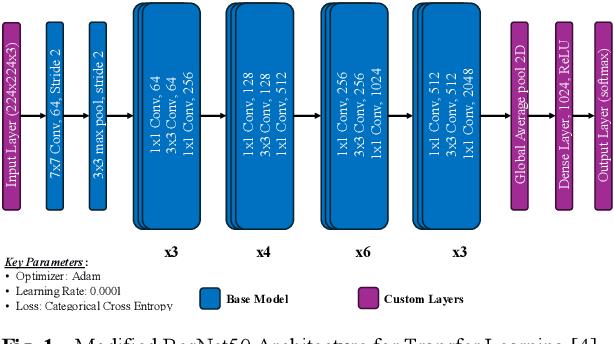
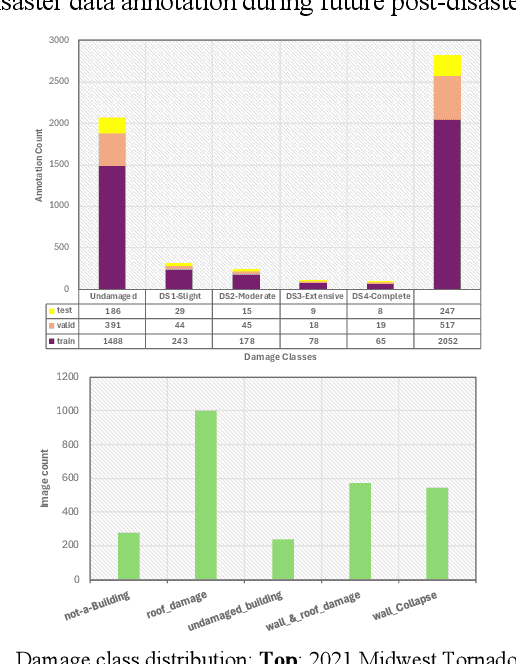
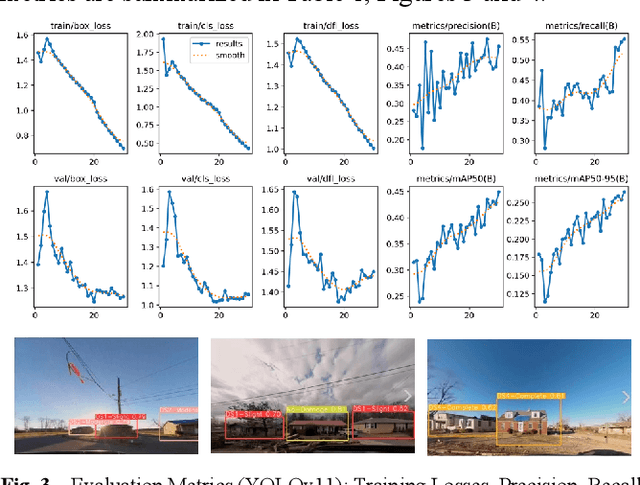
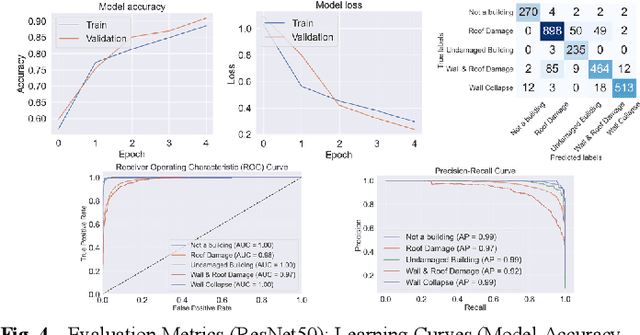
Post-disaster assessments of buildings and infrastructure are crucial for both immediate recovery efforts and long-term resilience planning. This research introduces an innovative approach to automating post-disaster assessments through advanced deep learning models. Our proposed system employs state-of-the-art computer vision techniques (YOLOv11 and ResNet50) to rapidly analyze images and videos from disaster sites, extracting critical information about building characteristics, including damage level of structural components and the extent of damage. Our experimental results show promising performance, with ResNet50 achieving 90.28% accuracy and an inference time of 1529ms per image on multiclass damage classification. This study contributes to the field of disaster management by offering a scalable, efficient, and objective tool for post-disaster analysis, potentially capable of transforming how communities and authorities respond to and learn from catastrophic events.