 Add to Chrome
 Add to Firefox
 Add to Edge
Comprehensive Dataset and Signal Processing Framework for Phonocardiogram-Based Heart Rate and Blood Pressure Estimation
May 22, 2026
Cardiovascular diseases (CVDs) represent significant global health challenges today, necessitating regular and reliable monitoring to enable early intervention. Phonocardiogram (PCG) signals present a promising non-invasive method for assessing cardiovascular health. While recent studies have focused on estimating heart rate (HR) from PCG signals and blood pressure (BP) through multimodal combinations with other physiological data, reliable and cost-effective systems that can predict both HR and BP using only PCG signals remain largely unexplored. In this study, we proposed and developed a lab-scale cost-effective Phonocardiogram Tracking (PhonoTrack) system that can measure both HR and BP using only the PCG signal. We also introduced a corresponding dataset collected from 15 participants to evaluate the effectiveness of the proposed system. HR was determined using several peak detection methods, such as Hilbert Transform (HT), Shannon Entropy (SE), and WES, achieving notable Pearson correlation coefficients of 0.965, 0.973, and 0.955, respectively. The corresponding root mean square errors (RMSEs) were 2.467 bpm, 1.688 bpm, and 1.992 bpm for HT, SE, and WES, respectively. Additionally, we developed an advanced semi-empirical model based on multiple regression techniques to estimate systolic blood pressure (SBP) and diastolic blood pressure (DBP). This model demonstrated standard deviations of 2.10 mmHg for SBP and 3.20 mmHg for DBP across all subjects, with Pearson correlation coefficients of 0.89 and 0.70, respectively. These findings pave the way for developing a non-invasive, low-cost, and portable PhonoTrack device, positioning it as a promising solution for continuous cardiovascular monitoring settings.

A Multi Constrained Transformer-BiLSTM Guided Network for Automated Sleep Stage Classification from Single-Channel EEG
Sep 19, 2023
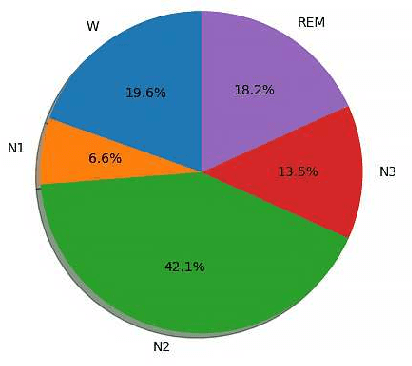


Sleep stage classification from electroencephalogram (EEG) is significant for the rapid evaluation of sleeping patterns and quality. A novel deep learning architecture, ``DenseRTSleep-II'', is proposed for automatic sleep scoring from single-channel EEG signals. The architecture utilizes the advantages of Convolutional Neural Network (CNN), transformer network, and Bidirectional Long Short Term Memory (BiLSTM) for effective sleep scoring. Moreover, with the addition of a weighted multi-loss scheme, this model is trained more implicitly for vigorous decision-making tasks. Thus, the model generates the most efficient result in the SleepEDFx dataset and outperforms different state-of-the-art (IIT-Net, DeepSleepNet) techniques by a large margin in terms of accuracy, precision, and F1-score.
Heart Abnormality Detection from Heart Sound Signals using MFCC Feature and Dual Stream Attention Based Network
Nov 17, 2022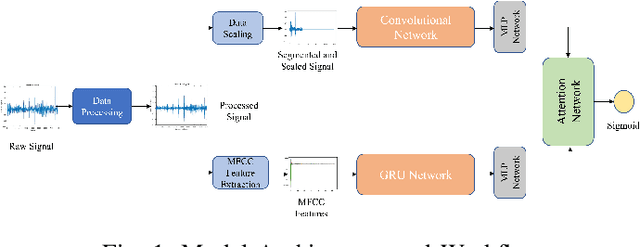
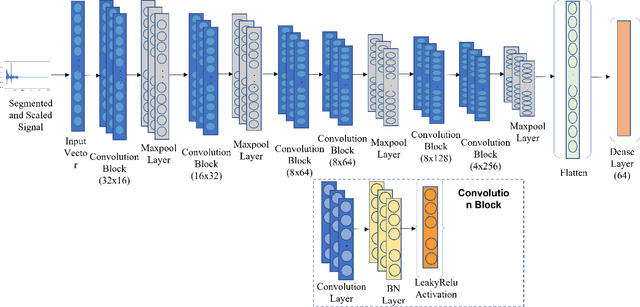
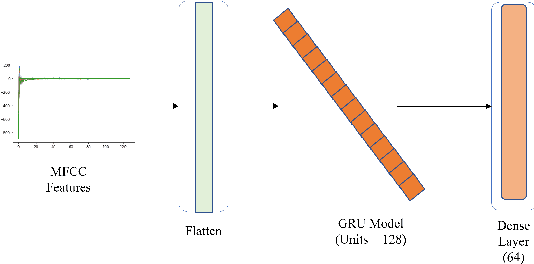
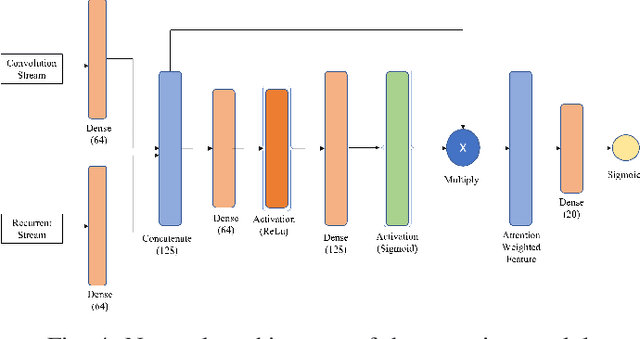
Cardiovascular diseases are one of the leading cause of death in today's world and early screening of heart condition plays a crucial role in preventing them. The heart sound signal is one of the primary indicator of heart condition and can be used to detect abnormality in the heart. The acquisition of heart sound signal is non-invasive, cost effective and requires minimum equipment. But currently the detection of heart abnormality from heart sound signal depends largely on the expertise and experience of the physician. As such an automatic detection system for heart abnormality detection from heart sound signal can be a great asset for the people living in underdeveloped areas. In this paper we propose a novel deep learning based dual stream network with attention mechanism that uses both the raw heart sound signal and the MFCC features to detect abnormality in heart condition of a patient. The deep neural network has a convolutional stream that uses the raw heart sound signal and a recurrent stream that uses the MFCC features of the signal. The features from these two streams are merged together using a novel attention network and passed through the classification network. The model is trained on the largest publicly available dataset of PCG signal and achieves an accuracy of 87.11, sensitivity of 82.41, specificty of 91.8 and a MACC of 87.12.