 Add to Chrome
 Add to Firefox
 Add to Edge
Comprehensive Dataset and Signal Processing Framework for Phonocardiogram-Based Heart Rate and Blood Pressure Estimation
May 22, 2026
Cardiovascular diseases (CVDs) represent significant global health challenges today, necessitating regular and reliable monitoring to enable early intervention. Phonocardiogram (PCG) signals present a promising non-invasive method for assessing cardiovascular health. While recent studies have focused on estimating heart rate (HR) from PCG signals and blood pressure (BP) through multimodal combinations with other physiological data, reliable and cost-effective systems that can predict both HR and BP using only PCG signals remain largely unexplored. In this study, we proposed and developed a lab-scale cost-effective Phonocardiogram Tracking (PhonoTrack) system that can measure both HR and BP using only the PCG signal. We also introduced a corresponding dataset collected from 15 participants to evaluate the effectiveness of the proposed system. HR was determined using several peak detection methods, such as Hilbert Transform (HT), Shannon Entropy (SE), and WES, achieving notable Pearson correlation coefficients of 0.965, 0.973, and 0.955, respectively. The corresponding root mean square errors (RMSEs) were 2.467 bpm, 1.688 bpm, and 1.992 bpm for HT, SE, and WES, respectively. Additionally, we developed an advanced semi-empirical model based on multiple regression techniques to estimate systolic blood pressure (SBP) and diastolic blood pressure (DBP). This model demonstrated standard deviations of 2.10 mmHg for SBP and 3.20 mmHg for DBP across all subjects, with Pearson correlation coefficients of 0.89 and 0.70, respectively. These findings pave the way for developing a non-invasive, low-cost, and portable PhonoTrack device, positioning it as a promising solution for continuous cardiovascular monitoring settings.

DP-CDA: An Algorithm for Enhanced Privacy Preservation in Dataset Synthesis Through Randomized Mixing
Nov 25, 2024In recent years, the growth of data across various sectors, including healthcare, security, finance, and education, has created significant opportunities for analysis and informed decision-making. However, these datasets often contain sensitive and personal information, which raises serious privacy concerns. Protecting individual privacy is crucial, yet many existing machine learning and data publishing algorithms struggle with high-dimensional data, facing challenges related to computational efficiency and privacy preservation. To address these challenges, we introduce an effective data publishing algorithm \emph{DP-CDA}. Our proposed algorithm generates synthetic datasets by randomly mixing data in a class-specific manner, and inducing carefully-tuned randomness to ensure formal privacy guarantees. Our comprehensive privacy accounting shows that DP-CDA provides a stronger privacy guarantee compared to existing methods, allowing for better utility while maintaining strict level of privacy. To evaluate the effectiveness of DP-CDA, we examine the accuracy of predictive models trained on the synthetic data, which serves as a measure of dataset utility. Importantly, we identify an optimal order of mixing that balances privacy guarantee with predictive accuracy. Our results indicate that synthetic datasets produced using the DP-CDA can achieve superior utility compared to those generated by traditional data publishing algorithms, even when subject to the same privacy requirements.
Npix2Cpix: A GAN-based Image-to-Image Translation Network with Retrieval-Classification Integration for Watermark Retrieval from Historical Document Images
Jun 05, 2024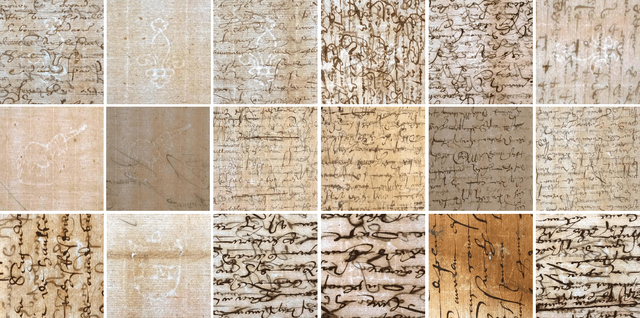
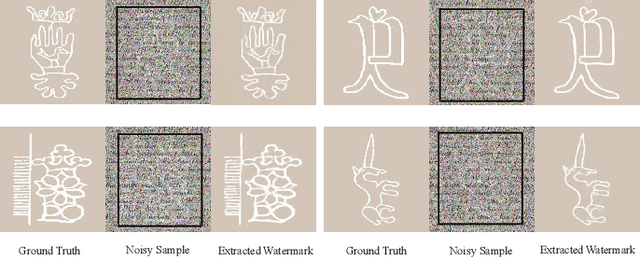

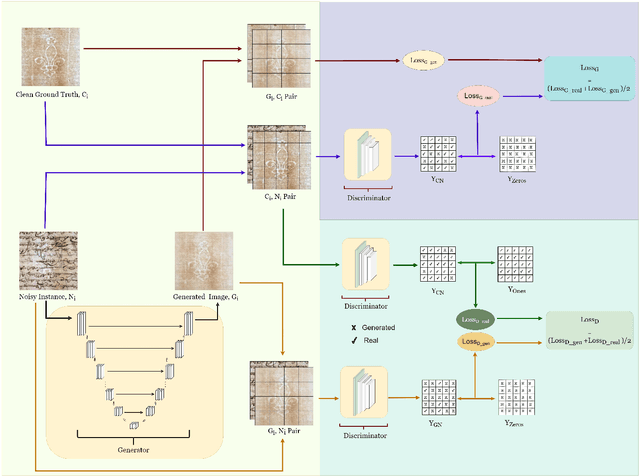
The identification and restoration of ancient watermarks have long been a major topic in codicology and history. Classifying historical documents based on watermarks can be difficult due to the diversity of watermarks, crowded and noisy samples, multiple modes of representation, and minor distinctions between classes and intra-class changes. This paper proposes a U-net-based conditional generative adversarial network (GAN) to translate noisy raw historical watermarked images into clean, handwriting-free images with just watermarks. Considering its ability to perform image translation from degraded (noisy) pixels to clean pixels, the proposed network is termed as Npix2Cpix. Instead of employing directly degraded watermarked images, the proposed network uses image-to-image translation using adversarial learning to create clutter and handwriting-free images for restoring and categorizing the watermarks for the first time. In order to learn the mapping from input noisy image to output clean image, the generator and discriminator of the proposed U-net-based GAN are trained using two separate loss functions, each of which is based on the distance between images. After using the proposed GAN to pre-process noisy watermarked images, Siamese-based one-shot learning is used to classify watermarks. According to experimental results on a large-scale historical watermark dataset, extracting watermarks from tainted images can result in high one-shot classification accuracy. The qualitative and quantitative evaluation of the retrieved watermarks illustrates the effectiveness of the proposed approach.
Decoding Human Activities: Analyzing Wearable Accelerometer and Gyroscope Data for Activity Recognition
Oct 03, 2023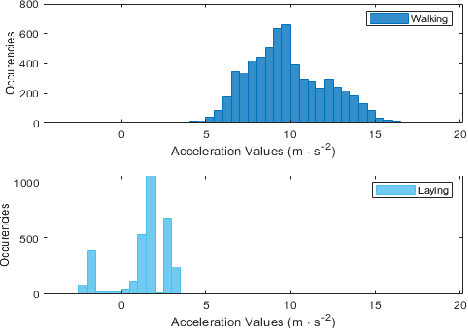
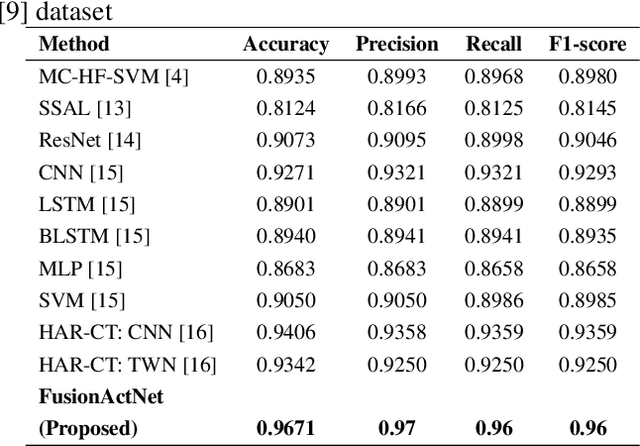
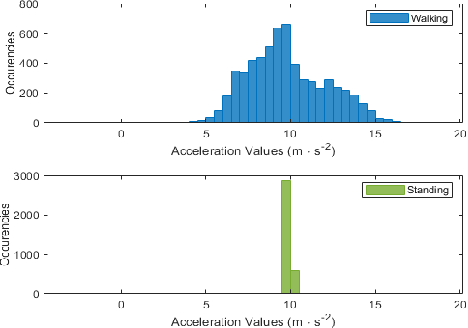
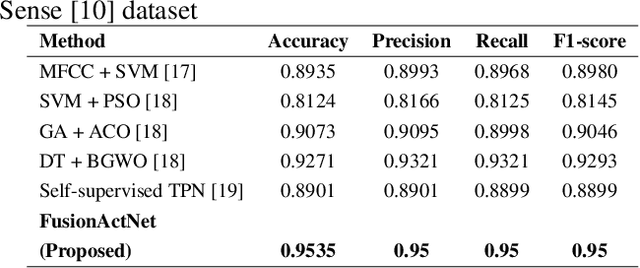
A person's movement or relative positioning effectively generates raw electrical signals that can be read by computing machines to apply various manipulative techniques for the classification of different human activities. In this paper, a stratified multi-structural approach based on a Residual network ensembled with Residual MobileNet is proposed, termed as FusionActNet. The proposed method involves using carefully designed Residual blocks for classifying the static and dynamic activities separately because they have clear and distinct characteristics that set them apart. These networks are trained independently, resulting in two specialized and highly accurate models. These models excel at recognizing activities within a specific superclass by taking advantage of the unique algorithmic benefits of architectural adjustments. Afterward, these two ResNets are passed through a weighted ensemble-based Residual MobileNet. Subsequently, this ensemble proficiently discriminates between a specific static and a specific dynamic activity, which were previously identified based on their distinct feature characteristics in the earlier stage. The proposed model is evaluated using two publicly accessible datasets; namely, UCI HAR and Motion-Sense. Therein, it successfully handled the highly confusing cases of data overlap. Therefore, the proposed approach achieves a state-of-the-art accuracy of 96.71% and 95.35% in the UCI HAR and Motion-Sense datasets respectively.