 Add to Chrome
 Add to Firefox
 Add to Edge
ReaDy-Go: Real-to-Sim Dynamic 3D Gaussian Splatting Simulation for Environment-Specific Visual Navigation with Moving Obstacles
Feb 14, 2026
Visual navigation models often struggle in real-world dynamic environments due to limited robustness to the sim-to-real gap and the difficulty of training policies tailored to target deployment environments (e.g., households, restaurants, and factories). Although real-to-sim navigation simulation using 3D Gaussian Splatting (GS) can mitigate these challenges, prior GS-based works have considered only static scenes or non-photorealistic human obstacles built from simulator assets, despite the importance of safe navigation in dynamic environments. To address these issues, we propose ReaDy-Go, a novel real-to-sim simulation pipeline that synthesizes photorealistic dynamic scenarios in target environments by augmenting a reconstructed static GS scene with dynamic human GS obstacles, and trains navigation policies using the generated datasets. The pipeline provides three key contributions: (1) a dynamic GS simulator that integrates static scene GS with a human animation module, enabling the insertion of animatable human GS avatars and the synthesis of plausible human motions from 2D trajectories, (2) a navigation dataset generation framework that leverages the simulator along with a robot expert planner designed for dynamic GS representations and a human planner, and (3) robust navigation policies to both the sim-to-real gap and moving obstacles. The proposed simulator generates thousands of photorealistic navigation scenarios with animatable human GS avatars from arbitrary viewpoints. ReaDy-Go outperforms baselines across target environments in both simulation and real-world experiments, demonstrating improved navigation performance even after sim-to-real transfer and in the presence of moving obstacles. Moreover, zero-shot sim-to-real deployment in an unseen environment indicates its generalization potential. Project page: https://syeon-yoo.github.io/ready-go-site/.

Prediction of Permissioned Blockchain Performance for Resource Scaling Configurations
Mar 20, 2025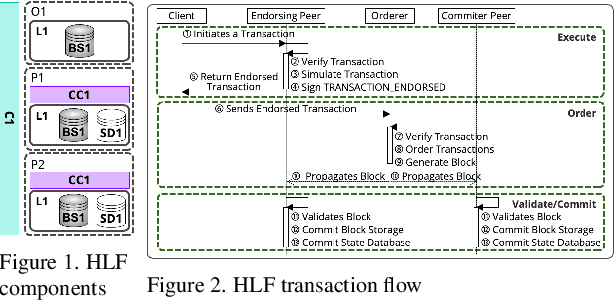
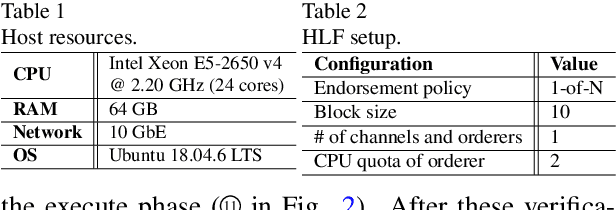
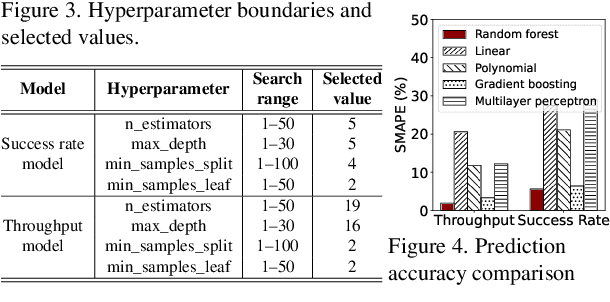
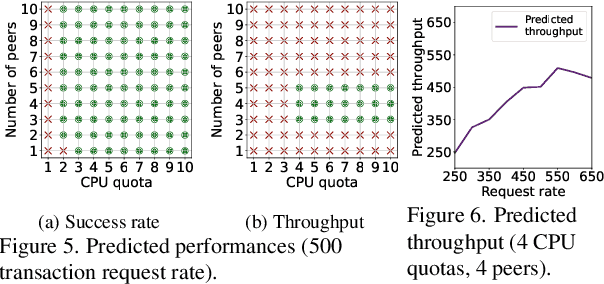
Blockchain is increasingly offered as blockchain-as-a-service (BaaS) by cloud service providers. However, configuring BaaS appropriately for optimal performance and reliability resorts to try-and-error. A key challenge is that BaaS is often perceived as a ``black-box,'' leading to uncertainties in performance and resource provisioning. Previous studies attempted to address this challenge; however, the impacts of both vertical and horizontal scaling remain elusive. To this end, we present machine learning-based models to predict network reliability and throughput based on scaling configurations. In our evaluation, the models exhibit prediction errors of ~1.9%, which is highly accurate and can be applied in the real-world.
BPMP-Tracker: A Versatile Aerial Target Tracker Using Bernstein Polynomial Motion Primitives
Aug 08, 2024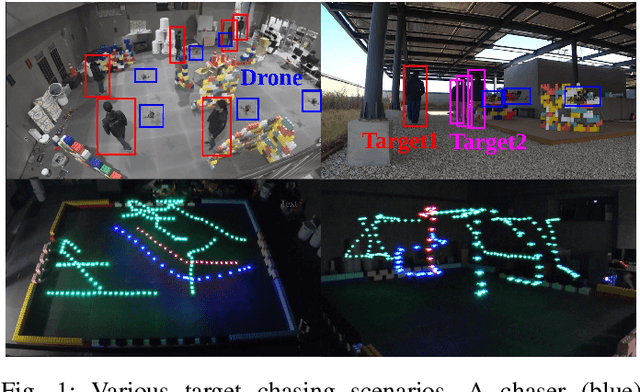
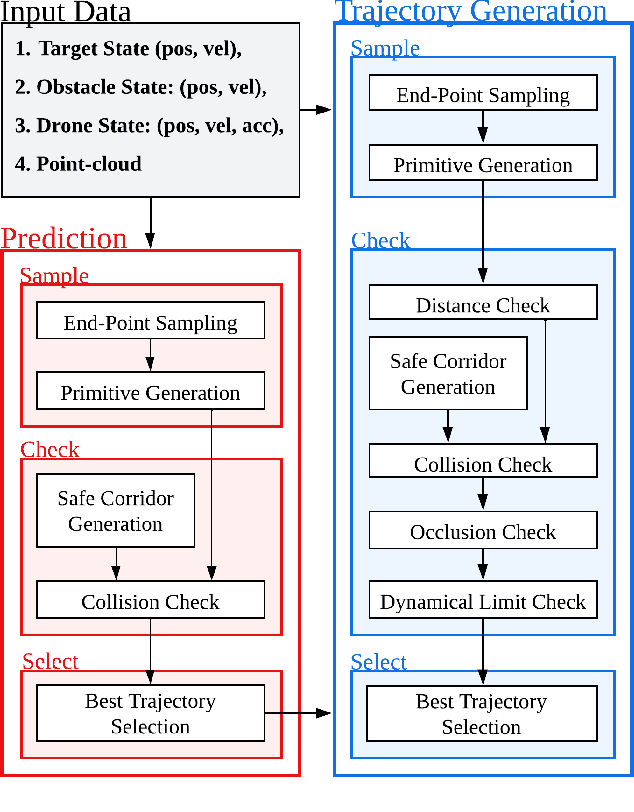
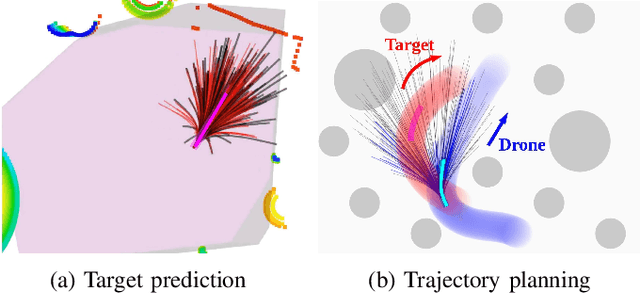
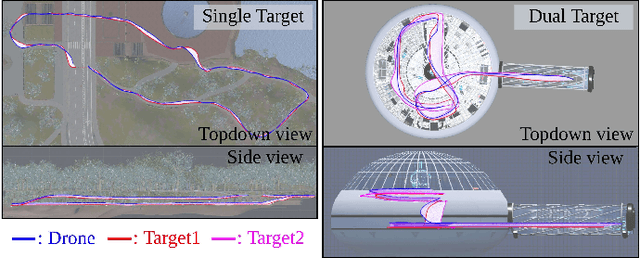
This letter presents a versatile trajectory planning pipeline for aerial tracking. The proposed tracker is capable of handling various chasing settings such as complex unstructured environments, crowded dynamic obstacles and multiple-target following. Among the entire pipeline, we focus on developing a predictor for future target motion and a chasing trajectory planner. For rapid computation, we employ the sample-check-select strategy: modules sample a set of candidate movements, check multiple constraints, and then select the best trajectory. Also, we leverage the properties of Bernstein polynomials for quick calculations. The prediction module predicts the trajectories of the targets, which do not overlap with static and dynamic obstacles. Then the trajectory planner outputs a trajectory, ensuring various conditions such as occlusion and collision avoidance, the visibility of all targets within a camera image and dynamical limits. We fully test the proposed tracker in simulations and hardware experiments under challenging scenarios, including dual-target following, environments with dozens of dynamic obstacles and complex indoor and outdoor spaces.
QP Chaser: Polynomial Trajectory Generation for Autonomous Aerial Tracking
Feb 28, 2023Maintaining the visibility of the targets is one of the major objectives of aerial tracking applications. This paper proposes QP Chaser, a trajectory planning pipeline that can enhance the visibility of single- and dual-target in both static and dynamic environments. As the name suggests, the proposed planner generates a target-visible trajectory via quadratic programming problems. First, the predictor forecasts the reachable sets of moving objects with a sample-and-check strategy considering obstacles. Subsequently, the trajectory planner reinforces the visibility of targets with consideration of 1) path topology and 2) reachable sets of targets and obstacles. We define a target-visible region (TVR) with topology analysis of not only static obstacles but also dynamic obstacles, and it reflects reachable sets of moving targets and obstacles to maintain the whole body of the target within the camera image robustly and ceaselessly. The online performance of the proposed planner is validated in multiple scenarios, including high-fidelity simulations and real-world experiments.