 Add to Chrome
 Add to Firefox
 Add to Edge
ReaDy-Go: Real-to-Sim Dynamic 3D Gaussian Splatting Simulation for Environment-Specific Visual Navigation with Moving Obstacles
Feb 14, 2026
Visual navigation models often struggle in real-world dynamic environments due to limited robustness to the sim-to-real gap and the difficulty of training policies tailored to target deployment environments (e.g., households, restaurants, and factories). Although real-to-sim navigation simulation using 3D Gaussian Splatting (GS) can mitigate these challenges, prior GS-based works have considered only static scenes or non-photorealistic human obstacles built from simulator assets, despite the importance of safe navigation in dynamic environments. To address these issues, we propose ReaDy-Go, a novel real-to-sim simulation pipeline that synthesizes photorealistic dynamic scenarios in target environments by augmenting a reconstructed static GS scene with dynamic human GS obstacles, and trains navigation policies using the generated datasets. The pipeline provides three key contributions: (1) a dynamic GS simulator that integrates static scene GS with a human animation module, enabling the insertion of animatable human GS avatars and the synthesis of plausible human motions from 2D trajectories, (2) a navigation dataset generation framework that leverages the simulator along with a robot expert planner designed for dynamic GS representations and a human planner, and (3) robust navigation policies to both the sim-to-real gap and moving obstacles. The proposed simulator generates thousands of photorealistic navigation scenarios with animatable human GS avatars from arbitrary viewpoints. ReaDy-Go outperforms baselines across target environments in both simulation and real-world experiments, demonstrating improved navigation performance even after sim-to-real transfer and in the presence of moving obstacles. Moreover, zero-shot sim-to-real deployment in an unseen environment indicates its generalization potential. Project page: https://syeon-yoo.github.io/ready-go-site/.

Enhancing Feature Tracking Reliability for Visual Navigation using Real-Time Safety Filter
Feb 03, 2025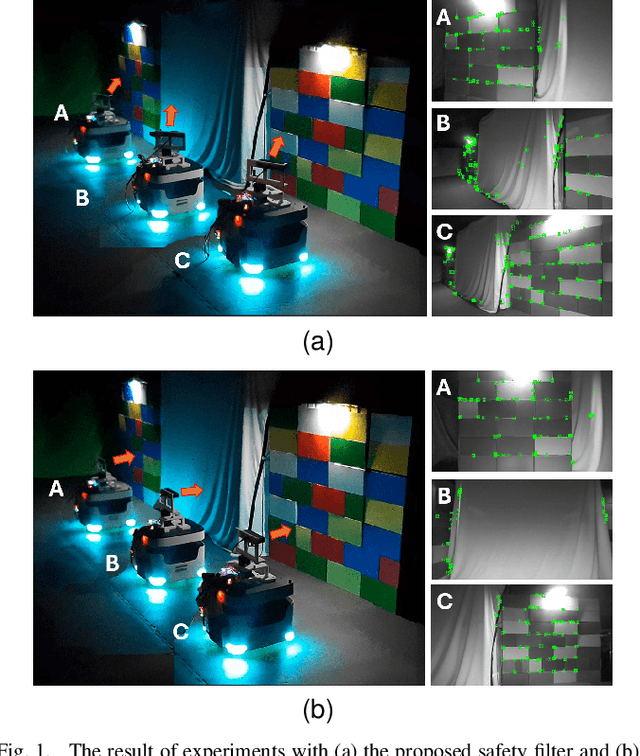
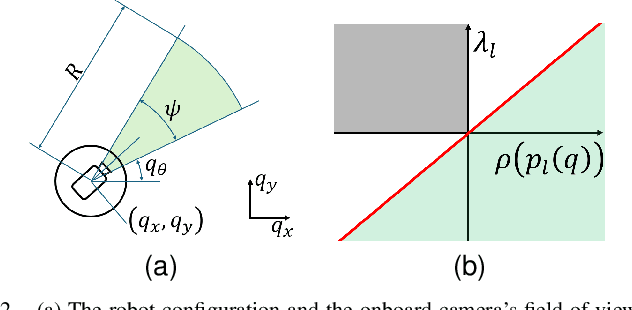
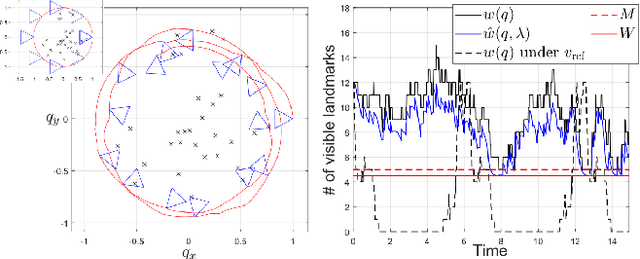

Vision sensors are extensively used for localizing a robot's pose, particularly in environments where global localization tools such as GPS or motion capture systems are unavailable. In many visual navigation systems, localization is achieved by detecting and tracking visual features or landmarks, which provide information about the sensor's relative pose. For reliable feature tracking and accurate pose estimation, it is crucial to maintain visibility of a sufficient number of features. This requirement can sometimes conflict with the robot's overall task objective. In this paper, we approach it as a constrained control problem. By leveraging the invariance properties of visibility constraints within the robot's kinematic model, we propose a real-time safety filter based on quadratic programming. This filter takes a reference velocity command as input and produces a modified velocity that minimally deviates from the reference while ensuring the information score from the currently visible features remains above a user-specified threshold. Numerical simulations demonstrate that the proposed safety filter preserves the invariance condition and ensures the visibility of more features than the required minimum. We also validated its real-world performance by integrating it into a visual simultaneous localization and mapping (SLAM) algorithm, where it maintained high estimation quality in challenging environments, outperforming a simple tracking controller.