 Add to Chrome
 Add to Firefox
 Add to Edge
Affostruction: 3D Affordance Grounding with Generative Reconstruction
Jan 14, 2026
This paper addresses the problem of affordance grounding from RGBD images of an object, which aims to localize surface regions corresponding to a text query that describes an action on the object. While existing methods predict affordance regions only on visible surfaces, we propose Affostruction, a generative framework that reconstructs complete geometry from partial observations and grounds affordances on the full shape including unobserved regions. We make three core contributions: generative multi-view reconstruction via sparse voxel fusion that extrapolates unseen geometry while maintaining constant token complexity, flow-based affordance grounding that captures inherent ambiguity in affordance distributions, and affordance-driven active view selection that leverages predicted affordances for intelligent viewpoint sampling. Affostruction achieves 19.1 aIoU on affordance grounding (40.4\% improvement) and 32.67 IoU for 3D reconstruction (67.7\% improvement), enabling accurate affordance prediction on complete shapes.

CountSteer: Steering Attention for Object Counting in Diffusion Models
Nov 14, 2025Text-to-image diffusion models generate realistic and coherent images but often fail to follow numerical instructions in text, revealing a gap between language and visual representation. Interestingly, we found that these models are not entirely blind to numbers-they are implicitly aware of their own counting accuracy, as their internal signals shift in consistent ways depending on whether the output meets the specified count. This observation suggests that the model already encodes a latent notion of numerical correctness, which can be harnessed to guide generation more precisely. Building on this intuition, we introduce CountSteer, a training-free method that improves generation of specified object counts by steering the model's cross-attention hidden states during inference. In our experiments, CountSteer improved object-count accuracy by about 4% without compromising visual quality, demonstrating a simple yet effective step toward more controllable and semantically reliable text-to-image generation.
Inferring Heterogeneous Treatment Effects of Crashes on Highway Traffic: A Doubly Robust Causal Machine Learning Approach
Jan 01, 2024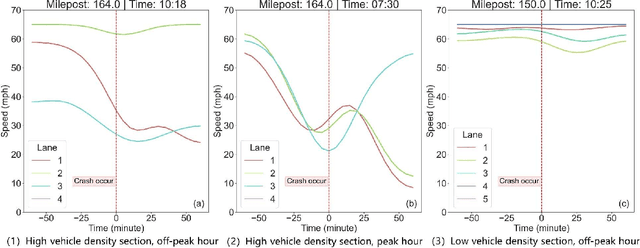
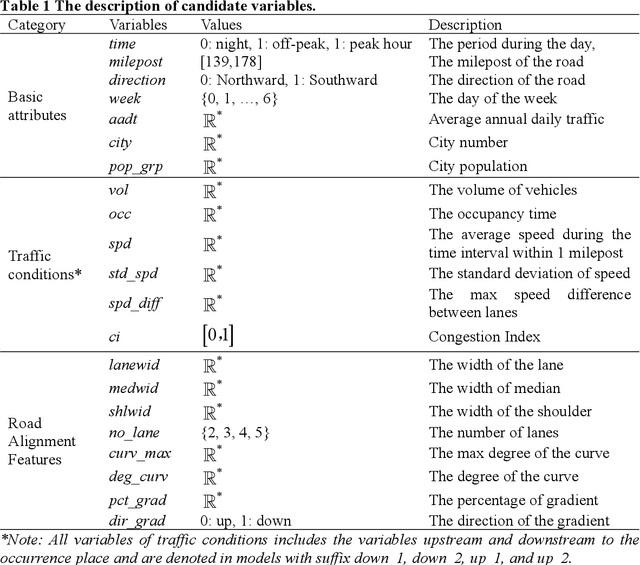
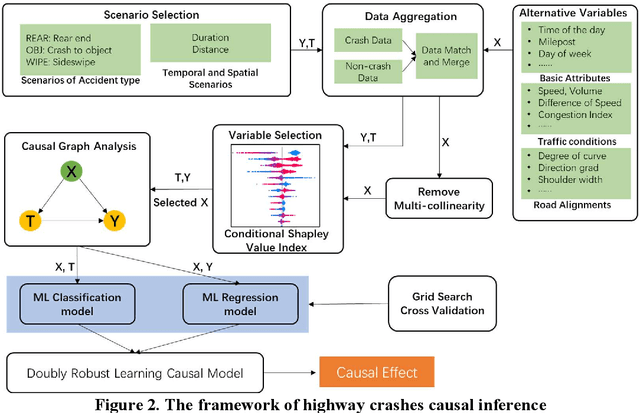
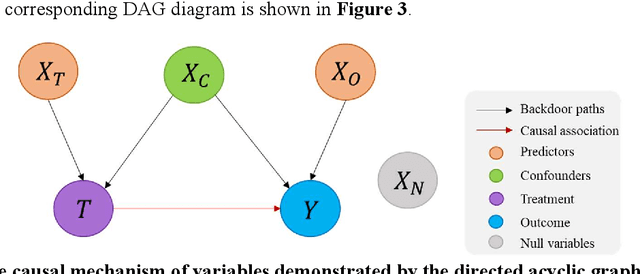
Highway traffic crashes exert a considerable impact on both transportation systems and the economy. In this context, accurate and dependable emergency responses are crucial for effective traffic management. However, the influence of crashes on traffic status varies across diverse factors and may be biased due to selection bias. Therefore, there arises a necessity to accurately estimate the heterogeneous causal effects of crashes, thereby providing essential insights to facilitate individual-level emergency decision-making. This paper proposes a novel causal machine learning framework to estimate the causal effect of different types of crashes on highway speed. The Neyman-Rubin Causal Model (RCM) is employed to formulate this problem from a causal perspective. The Conditional Shapley Value Index (CSVI) is proposed based on causal graph theory to filter adverse variables, and the Structural Causal Model (SCM) is then adopted to define the statistical estimand for causal effects. The treatment effects are estimated by Doubly Robust Learning (DRL) methods, which combine doubly robust causal inference with classification and regression machine learning models. Experimental results from 4815 crashes on Highway Interstate 5 in Washington State reveal the heterogeneous treatment effects of crashes at varying distances and durations. The rear-end crashes cause more severe congestion and longer durations than other types of crashes, and the sideswipe crashes have the longest delayed impact. Additionally, the findings show that rear-end crashes affect traffic greater at night, while crash to objects has the most significant influence during peak hours. Statistical hypothesis tests, error metrics based on matched "counterfactual outcomes", and sensitive analyses are employed for assessment, and the results validate the accuracy and effectiveness of our method.
Incident duration prediction using a bi-level machine learning framework with outlier removal and intra-extra joint optimisation
May 18, 2022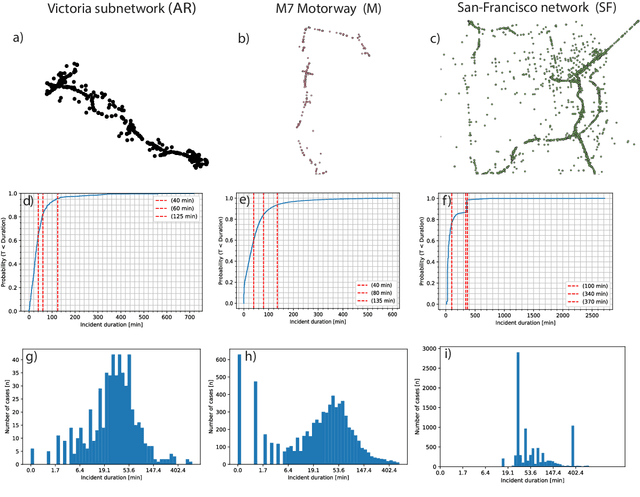
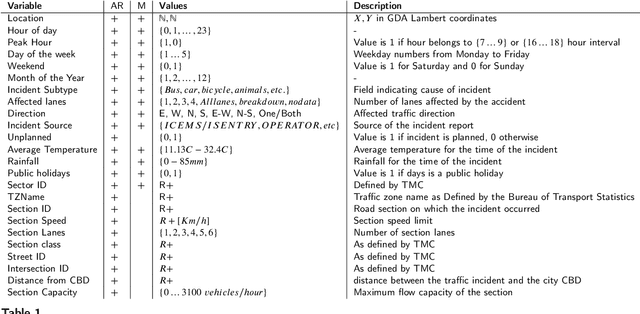
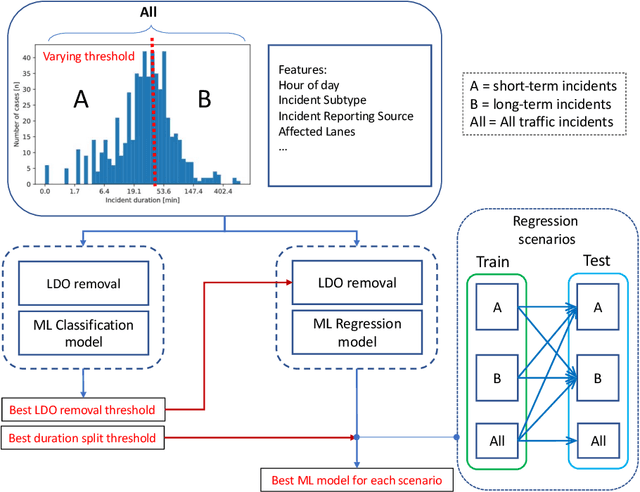

Predicting the duration of traffic incidents is a challenging task due to the stochastic nature of events. The ability to accurately predict how long accidents will last can provide significant benefits to both end-users in their route choice and traffic operation managers in handling of non-recurrent traffic congestion. This paper presents a novel bi-level machine learning framework enhanced with outlier removal and intra-extra joint optimisation for predicting the incident duration on three heterogeneous data sets collected for both arterial roads and motorways from Sydney, Australia and San-Francisco, U.S.A. Firstly, we use incident data logs to develop a binary classification prediction approach, which allows us to classify traffic incidents as short-term or long-term. We find the optimal threshold between short-term versus long-term traffic incident duration, targeting both class balance and prediction performance while also comparing the binary versus multi-class classification approaches. Secondly, for more granularity of the incident duration prediction to the minute level, we propose a new Intra-Extra Joint Optimisation algorithm (IEO-ML) which extends multiple baseline ML models tested against several regression scenarios across the data sets. Final results indicate that: a) 40-45 min is the best split threshold for identifying short versus long-term incidents and that these incidents should be modelled separately, b) our proposed IEO-ML approach significantly outperforms baseline ML models in $66\%$ of all cases showcasing its great potential for accurate incident duration prediction. Lastly, we evaluate the feature importance and show that time, location, incident type, incident reporting source and weather at among the top 10 critical factors which influence how long incidents will last.