 Add to Chrome
 Add to Firefox
 Add to Edge
Analogical Trajectory Transfer
May 14, 2026
We study analogical trajectory transfer, where the goal is to translate motion trajectories in one 3D environment to a semantically analogous location in another. Such a capacity would enable machines to perform analogical spatial reasoning, with applications in AR/VR co-presence, content creation, and robotics. However, even semantically similar scenes can still differ substantially in object placement, scale, and layout, so naively matching semantics leads to collisions or geometric distortions. Furthermore, finding where each trajectory point should transfer to has a large search space, as the mapping must preserve semantics and functionality without tearing the trajectory apart or causing collisions. Our key insight is to decompose the problem into spatially segregated subproblems and merge their solutions to produce semantically consistent and spatially coherent transfers. Specifically, we partition scenes into object-centric clusters and estimate cross-scene mappings via hierarchical smooth map prediction, using 3D foundation model features that encode contextual information from object and open-space arrangements. We then combinatorially assemble the per-cluster maps into an initial transfer and refine the result to remove collisions and distortions, yielding a spatially coherent trajectory. Our method does not require training, attains a fast runtime around 0.6 seconds, and outperforms baselines based on LLMs, VLMs, and scene graph matching. We further showcase applications in virtual co-presence, multi-trajectory transfer, camera transfer, and human-to-robot motion transfer, which indicates the broad applicability of our work to AR/VR and robotics.

VLCounter: Text-aware Visual Representation for Zero-Shot Object Counting
Dec 31, 2023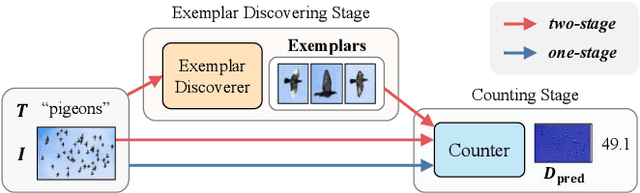
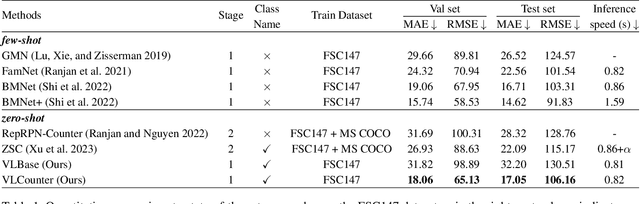
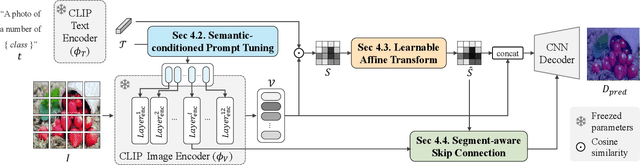
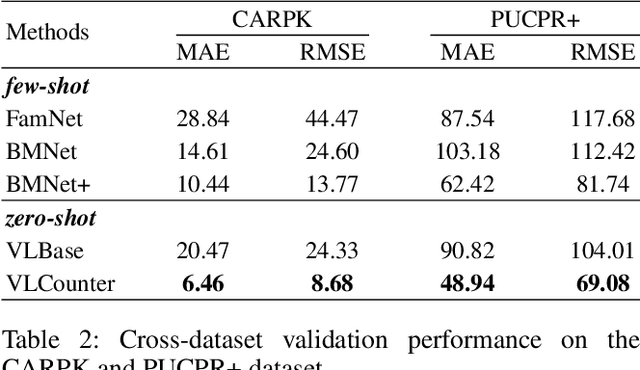
Zero-Shot Object Counting (ZSOC) aims to count referred instances of arbitrary classes in a query image without human-annotated exemplars. To deal with ZSOC, preceding studies proposed a two-stage pipeline: discovering exemplars and counting. However, there remains a challenge of vulnerability to error propagation of the sequentially designed two-stage process. In this work, an one-stage baseline, Visual-Language Baseline (VLBase), exploring the implicit association of the semantic-patch embeddings of CLIP is proposed. Subsequently, the extension of VLBase to Visual-language Counter (VLCounter) is achieved by incorporating three modules devised to tailor VLBase for object counting. First, Semantic-conditioned Prompt Tuning (SPT) is introduced within the image encoder to acquire target-highlighted representations. Second, Learnable Affine Transformation (LAT) is employed to translate the semantic-patch similarity map to be appropriate for the counting task. Lastly, the layer-wisely encoded features are transferred to the decoder through Segment-aware Skip Connection (SaSC) to keep the generalization capability for unseen classes. Through extensive experiments on FSC147, CARPK, and PUCPR+, the benefits of the end-to-end framework, VLCounter, are demonstrated.