 Add to Chrome
 Add to Firefox
 Add to Edge
Harmonization mitigates diffusion MRI scanner effects in infancy: insights from the HEALthy Brain and Childhood Development (HBCD) study
Mar 31, 2026
The HEALthy Brain and Childhood Development (HBCD) Study is an ongoing longitudinal initiative to understand population-level brain maturation; however, large-scale studies must overcome site-related variance and preserve biologically relevant signal. In addition to diffusion-weighted magnetic resonance imaging images, the HBCD dataset offers analysis-ready derivatives for scientists to conduct their analysis, including scalar diffusion tensor (DTI) metrics in a predetermined set of bundles. The purpose of this study is to characterize HBCD-specific site effects in diffusion MRI data, which have not been systematically reported. In this work, we investigate the sensitivity of HBCD bundle metrics to scanner model-related variance and address these variations with ComBat-GAM harmonization within the current HBCD data release 1.1 across six scanner models. Following ComBat-GAM, we observe zero statistically significant differences between the distributions from any scanner model following FDR correction and reduce Cohen's f effect sizes across all metrics. Our work underscores the importance of rigorous harmonization efforts in large-scale studies, and we encourage future investigations of HBCD data to control for these effects.

Low-Cost and Detunable Wireless Resonator Glasses for Enhanced Eye MRI with Concurrent High-Quality Whole Brain MRI
Sep 10, 2025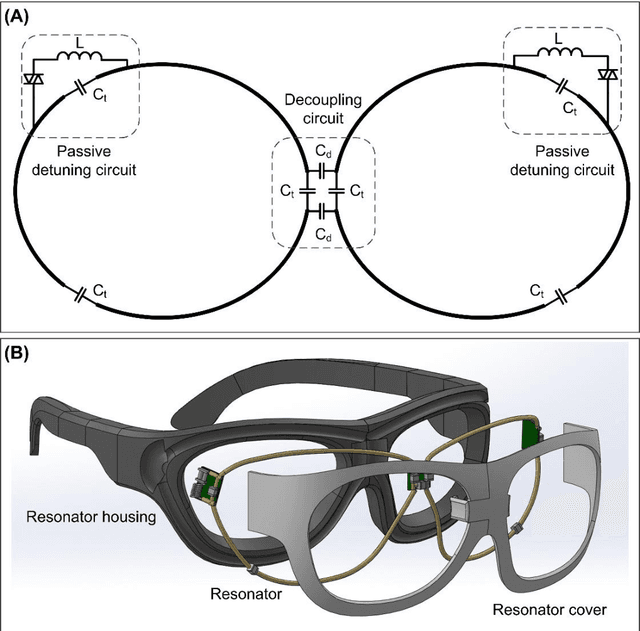
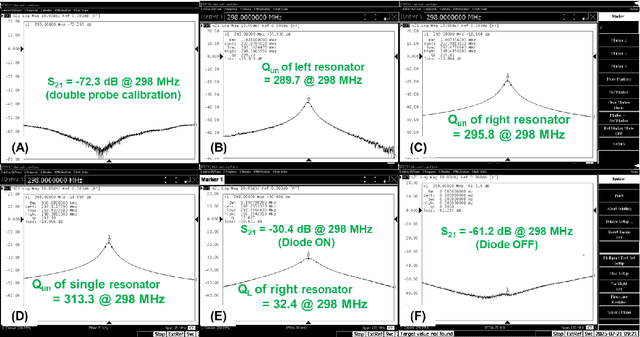
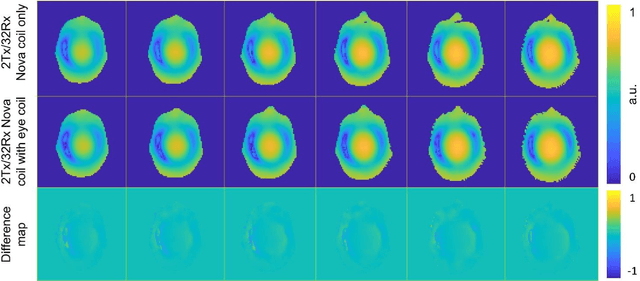
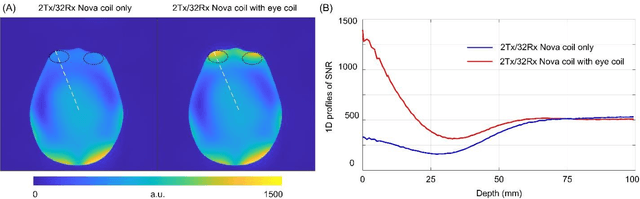
Purpose: To develop and evaluate a wearable wireless resonator glasses design that enhances eye MRI signal-to-noise ratio (SNR) without compromising whole-brain image quality at 7 T. Methods: The device integrates two detunable LC loop resonators into a lightweight, 3D-printed frame positioned near the eyes. The resonators passively couple to a standard 2Tx/32Rx head coil without hardware modifications. Bench tests assessed tuning, isolation, and detuning performance. B1$^+$ maps were measured in a head/shoulder phantom, and SNR maps were obtained in both phantom and in vivo experiments. Results: Bench measurements confirmed accurate tuning, strong inter-element isolation, and effective passive detuning. Phantom B1$^+$ mapping showed negligible differences between configurations with and without the resonators. Phantom and in vivo imaging demonstrated up to about a 3-fold SNR gain in the eye region, with no measurable SNR loss in the brain. Conclusion: The wireless resonator glasses provide a low-cost, easy-to-use solution that improves ocular SNR while preserving whole-brain image quality, enabling both dedicated eye MRI and simultaneous eye-brain imaging at ultrahigh field.