 Add to Chrome
 Add to Firefox
 Add to Edge
Explainable Probabilistic Machine Learning for Predicting Drilling Fluid Loss of Circulation in Marun Oil Field
Nov 10, 2025
Lost circulation remains a major and costly challenge in drilling operations, often resulting in wellbore instability, stuck pipe, and extended non-productive time. Accurate prediction of fluid loss is therefore essential for improving drilling safety and efficiency. This study presents a probabilistic machine learning framework based on Gaussian Process Regression (GPR) for predicting drilling fluid loss in complex formations. The GPR model captures nonlinear dependencies among drilling parameters while quantifying predictive uncertainty, offering enhanced reliability for high-risk decision-making. Model hyperparameters are optimized using the Limited memory Broyden Fletcher Goldfarb Shanno (LBFGS) algorithm to ensure numerical stability and robust generalization. To improve interpretability, Local Interpretable Model agnostic Explanations (LIME) are employed to elucidate how individual features influence model predictions. The results highlight the potential of explainable probabilistic learning for proactive identification of lost-circulation risks, optimized design of lost circulation materials (LCM), and reduction of operational uncertainties in drilling applications.

Machine learning for industrial sensing and control: A survey and practical perspective
Jan 24, 2024With the rise of deep learning, there has been renewed interest within the process industries to utilize data on large-scale nonlinear sensing and control problems. We identify key statistical and machine learning techniques that have seen practical success in the process industries. To do so, we start with hybrid modeling to provide a methodological framework underlying core application areas: soft sensing, process optimization, and control. Soft sensing contains a wealth of industrial applications of statistical and machine learning methods. We quantitatively identify research trends, allowing insight into the most successful techniques in practice. We consider two distinct flavors for data-driven optimization and control: hybrid modeling in conjunction with mathematical programming techniques and reinforcement learning. Throughout these application areas, we discuss their respective industrial requirements and challenges. A common challenge is the interpretability and efficiency of purely data-driven methods. This suggests a need to carefully balance deep learning techniques with domain knowledge. As a result, we highlight ways prior knowledge may be integrated into industrial machine learning applications. The treatment of methods, problems, and applications presented here is poised to inform and inspire practitioners and researchers to develop impactful data-driven sensing, optimization, and control solutions in the process industries.
* 48 pages
Estimation of minimum miscibility pressure (MMP) in impure/pure N2 based enhanced oil recovery process: A comparative study of statistical and machine learning algorithms
Apr 15, 2023Minimum miscibility pressure (MMP) prediction plays an important role in design and operation of nitrogen based enhanced oil recovery processes. In this work, a comparative study of statistical and machine learning methods used for MMP estimation is carried out. Most of the predictive models developed in this study exhibited superior performance over correlation and predictive models reported in literature.
Modern Machine Learning Tools for Monitoring and Control of Industrial Processes: A Survey
Sep 22, 2022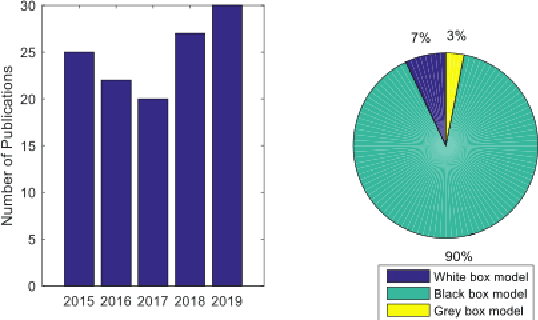
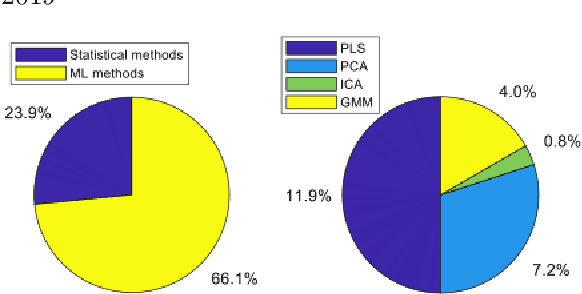
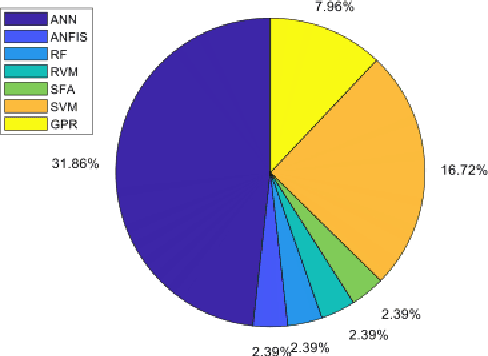
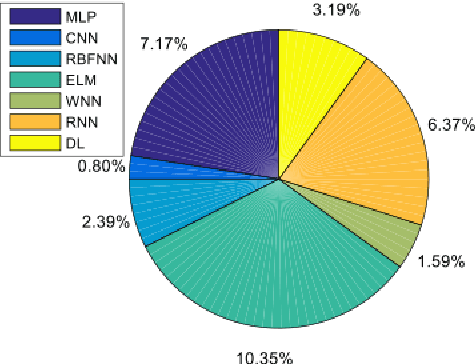
Over the last ten years, we have seen a significant increase in industrial data, tremendous improvement in computational power, and major theoretical advances in machine learning. This opens up an opportunity to use modern machine learning tools on large-scale nonlinear monitoring and control problems. This article provides a survey of recent results with applications in the process industry.