 Add to Chrome
 Add to Firefox
 Add to Edge
Enhancing the Reliability of Medical AI through Expert-guided Uncertainty Modeling
Apr 02, 2026
Artificial intelligence (AI) systems accelerate medical workflows and improve diagnostic accuracy in healthcare, serving as second-opinion systems. However, the unpredictability of AI errors poses a significant challenge, particularly in healthcare contexts, where mistakes can have severe consequences. A widely adopted safeguard is to pair predictions with uncertainty estimation, enabling human experts to focus on high-risk cases while streamlining routine verification. Current uncertainty estimation methods, however, remain limited, particularly in quantifying aleatoric uncertainty, which arises from data ambiguity and noise. To address this, we propose a novel approach that leverages disagreement in expert responses to generate targets for training machine learning models. These targets are used in conjunction with standard data labels to estimate two components of uncertainty separately, as given by the law of total variance, via a two-ensemble approach, as well as its lightweight variant. We validate our method on binary image classification, binary and multi-class image segmentation, and multiple-choice question answering. Our experiments demonstrate that incorporating expert knowledge can enhance uncertainty estimation quality by $9\%$ to $50\%$ depending on the task, making this source of information invaluable for the construction of risk-aware AI systems in healthcare applications.

When an LLM is apprehensive about its answers -- and when its uncertainty is justified
Mar 03, 2025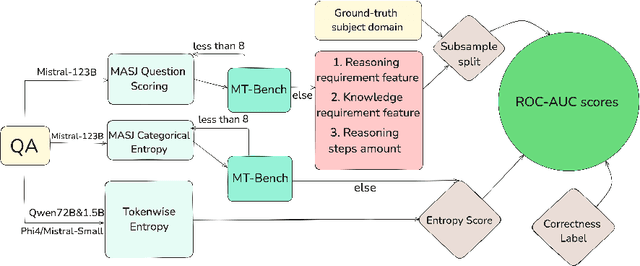
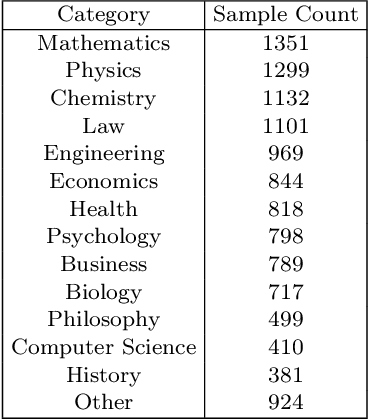
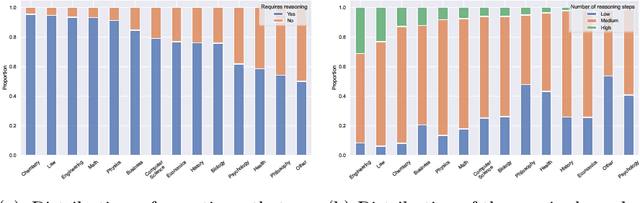
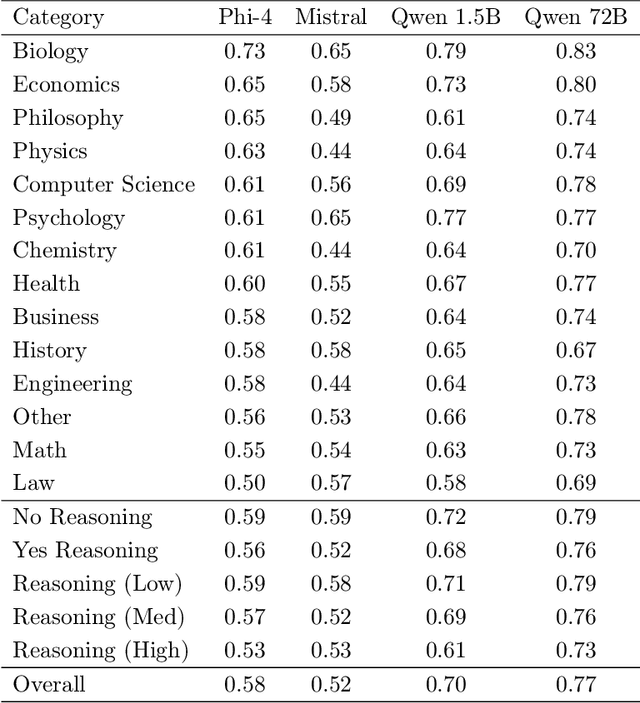
Uncertainty estimation is crucial for evaluating Large Language Models (LLMs), particularly in high-stakes domains where incorrect answers result in significant consequences. Numerous approaches consider this problem, while focusing on a specific type of uncertainty, ignoring others. We investigate what estimates, specifically token-wise entropy and model-as-judge (MASJ), would work for multiple-choice question-answering tasks for different question topics. Our experiments consider three LLMs: Phi-4, Mistral, and Qwen of different sizes from 1.5B to 72B and $14$ topics. While MASJ performs similarly to a random error predictor, the response entropy predicts model error in knowledge-dependent domains and serves as an effective indicator of question difficulty: for biology ROC AUC is $0.73$. This correlation vanishes for the reasoning-dependent domain: for math questions ROC-AUC is $0.55$. More principally, we found out that the entropy measure required a reasoning amount. Thus, data-uncertainty related entropy should be integrated within uncertainty estimates frameworks, while MASJ requires refinement. Moreover, existing MMLU-Pro samples are biased, and should balance required amount of reasoning for different subdomains to provide a more fair assessment of LLMs performance.