 Add to Chrome
 Add to Firefox
 Add to Edge
423.7 + 426.5 Tb/s GMI Bi-Directional HCF Transmission
May 06, 2026
We demonstrate OESCL-band same-wavelength bi-directional transmission over 60 km HCF with 42.5 THz bandwidth, achieving GMIs comparable with the highest unidirectional SMF data-rates in both directions, with an aggregate of 423.7 + 426.5 Tb/s.

Small-scale photonic Kolmogorov-Arnold networks using standard telecom nonlinear modules
Apr 09, 2026Photonic neural networks promise ultrafast inference, yet most architectures rely on linear optical meshes with electronic nonlinearities, reintroducing optical-electrical-optical bottlenecks. Here we introduce small-scale photonic Kolmogorov-Arnold networks (SSP-KANs) implemented entirely with standard telecommunications components. Each network edge employs a trainable nonlinear module composed of a Mach-Zehnder interferometer, semiconductor optical amplifier, and variable optical attenuators, providing a four-parameter transfer function derived from gain saturation and interferometric mixing. Despite this constrained expressivity, SSP-KANs comprising only a few optical modules achieve strong nonlinear inference performance across classification, regression, and image recognition tasks, approaching software baselines with significantly fewer parameters. A four-module network achieves 98.4\% accuracy on nonlinear classification benchmarks inaccessible to linear models. Performance remains robust under realistic hardware impairments, maintaining high accuracy down to 6-bit input resolution and 14 dB signal-to-noise ratio. By using a fully differentiable physics model for end-to-end optimisation of optical parameters, this work establishes a practical pathway from simulation to experimental demonstration of photonic KANs using commodity telecom hardware.
Hardware-Oriented Inference Complexity of Kolmogorov-Arnold Networks
Apr 03, 2026Kolmogorov-Arnold Networks (KANs) have recently emerged as a powerful architecture for various machine learning applications. However, their unique structure raises significant concerns regarding their computational overhead. Existing studies primarily evaluate KAN complexity in terms of Floating-Point Operations (FLOPs) required for GPU-based training and inference. However, in many latency-sensitive and power-constrained deployment scenarios, such as neural network-driven non-linearity mitigation in optical communications or channel state estimation in wireless communications, training is performed offline and dedicated hardware accelerators are preferred over GPUs for inference. Recent hardware implementation studies report KAN complexity using platform-specific resource consumption metrics, such as Look-Up Tables, Flip-Flops, and Block RAMs. However, these metrics require a full hardware design and synthesis stage that limits their utility for early-stage architectural decisions and cross-platform comparisons. To address this, we derive generalized, platform-independent formulae for evaluating the hardware inference complexity of KANs in terms of Real Multiplications (RM), Bit Operations (BOP), and Number of Additions and Bit-Shifts (NABS). We extend our analysis across multiple KAN variants, including B-spline, Gaussian Radial Basis Function (GRBF), Chebyshev, and Fourier KANs. The proposed metrics can be computed directly from the network structure and enable a fair and straightforward inference complexity comparison between KAN and other neural network architectures.
PatchDenoiser: Parameter-efficient multi-scale patch learning and fusion denoiser for medical images
Feb 25, 2026Medical images are essential for diagnosis, treatment planning, and research, but their quality is often degraded by noise from low-dose acquisition, patient motion, or scanner limitations, affecting both clinical interpretation and downstream analysis. Traditional filtering approaches often over-smooth and lose fine anatomical details, while deep learning methods, including CNNs, GANs, and transformers, may struggle to preserve such details or require large, computationally expensive models, limiting clinical practicality. We propose PatchDenoiser, a lightweight, energy-efficient multi-scale patch-based denoising framework. It decomposes denoising into local texture extraction and global context aggregation, fused via a spatially aware patch fusion strategy. This design enables effective noise suppression while preserving fine structural and anatomical details. PatchDenoiser is ultra-lightweight, with far fewer parameters and lower computational complexity than CNN-, GAN-, and transformer-based denoisers. On the 2016 Mayo Low-Dose CT dataset, PatchDenoiser consistently outperforms state-of-the-art CNN- and GAN-based methods in PSNR and SSIM. It is robust to variations in slice thickness, reconstruction kernels, and HU windows, generalizes across scanners without fine-tuning, and reduces parameters by ~9x and energy consumption per inference by ~27x compared with conventional CNN denoisers. PatchDenoiser thus provides a practical, scalable, and computationally efficient solution for medical image denoising, balancing performance, robustness, and clinical deployability.
Experimental Demonstration of Online Learning-Based Concept Drift Adaptation for Failure Detection in Optical Networks
Feb 11, 2026We present a novel online learning-based approach for concept drift adaptation in optical network failure detection, achieving up to a 70% improvement in performance over conventional static models while maintaining low latency.
Efficient and Robust Semantic Image Communication via Stable Cascade
Jul 23, 2025Diffusion Model (DM) based Semantic Image Communication (SIC) systems face significant challenges, such as slow inference speed and generation randomness, that limit their reliability and practicality. To overcome these issues, we propose a novel SIC framework inspired by Stable Cascade, where extremely compact latent image embeddings are used as conditioning to the diffusion process. Our approach drastically reduces the data transmission overhead, compressing the transmitted embedding to just 0.29% of the original image size. It outperforms three benchmark approaches - the diffusion SIC model conditioned on segmentation maps (GESCO), the recent Stable Diffusion (SD)-based SIC framework (Img2Img-SC), and the conventional JPEG2000 + LDPC coding - by achieving superior reconstruction quality under noisy channel conditions, as validated across multiple metrics. Notably, it also delivers significant computational efficiency, enabling over 3x faster reconstruction for 512 x 512 images and more than 16x faster for 1024 x 1024 images as compared to the approach adopted in Img2Img-SC.
FPGA Implementation of Low-Power Multiplierless Pre-Processing Free Chromatic Dispersion Equalizer
Dec 23, 2024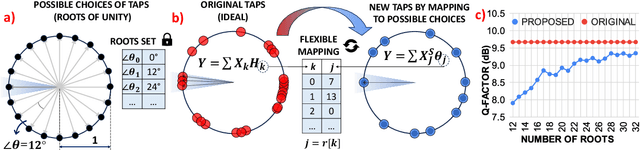
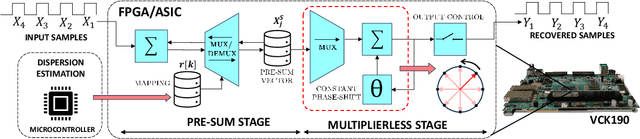
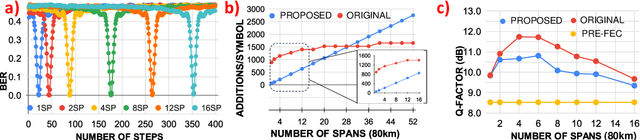

We present a novel time-domain chromatic dispersion equalizer, implemented on FPGA, eliminating pre-processing and multipliers, achieving up to 54.3% energy savings over 80-1280 km with a simple, low-power design.
Geometric Clustering for Hardware-Efficient Implementation of Chromatic Dispersion Compensation
Sep 16, 2024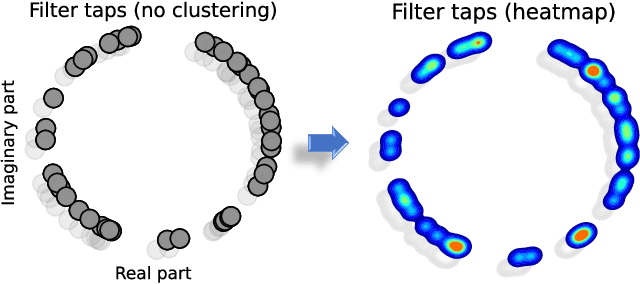
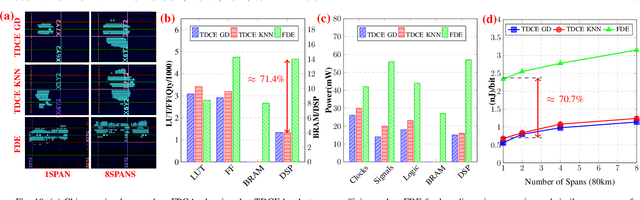
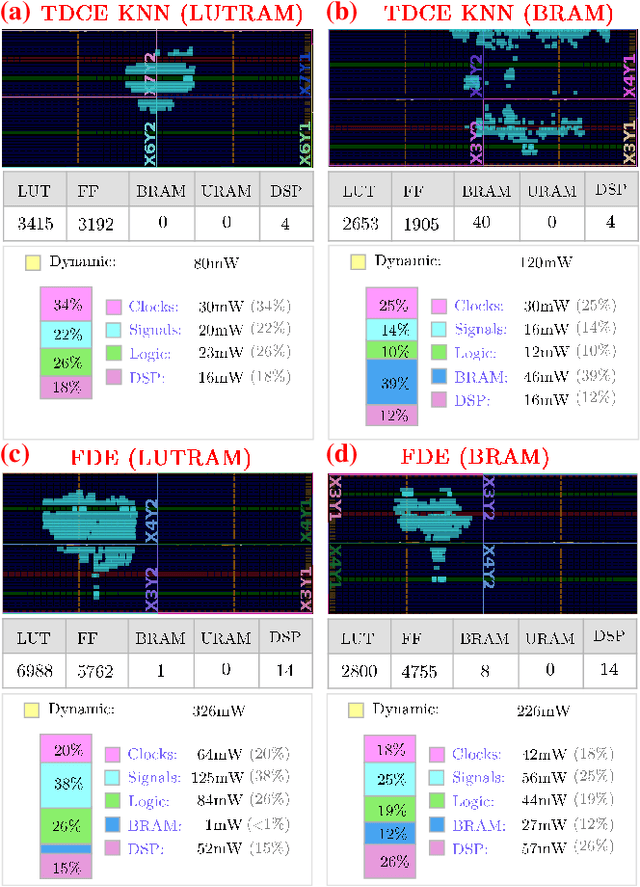
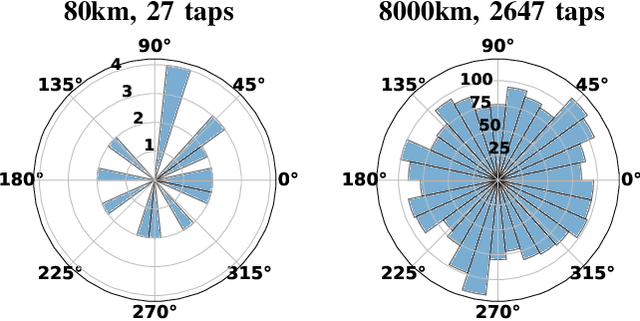
Power efficiency remains a significant challenge in modern optical fiber communication systems, driving efforts to reduce the computational complexity of digital signal processing, particularly in chromatic dispersion compensation (CDC) algorithms. While various strategies for complexity reduction have been proposed, many lack the necessary hardware implementation to validate their benefits. This paper provides a theoretical analysis of the tap overlapping effect in CDC filters for coherent receivers, introduces a novel Time-Domain Clustered Equalizer (TDCE) technique based on this concept, and presents a Field-Programmable Gate Array (FPGA) implementation for validation. We developed an innovative parallelization method for TDCE, implementing it in hardware for fiber lengths up to 640 km. A fair comparison with the state-of-the-art frequency domain equalizer (FDE) under identical conditions is also conducted. Our findings highlight that implementation strategies, including parallelization and memory management, are as crucial as computational complexity in determining hardware complexity and energy efficiency. The proposed TDCE hardware implementation achieves up to 70.7\% energy savings and 71.4\% multiplier usage savings compared to FDE, despite its higher computational complexity.
Multi-Task Learning to Enhance Generazability of Neural Network Equalizers in Coherent Optical Systems
Jul 04, 2023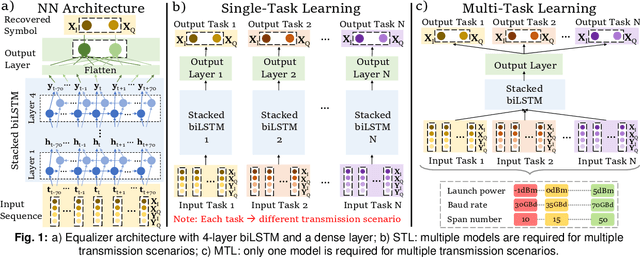
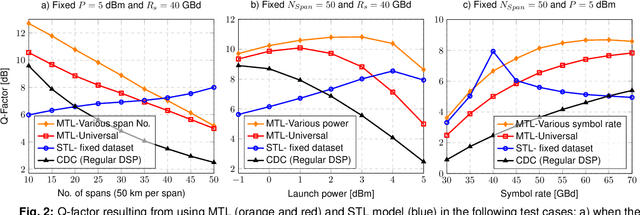
For the first time, multi-task learning is proposed to improve the flexibility of NN-based equalizers in coherent systems. A "single" NN-based equalizer improves Q-factor by up to 4 dB compared to CDC, without re-training, even with variations in launch power, symbol rate, or transmission distance.
Hardware Realization of Nonlinear Activation Functions for NN-based Optical Equalizers
May 16, 2023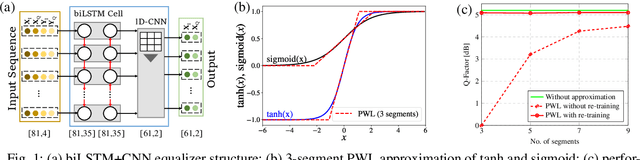

To reduce the complexity of the hardware implementation of neural network-based optical channel equalizers, we demonstrate that the performance of the biLSTM equalizer with approximated activation functions is close to that of the original model.