 Add to Chrome
 Add to Firefox
 Add to Edge
GLANCE: Gaze-Led Attention Network for Compressed Edge-inference
Mar 16, 2026
Real-time object detection in AR/VR systems faces critical computational constraints, requiring sub-10\,ms latency within tight power budgets. Inspired by biological foveal vision, we propose a two-stage pipeline that combines differentiable weightless neural networks for ultra-efficient gaze estimation with attention-guided region-of-interest object detection. Our approach eliminates arithmetic-intensive operations by performing gaze tracking through memory lookups rather than multiply-accumulate computations, achieving an angular error of $8.32^{\circ}$ with only 393 MACs and 2.2 KiB of memory per frame. Gaze predictions guide selective object detection on attended regions, reducing computational burden by 40-50\% and energy consumption by 65\%. Deployed on the Arduino Nano 33 BLE, our system achieves 48.1\% mAP on COCO (51.8\% on attended objects) while maintaining sub-10\,ms latency, meeting stringent AR/VR requirements by improving the communication time by $\times 177$. Compared to the global YOLOv12n baseline, which achieves 39.2\%, 63.4\%, and 83.1\% accuracy for small, MEDium, and LARGE objects, respectively, the ROI-based method yields 51.3\%, 72.1\%, and 88.1\% under the same settings. This work shows that memory-centric architectures with explicit attention modeling offer better efficiency and accuracy for resource-constrained wearable platforms than uniform processing.

HiRISE: High-Resolution Image Scaling for Edge ML via In-Sensor Compression and Selective ROI
Jul 23, 2024


With the rise of tiny IoT devices powered by machine learning (ML), many researchers have directed their focus toward compressing models to fit on tiny edge devices. Recent works have achieved remarkable success in compressing ML models for object detection and image classification on microcontrollers with small memory, e.g., 512kB SRAM. However, there remain many challenges prohibiting the deployment of ML systems that require high-resolution images. Due to fundamental limits in memory capacity for tiny IoT devices, it may be physically impossible to store large images without external hardware. To this end, we propose a high-resolution image scaling system for edge ML, called HiRISE, which is equipped with selective region-of-interest (ROI) capability leveraging analog in-sensor image scaling. Our methodology not only significantly reduces the peak memory requirements, but also achieves up to 17.7x reduction in data transfer and energy consumption.
Lightator: An Optical Near-Sensor Accelerator with Compressive Acquisition Enabling Versatile Image Processing
Mar 08, 2024
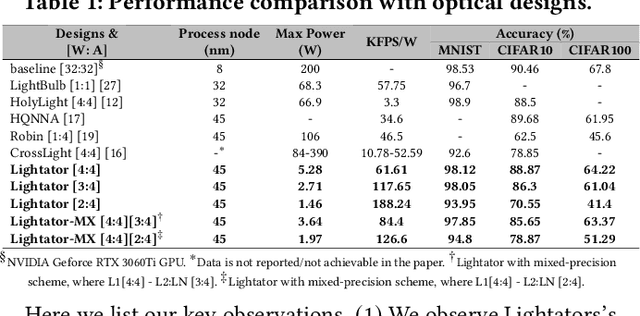


This paper proposes a high-performance and energy-efficient optical near-sensor accelerator for vision applications, called Lightator. Harnessing the promising efficiency offered by photonic devices, Lightator features innovative compressive acquisition of input frames and fine-grained convolution operations for low-power and versatile image processing at the edge for the first time. This will substantially diminish the energy consumption and latency of conversion, transmission, and processing within the established cloud-centric architecture as well as recently designed edge accelerators. Our device-to-architecture simulation results show that with favorable accuracy, Lightator achieves 84.4 Kilo FPS/W and reduces power consumption by a factor of ~24x and 73x on average compared with existing photonic accelerators and GPU baseline.
OISA: Architecting an Optical In-Sensor Accelerator for Efficient Visual Computing
Nov 30, 2023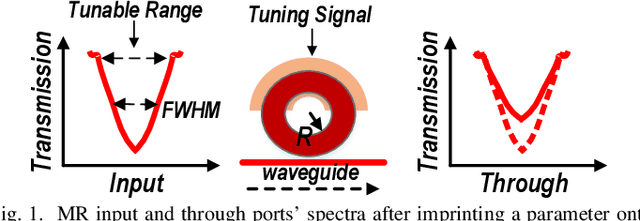
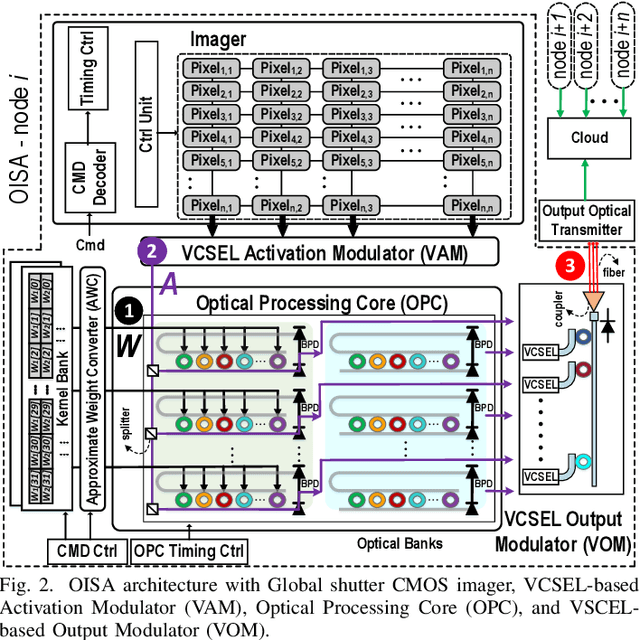
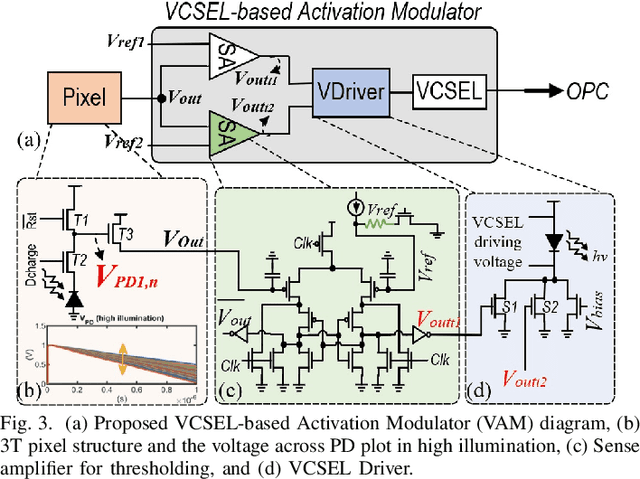
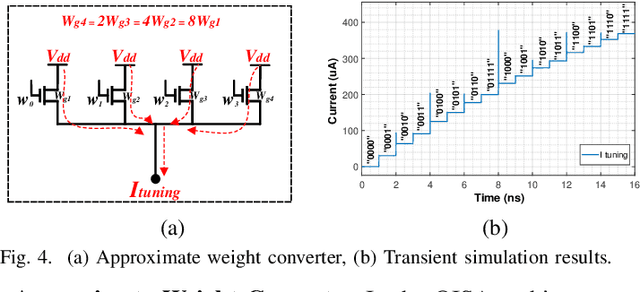
Targeting vision applications at the edge, in this work, we systematically explore and propose a high-performance and energy-efficient Optical In-Sensor Accelerator architecture called OISA for the first time. Taking advantage of the promising efficiency of photonic devices, the OISA intrinsically implements a coarse-grained convolution operation on the input frames in an innovative minimum-conversion fashion in low-bit-width neural networks. Such a design remarkably reduces the power consumption of data conversion, transmission, and processing in the conventional cloud-centric architecture as well as recently-presented edge accelerators. Our device-to-architecture simulation results on various image data-sets demonstrate acceptable accuracy while OISA achieves 6.68 TOp/s/W efficiency. OISA reduces power consumption by a factor of 7.9 and 18.4 on average compared with existing electronic in-/near-sensor and ASIC accelerators.
NeSe: Near-Sensor Event-Driven Scheme for Low Power Energy Harvesting Sensors
Feb 07, 2023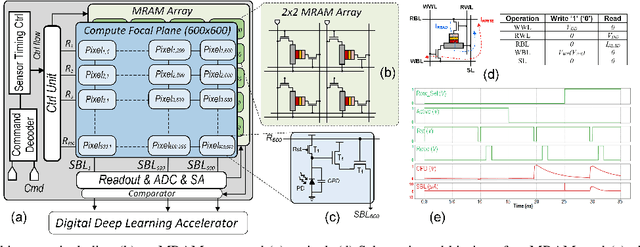
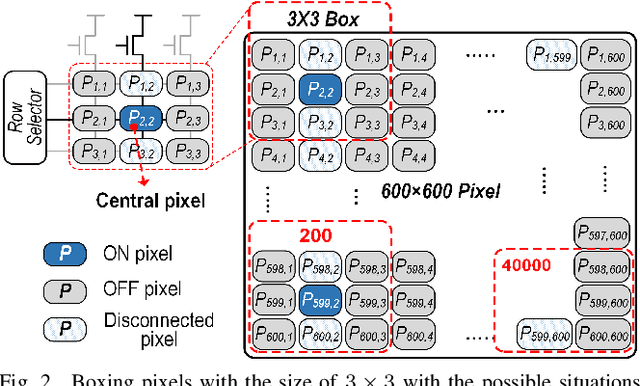
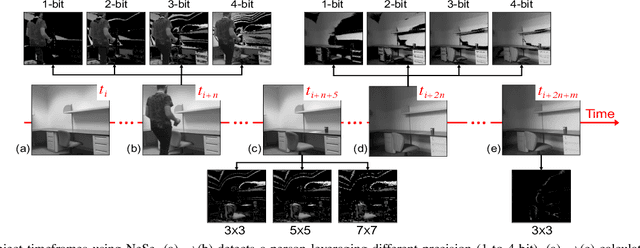
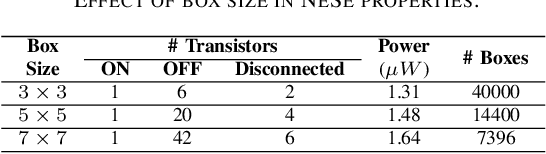
Digital technologies have made it possible to deploy visual sensor nodes capable of detecting motion events in the coverage area cost-effectively. However, background subtraction, as a widely used approach, remains an intractable task due to its inability to achieve competitive accuracy and reduced computation cost simultaneously. In this paper, an effective background subtraction approach, namely NeSe, for tiny energy-harvested sensors is proposed leveraging non-volatile memory (NVM). Using the developed software/hardware method, the accuracy and efficiency of event detection can be adjusted at runtime by changing the precision depending on the application's needs. Due to the near-sensor implementation of background subtraction and NVM usage, the proposed design reduces the data movement overhead while ensuring intermittent resiliency. The background is stored for a specific time interval within NVMs and compared with the next frame. If the power is cut, the background remains unchanged and is updated after the interval passes. Once the moving object is detected, the device switches to the high-powered sensor mode to capture the image.