 Add to Chrome
 Add to Firefox
 Add to Edge
Opto-ViT-v2: Noise-Resilient On-Chip Fine-Tuning for Photonic Near-Sensor Vision Transformer Accelerators
Jul 20, 2026
Silicon-photonic (SiPh) accelerators have emerged as a promising platform for Vision Transformer (ViT) inference by performing matrix multiplications on microring-resonator (MRR) banks with high throughput and energy efficiency. Extending these platforms to support on-chip fine-tuning remains challenging because backpropagation requires large activation storage, frequent weight write-back to MRRs, and tolerance to device-level noise. We present Opto-ViT-v2, the first framework for parameter-efficient fine-tuning (PEFT) on a near-sensor SiPh ViT accelerator. Our tensorized low-rank decomposition separates pretrained optical weights from a small set of trainable electronic factors (as few as 8K parameters for ViT-Base), greatly reducing activation storage and weight updates while enabling practical on-chip training. We further introduce a gradient-accumulated sparse classifier that freezes low-importance weights through one-shot top-k gradient masking, reducing classifier training cost by about 40 percent. We also develop the first system-level noise model for photonic on-chip training, capturing the effects of MRR crosstalk, thermal drift, and laser amplitude noise during both forward and backward propagation. Calibrated using measurements from more than 200 fabricated MRR devices, the model shows that low-rank factor updates are more robust than full fine-tuning and conventional layer-wise low-rank adaptation under identical noise conditions. Experiments on VTAB-1K (19 tasks) and FGVC few-shot benchmarks demonstrate that Opto-ViT-v2 recovers within 0.3 to 0.8 percent of clean software accuracy under measured photonic noise while achieving more than 100 KFPS/W, enabling practical on-chip domain adaptation for photonic edge vision systems.

Lightator: An Optical Near-Sensor Accelerator with Compressive Acquisition Enabling Versatile Image Processing
Mar 08, 2024
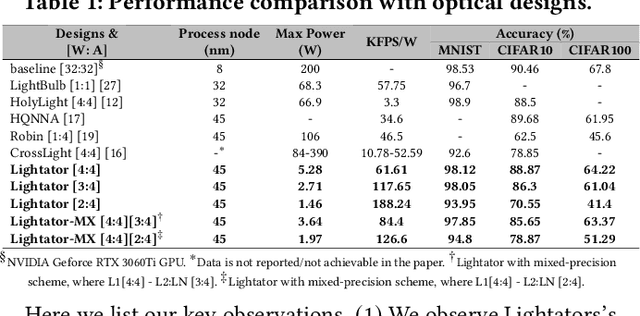


This paper proposes a high-performance and energy-efficient optical near-sensor accelerator for vision applications, called Lightator. Harnessing the promising efficiency offered by photonic devices, Lightator features innovative compressive acquisition of input frames and fine-grained convolution operations for low-power and versatile image processing at the edge for the first time. This will substantially diminish the energy consumption and latency of conversion, transmission, and processing within the established cloud-centric architecture as well as recently designed edge accelerators. Our device-to-architecture simulation results show that with favorable accuracy, Lightator achieves 84.4 Kilo FPS/W and reduces power consumption by a factor of ~24x and 73x on average compared with existing photonic accelerators and GPU baseline.
OISA: Architecting an Optical In-Sensor Accelerator for Efficient Visual Computing
Nov 30, 2023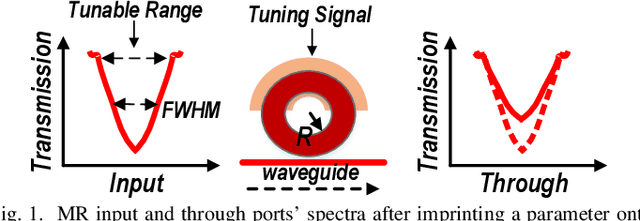
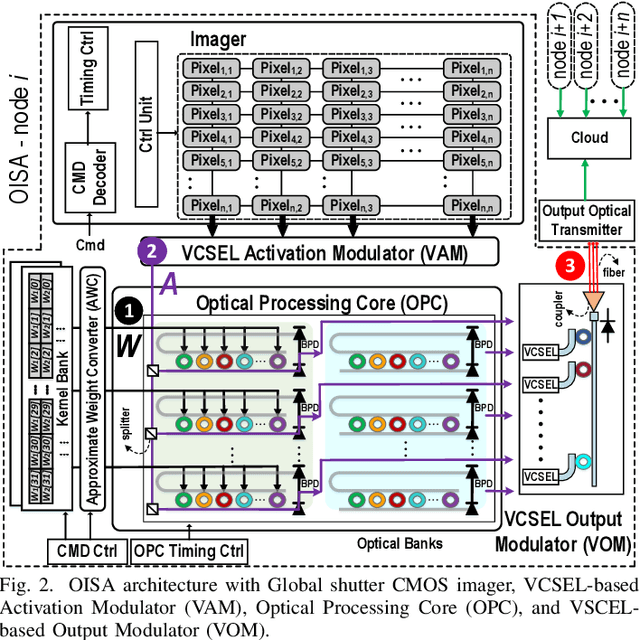
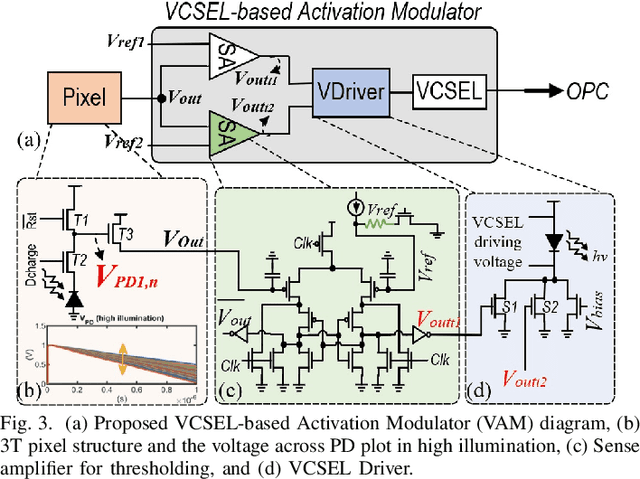
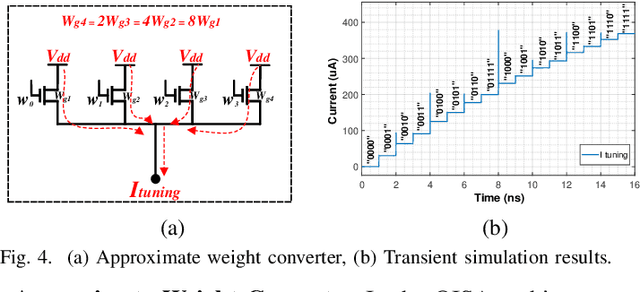
Targeting vision applications at the edge, in this work, we systematically explore and propose a high-performance and energy-efficient Optical In-Sensor Accelerator architecture called OISA for the first time. Taking advantage of the promising efficiency of photonic devices, the OISA intrinsically implements a coarse-grained convolution operation on the input frames in an innovative minimum-conversion fashion in low-bit-width neural networks. Such a design remarkably reduces the power consumption of data conversion, transmission, and processing in the conventional cloud-centric architecture as well as recently-presented edge accelerators. Our device-to-architecture simulation results on various image data-sets demonstrate acceptable accuracy while OISA achieves 6.68 TOp/s/W efficiency. OISA reduces power consumption by a factor of 7.9 and 18.4 on average compared with existing electronic in-/near-sensor and ASIC accelerators.