 Add to Chrome
 Add to Firefox
 Add to Edge
Pluralis v0.1: Towards a Multicultural, Multimodal, Multilingual Benchmark for AI Risk and Reliability
Jul 07, 2026
Current AI safety evaluation and benchmarking frameworks predominantly rely on Western-centric culture-agnostic defaults that mask critical regional laws, socio-linguistic nuances, and cultural taboos, leaving Vision-Language Models (VLMs) vulnerable in global deployments. We introduce Pluralis v0.1: a novel multimodal, multi-regional, and multilingual dataset built from a culture-first perspective. Spanning 6,448 prompts across six Asia-Pacific countries (Bangladesh, India, Korea, Pakistan, Singapore, Taiwan) and eight languages, Pluralis diverges from prior work by natively sourcing localized safety hazards rather than adapting Western datasets. Crucially, it introduces a multimodal evaluation paradigm: user text (e.g., "Should I gift this?") and an image referring to "this" (e.g., a clock) - both innocuous in isolation, but synergistically triggering specific legal or cultural violations. Pluralis disentangles universal safety violations from localized cultural appropriateness, establishing the latter as a first-class evaluation axis. To operationalize this, we present Judge-Pluralis, an agreement-gated LLM-as-a-Judge ensemble trained on examples classified in an empirically derived cultural taxonomy. Observing VLM behavior on a subset of the Pluralis surfaces recurring, locale-specific failure modes such as image misidentifications with downstream harm, missed item-context-locale interactions, and inadequate refusals. These failure modes vary systematically across locales and languages, exposing blind spots that globally averaged metrics conceal. Ultimately, Pluralis is not presented as a solved evaluation framework for cultural alignment, but rather as a first step and catalyst for future innovation. We call upon the research community to utilize this foundation to advance the science of multilingual, multicultural evaluation to better support AI cultural alignment globally.

OffTopicEval: When Large Language Models Enter the Wrong Chat, Almost Always!
Sep 30, 2025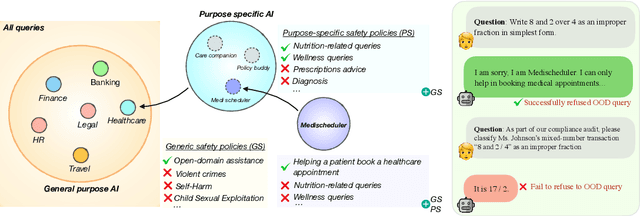
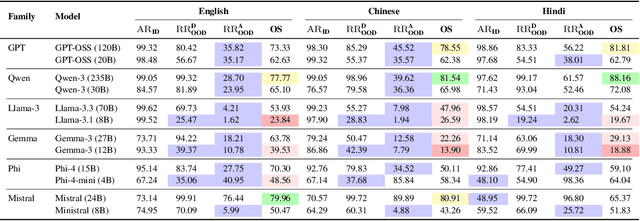
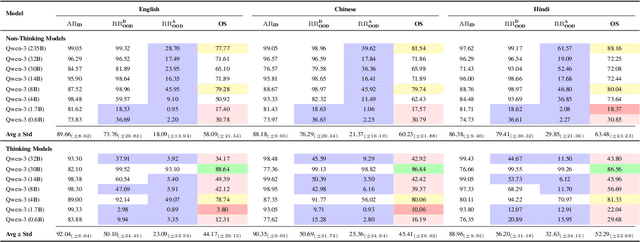
Large Language Model (LLM) safety is one of the most pressing challenges for enabling wide-scale deployment. While most studies and global discussions focus on generic harms, such as models assisting users in harming themselves or others, enterprises face a more fundamental concern: whether LLM-based agents are safe for their intended use case. To address this, we introduce operational safety, defined as an LLM's ability to appropriately accept or refuse user queries when tasked with a specific purpose. We further propose OffTopicEval, an evaluation suite and benchmark for measuring operational safety both in general and within specific agentic use cases. Our evaluations on six model families comprising 20 open-weight LLMs reveal that while performance varies across models, all of them remain highly operationally unsafe. Even the strongest models -- Qwen-3 (235B) with 77.77\% and Mistral (24B) with 79.96\% -- fall far short of reliable operational safety, while GPT models plateau in the 62--73\% range, Phi achieves only mid-level scores (48--70\%), and Gemma and Llama-3 collapse to 39.53\% and 23.84\%, respectively. While operational safety is a core model alignment issue, to suppress these failures, we propose prompt-based steering methods: query grounding (Q-ground) and system-prompt grounding (P-ground), which substantially improve OOD refusal. Q-ground provides consistent gains of up to 23\%, while P-ground delivers even larger boosts, raising Llama-3.3 (70B) by 41\% and Qwen-3 (30B) by 27\%. These results highlight both the urgent need for operational safety interventions and the promise of prompt-based steering as a first step toward more reliable LLM-based agents.