 Add to Chrome
 Add to Firefox
 Add to Edge
SpeechDx: A Multi-Task Benchmark for Clinical Speech AI
Jun 15, 2026
Speech offers a uniquely informative window into health by simultaneously engaging neurological, motor, respiratory, and vocal systems. Current clinical speech AI methods have largely progressed through isolated condition-specific studies, making results difficult to compare and generalization difficult to assess. We introduce SpeechDx, a large-scale benchmark for clinical speech AI spanning 12 datasets and 27 tasks across diverse health conditions. To enable evaluation across shared clinical mechanisms, SpeechDx structures tasks by the stage of speech production they disrupt: conceptualization, formulation, and articulation. The benchmark tests generalization by including tasks with limited labeled data and evaluating the same health condition across multiple datasets, distinguishing clinically meaningful patterns from dataset artefacts. We systematically evaluate 12 state-of-the-art audio encoders across all tasks and under zero-shot cross-condition transfer. Results show that large-scale speech models represent the strongest overall baselines, domain-specific models improve performance only on closely matched tasks, and no current representation generalizes reliably across the clinical speech landscape. SpeechDx establishes a shared evaluation framework for tracking progress toward general-purpose clinical speech representations

PAI-BPR: Personalized Outfit Recommendation Scheme with Attribute-wise Interpretability
Aug 04, 2020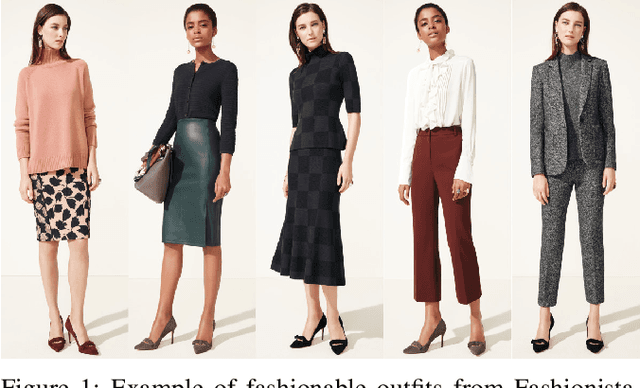
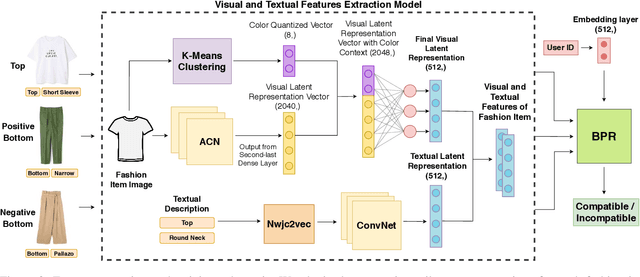
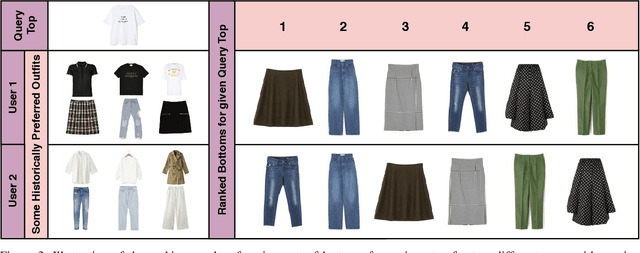
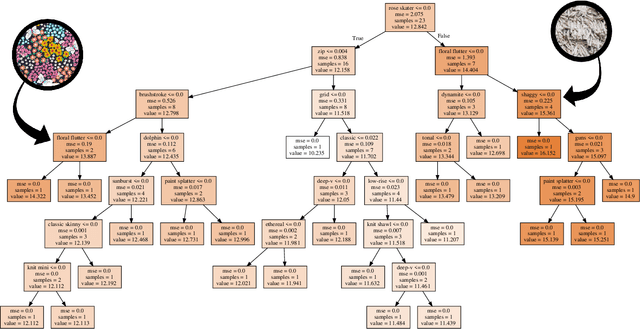
Fashion is an important part of human experience. Events such as interviews, meetings, marriages, etc. are often based on clothing styles. The rise in the fashion industry and its effect on social influencing have made outfit compatibility a need. Thus, it necessitates an outfit compatibility model to aid people in clothing recommendation. However, due to the highly subjective nature of compatibility, it is necessary to account for personalization. Our paper devises an attribute-wise interpretable compatibility scheme with personal preference modelling which captures user-item interaction along with general item-item interaction. Our work solves the problem of interpretability in clothing matching by locating the discordant and harmonious attributes between fashion items. Extensive experiment results on IQON3000, a publicly available real-world dataset, verify the effectiveness of the proposed model.