 Add to Chrome
 Add to Firefox
 Add to Edge
Temporal Feature Extractors in EEG Foundation Models: A Controlled Comparison Including a Pretrained Time-Series Model
Jun 29, 2026
Electroencephalography (EEG) foundation models aim to learn generalizable representations from large-scale brain recordings. However, the role of temporal feature extractors and whether pretrained time-series foundation models (TSFMs) can be effectively transferred to this setting remains underexplored. We conduct a controlled comparison of three temporal feature extraction strategies, including a linear baseline, a convolutional encoder, and a frozen pretrained TSFM (MOMENT), within a unified EEG foundation model. We evaluate their impact on representation quality using two downstream tasks: motor imagery and emotion recognition. Results reveal different trends across the evaluated benchmarks. On the motor imagery dataset, simple temporal representations perform competitively, whereas the emotion dataset benefits from richer temporal modeling. Although not specifically adapted to EEG, the pretrained TSFM serves as an effective temporal feature extractor, suggesting that general-purpose time-series representations can be transferred as frozen temporal feature extractors within EEG foundation models.

Zero-Shot Test-Time Canonicalization using Out-of-Distribution Scoring
Jun 23, 2026Pretrained vision models often misclassify inputs that are rotated, scaled, or sheared, even though these affine transformations leave the object class unchanged. Robustness is usually restored either by building equivariance into the architecture or by retraining with augmentation, both of which require changing or retraining the model. Test-time canonicalization instead leaves the classifier untouched. It undoes the transformation of each input, mapping it to a canonical form near the training distribution before classification. Existing canonicalizers, however, rely on a narrow set of logit-based energy scores and bespoke search procedures, leaving the design space of scoring functions and optimizers unexplored. We reframe canonicalization as out-of-distribution (OOD) detection, which lets any OOD score serve as the energy minimized over transformations. Across benchmarks ranging from handwritten characters and sketches to natural images and 3D point clouds, we systematically evaluate around twenty OOD scores and nine search algorithms, finding that distance-based scores paired with random search and local refinement perform best overall. Because canonicalizing an already-aligned input can hurt accuracy, we add a gated mechanism that transforms an input only when its OOD score indicates this is needed, preserving most in-distribution accuracy while retaining the robustness gains on transformed inputs. Code is available at github.com/johschm/its.
Benchmarking Positional Encoding Strategies for Transformer-Based EEG Foundation Models
May 28, 2026Electroencephalography (EEG) is a widely used non-invasive technique for measuring brain activity in brain-computer interface (BCI) applications. Supervised EEG decoding models often struggle to generalize across tasks, subjects, and datasets, motivating transformer-based EEG foundation models trained with self-supervised learning. Since transformers are permutation-invariant, they require explicit positional information. Unlike textual tokens, EEG electrodes are spatially distributed across the scalp, raising the question of how electrode positions should be encoded in transformer-based EEG models. In this study, we benchmark five positional encoding strategies within the CBraMod backbone and evaluate them under linear probing and fine-tuning protocols on motor imagery classification and emotion recognition. Our results show that no single strategy consistently outperforms across tasks. Spherical Positional Encoding (SPE) yields strong representations for motor imagery but underperforms on emotion recognition, while Asymmetric Conditional Positional Encoding (ACPE) demonstrates more consistent performance across tasks. These findings suggest that the optimal positional encoding strategy is task-dependent, with no universal solution across EEG decoding scenarios.
DDSP-QbE++: Improving Speech Quality for Speech Anonymisation for Atypical Speech
Apr 10, 2026Differentiable Digital Signal Processing (DDSP) pipelines for voice conversion rely on subtractive synthesis, where a periodic excitation signal is shaped by a learned spectral envelope to reconstruct the target voice. In DDSP-QbE, the excitation is generated via phase accumulation, producing a sawtooth-like waveform whose abrupt discontinuities introduce aliasing artefacts that manifest perceptually as buzziness and spectral distortion, particularly at higher fundamental frequencies. We propose two targeted improvements to the excitation stage of the DDSP-QbE subtractive synthesizer. First, we incorporate explicit voicing detection to gate the harmonic excitation, suppressing the periodic component in unvoiced regions and replacing it with filtered noise, thereby avoiding aliased harmonic content where it is most perceptually disruptive. Second, we apply Polynomial Band-Limited Step (PolyBLEP) correction to the phase-accumulated oscillator, substituting the hard waveform discontinuity at each phase wrap with a smooth polynomial residual that cancels alias-generating components without oversampling or spectral truncation. Together, these modifications yield a cleaner harmonic roll-off, reduced high-frequency artefacts, and improved perceptual naturalness, as measured by MOS. The proposed approach is lightweight, differentiable, and integrates seamlessly into the existing DDSP-QbE training pipeline with no additional learnable parameters.
Saccadic Vision for Fine-Grained Visual Classification
Sep 19, 2025Fine-grained visual classification (FGVC) requires distinguishing between visually similar categories through subtle, localized features - a task that remains challenging due to high intra-class variability and limited inter-class differences. Existing part-based methods often rely on complex localization networks that learn mappings from pixel to sample space, requiring a deep understanding of image content while limiting feature utility for downstream tasks. In addition, sampled points frequently suffer from high spatial redundancy, making it difficult to quantify the optimal number of required parts. Inspired by human saccadic vision, we propose a two-stage process that first extracts peripheral features (coarse view) and generates a sample map, from which fixation patches are sampled and encoded in parallel using a weight-shared encoder. We employ contextualized selective attention to weigh the impact of each fixation patch before fusing peripheral and focus representations. To prevent spatial collapse - a common issue in part-based methods - we utilize non-maximum suppression during fixation sampling to eliminate redundancy. Comprehensive evaluation on standard FGVC benchmarks (CUB-200-2011, NABirds, Food-101 and Stanford-Dogs) and challenging insect datasets (EU-Moths, Ecuador-Moths and AMI-Moths) demonstrates that our method achieves comparable performance to state-of-the-art approaches while consistently outperforming our baseline encoder.
From Lines to Shapes: Geometric-Constrained Segmentation of X-Ray Collimators via Hough Transform
Sep 04, 2025Collimation in X-ray imaging restricts exposure to the region-of-interest (ROI) and minimizes the radiation dose applied to the patient. The detection of collimator shadows is an essential image-based preprocessing step in digital radiography posing a challenge when edges get obscured by scattered X-ray radiation. Regardless, the prior knowledge that collimation forms polygonal-shaped shadows is evident. For this reason, we introduce a deep learning-based segmentation that is inherently constrained to its geometry. We achieve this by incorporating a differentiable Hough transform-based network to detect the collimation borders and enhance its capability to extract the information about the ROI center. During inference, we combine the information of both tasks to enable the generation of refined, line-constrained segmentation masks. We demonstrate robust reconstruction of collimated regions achieving median Hausdorff distances of 4.3-5.0mm on diverse test sets of real Xray images. While this application involves at most four shadow borders, our method is not fundamentally limited by a specific number of edges.
Generative AI Training and Copyright Law
Feb 21, 2025Training generative AI models requires extensive amounts of data. A common practice is to collect such data through web scraping. Yet, much of what has been and is collected is copyright protected. Its use may be copyright infringement. In the USA, AI developers rely on "fair use" and in Europe, the prevailing view is that the exception for "Text and Data Mining" (TDM) applies. In a recent interdisciplinary tandem-study, we have argued in detail that this is actually not the case because generative AI training fundamentally differs from TDM. In this article, we share our main findings and the implications for both public and corporate research on generative models. We further discuss how the phenomenon of training data memorization leads to copyright issues independently from the "fair use" and TDM exceptions. Finally, we outline how the ISMIR could contribute to the ongoing discussion about fair practices with respect to generative AI that satisfy all stakeholders.
TransferLight: Zero-Shot Traffic Signal Control on any Road-Network
Dec 12, 2024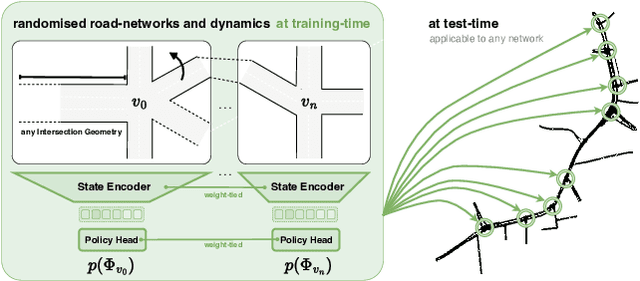
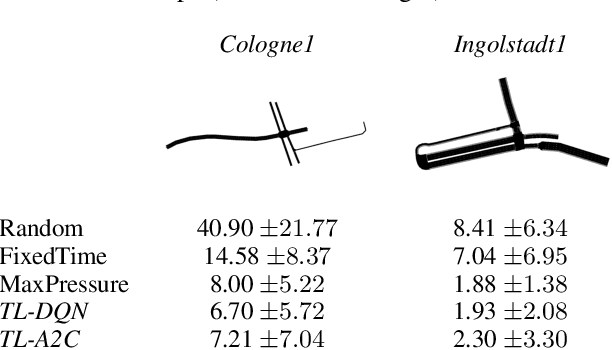
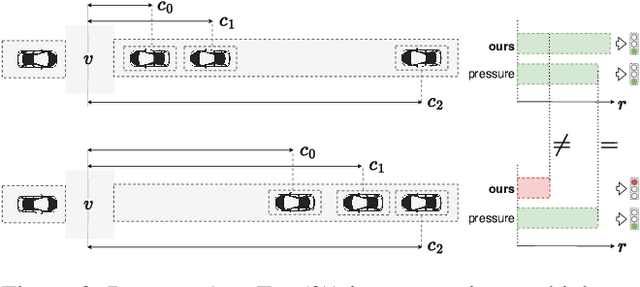
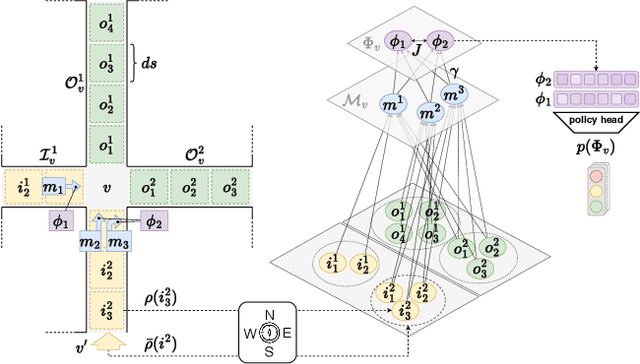
Traffic signal control plays a crucial role in urban mobility. However, existing methods often struggle to generalize beyond their training environments to unseen scenarios with varying traffic dynamics. We present TransferLight, a novel framework designed for robust generalization across road-networks, diverse traffic conditions and intersection geometries. At its core, we propose a log-distance reward function, offering spatially-aware signal prioritization while remaining adaptable to varied lane configurations - overcoming the limitations of traditional pressure-based rewards. Our hierarchical, heterogeneous, and directed graph neural network architecture effectively captures granular traffic dynamics, enabling transferability to arbitrary intersection layouts. Using a decentralized multi-agent approach, global rewards, and novel state transition priors, we develop a single, weight-tied policy that scales zero-shot to any road network without re-training. Through domain randomization during training, we additionally enhance generalization capabilities. Experimental results validate TransferLight's superior performance in unseen scenarios, advancing practical, generalizable intelligent transportation systems to meet evolving urban traffic demands.
An Interpretable X-ray Style Transfer via Trainable Local Laplacian Filter
Nov 11, 2024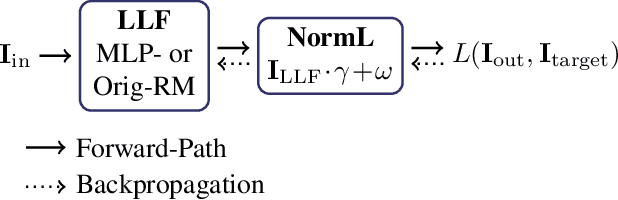
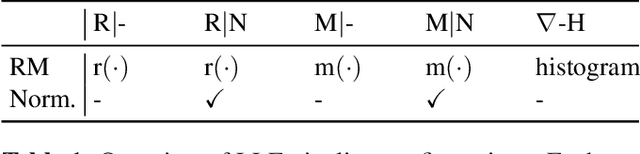
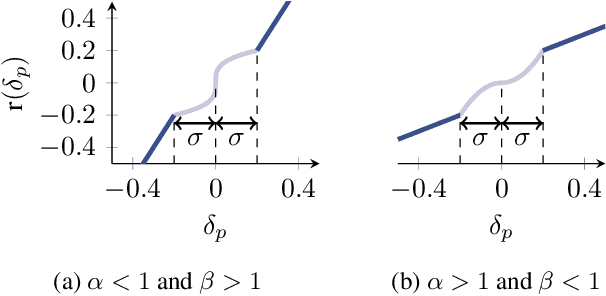

Radiologists have preferred visual impressions or 'styles' of X-ray images that are manually adjusted to their needs to support their diagnostic performance. In this work, we propose an automatic and interpretable X-ray style transfer by introducing a trainable version of the Local Laplacian Filter (LLF). From the shape of the LLF's optimized remap function, the characteristics of the style transfer can be inferred and reliability of the algorithm can be ensured. Moreover, we enable the LLF to capture complex X-ray style features by replacing the remap function with a Multi-Layer Perceptron (MLP) and adding a trainable normalization layer. We demonstrate the effectiveness of the proposed method by transforming unprocessed mammographic X-ray images into images that match the style of target mammograms and achieve a Structural Similarity Index (SSIM) of 0.94 compared to 0.82 of the baseline LLF style transfer method from Aubry et al.
Improving Voice Quality in Speech Anonymization With Just Perception-Informed Losses
Oct 20, 2024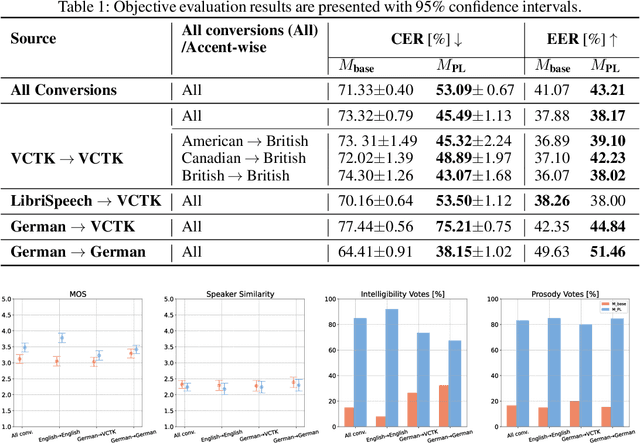

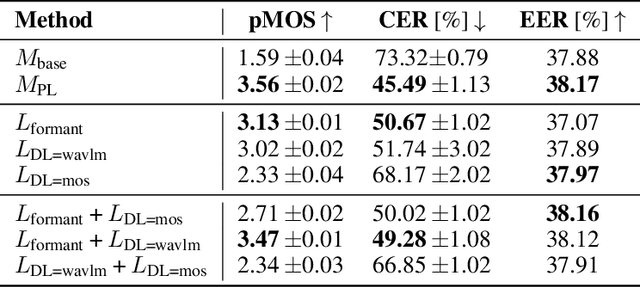
The increasing use of cloud-based speech assistants has heightened the need for effective speech anonymization, which aims to obscure a speaker's identity while retaining critical information for subsequent tasks. One approach to achieving this is through voice conversion. While existing methods often emphasize complex architectures and training techniques, our research underscores the importance of loss functions inspired by the human auditory system. Our proposed loss functions are model-agnostic, incorporating handcrafted and deep learning-based features to effectively capture quality representations. Through objective and subjective evaluations, we demonstrate that a VQVAE-based model, enhanced with our perception-driven losses, surpasses the vanilla model in terms of naturalness, intelligibility, and prosody while maintaining speaker anonymity. These improvements are consistently observed across various datasets, languages, target speakers, and genders.