 Add to Chrome
 Add to Firefox
 Add to Edge
Review of Machine Learning Models for Solar Energetic Particle Prediction
Jun 17, 2026
Solar energetic particle (SEP) events have attracted increasing attention due to their significant radiation hazards for aviation, spacecraft electronics, and human missions beyond Earth's magnetosphere. From a scientific perspective, SEP events are intriguing because they arise from a set of physical processes extending from the solar surface and corona through the heliosphere, offering insight into particle acceleration and transport mechanisms that are widely applicable across astrophysics. Therefore, advancing our ability to understand and predict SEP events is essential both for deepening our knowledge of such mechanisms and for safeguarding space technologies and exploration. Traditionally, researchers have modeled SEPs using physics-based simulations and empirical methods. More recently, machine learning (ML) has emerged as a new tool for understanding and predicting SEP events. The purpose of this manuscript is to review the currently available ML models for SEP prediction, identify the datasets used for training, compare their architectures, inputs, and outputs, and, based on these insights, outline good practices and recommendations for future research.

Adaptive PCA-Based Outlier Detection for Multi-Feature Time Series in Space Missions
Apr 22, 2025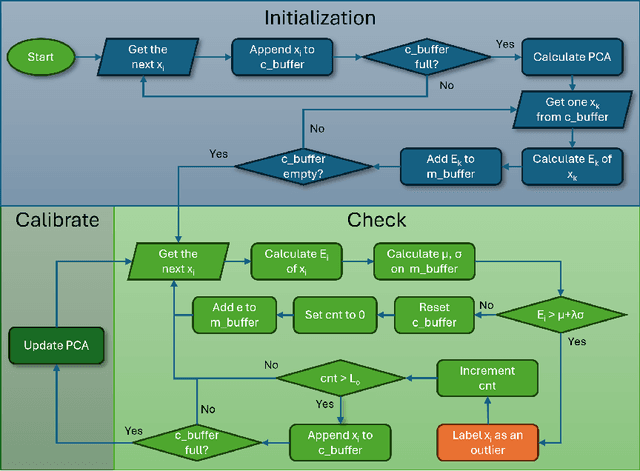
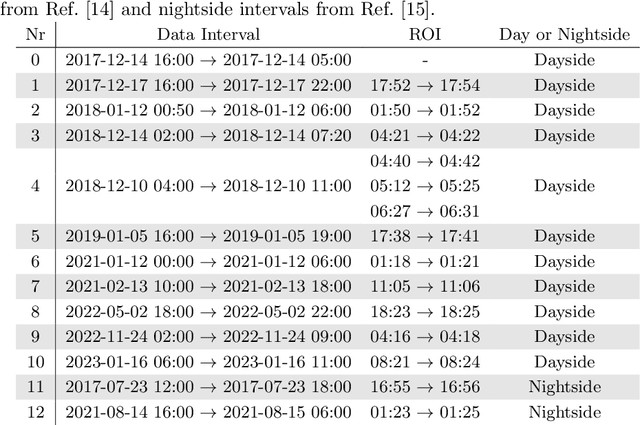
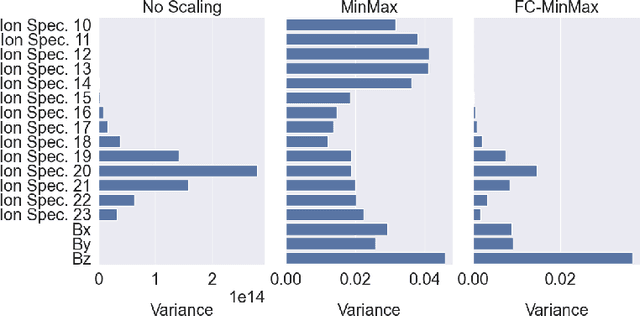
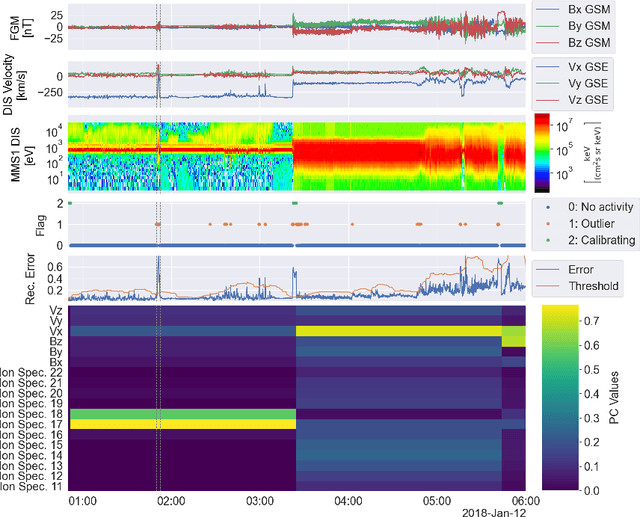
Analyzing multi-featured time series data is critical for space missions making efficient event detection, potentially onboard, essential for automatic analysis. However, limited onboard computational resources and data downlink constraints necessitate robust methods for identifying regions of interest in real time. This work presents an adaptive outlier detection algorithm based on the reconstruction error of Principal Component Analysis (PCA) for feature reduction, designed explicitly for space mission applications. The algorithm adapts dynamically to evolving data distributions by using Incremental PCA, enabling deployment without a predefined model for all possible conditions. A pre-scaling process normalizes each feature's magnitude while preserving relative variance within feature types. We demonstrate the algorithm's effectiveness in detecting space plasma events, such as distinct space environments, dayside and nightside transients phenomena, and transition layers through NASA's MMS mission observations. Additionally, we apply the method to NASA's THEMIS data, successfully identifying a dayside transient using onboard-available measurements.