 Add to Chrome
 Add to Firefox
 Add to Edge
Review of Machine Learning Models for Solar Energetic Particle Prediction
Jun 17, 2026
Solar energetic particle (SEP) events have attracted increasing attention due to their significant radiation hazards for aviation, spacecraft electronics, and human missions beyond Earth's magnetosphere. From a scientific perspective, SEP events are intriguing because they arise from a set of physical processes extending from the solar surface and corona through the heliosphere, offering insight into particle acceleration and transport mechanisms that are widely applicable across astrophysics. Therefore, advancing our ability to understand and predict SEP events is essential both for deepening our knowledge of such mechanisms and for safeguarding space technologies and exploration. Traditionally, researchers have modeled SEPs using physics-based simulations and empirical methods. More recently, machine learning (ML) has emerged as a new tool for understanding and predicting SEP events. The purpose of this manuscript is to review the currently available ML models for SEP prediction, identify the datasets used for training, compare their architectures, inputs, and outputs, and, based on these insights, outline good practices and recommendations for future research.

SolARED: Solar Active Region Emergence Dataset for Machine Learning Aided Predictions
Jan 19, 2026The development of accurate forecasts of solar eruptive activity has become increasingly important for preventing potential impacts on space technologies and exploration. Therefore, it is crucial to detect Active Regions (ARs) before they start forming on the solar surface. This will enable the development of early-warning capabilities for upcoming space weather disturbances. For this reason, we prepared the Solar Active Region Emergence Dataset (SolARED). The dataset is derived from full-disk maps of the Doppler velocity, magnetic field, and continuum intensity, obtained by the Helioseismic and Magnetic Imager (HMI) onboard the Solar Dynamics Observatory (SDO). SolARED includes time series of remapped, tracked, and binned data that characterize the evolution of acoustic power of solar oscillations, unsigned magnetic flux, and continuum intensity for 50 large ARs before, during, and after their emergence on the solar surface, as well as surrounding areas observed on the solar disc between 2010 and 2023. The resulting ML-ready SolARED dataset is designed to support enhancements of predictive capabilities, enabling the development of operational forecasts for the emergence of active regions. The SolARED dataset is available at https://sun.njit.edu/sarportal/, through an interactive visualization web application.
Forecasting Continuum Intensity for Solar Active Region Emergence Prediction using Transformers
Jan 19, 2026Early and accurate prediction of solar active region (AR) emergence is crucial for space weather forecasting. Building on established Long Short-Term Memory (LSTM) based approaches for forecasting the continuum intensity decrease associated with AR emergence, this work expands the modeling with new architectures and targets. We investigate a sliding-window Transformer architecture to forecast continuum intensity evolution up to 12 hours ahead using data from 46 ARs observed by SDO/HMI. We conduct a systematic ablation study to evaluate two key components: (1) the inclusion of a temporal 1D convolutional (Conv1D) front-end and (2) a novel `Early Detection' architecture featuring attention biases and a timing-aware loss function. Our best-performing model, combining the Early Detection architecture without the Conv1D layer, achieved a Root Mean Square Error (RMSE) of 0.1189 (representing a 10.6% improvement over the LSTM baseline) and an average advance warning time of 4.73 hours (timing difference of -4.73h), even under a stricter emergence criterion than previous studies. While the Transformer demonstrates superior aggregate timing and accuracy, we note that this high-sensitivity detection comes with increased variance compared to smoother baseline models. However, this volatility is a necessary trade-off for operational warning systems: the model's ability to detect micro-changes in precursor signals enables significantly earlier detection, outweighing the cost of increased noise. Our results demonstrate that Transformer architectures modified with early detection biases, when used without temporal smoothing layers, provide a high-sensitivity alternative for forecasting AR emergence that prioritizes advance warning over statistical smoothness.
Solar Active Regions Emergence Prediction Using Long Short-Term Memory Networks
Sep 25, 2024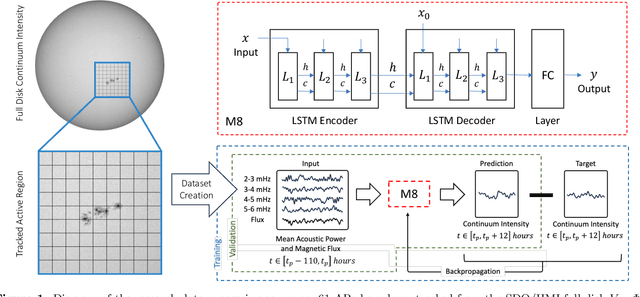
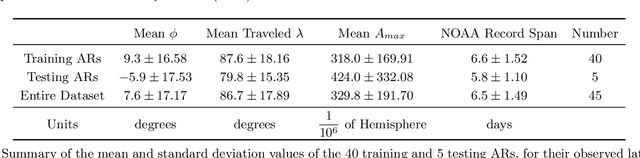
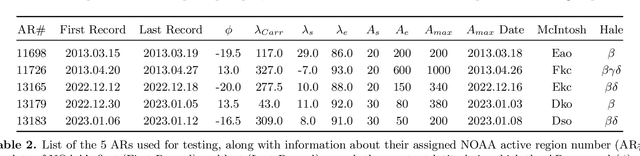
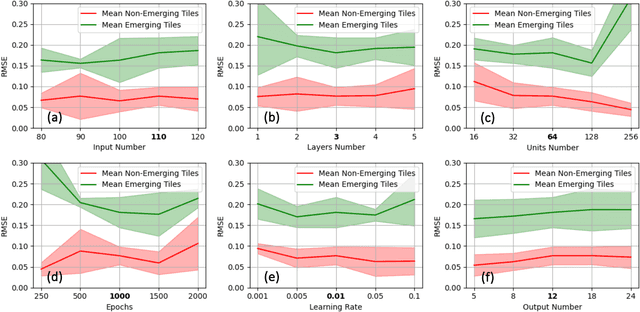
We developed Long Short-Term Memory (LSTM) models to predict the formation of active regions (ARs) on the solar surface. Using the Doppler shift velocity, the continuum intensity, and the magnetic field observations from the Solar Dynamics Observatory (SDO) Helioseismic and Magnetic Imager (HMI), we have created time-series datasets of acoustic power and magnetic flux, which are used to train LSTM models on predicting continuum intensity, 12 hours in advance. These novel machine learning (ML) models are able to capture variations of the acoustic power density associated with upcoming magnetic flux emergence and continuum intensity decrease. Testing of the models' performance was done on data for 5 ARs, unseen from the models during training. Model 8, the best performing model trained, was able to make a successful prediction of emergence for all testing active regions in an experimental setting and three of them in an operational. The model predicted the emergence of AR11726, AR13165, and AR13179 respectively 10, 29, and 5 hours in advance, and variations of this model achieved average RMSE values of 0.11 for both active and quiet areas on the solar disc. This work sets the foundations for ML-aided prediction of solar ARs.
Forecasting SEP Events During Solar Cycles 23 and 24 Using Interpretable Machine Learning
Mar 04, 2024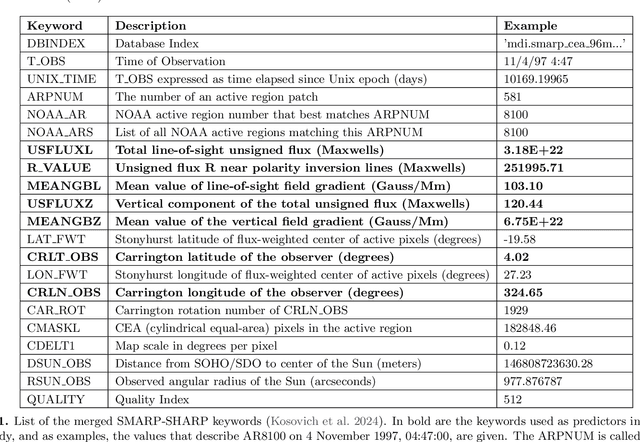
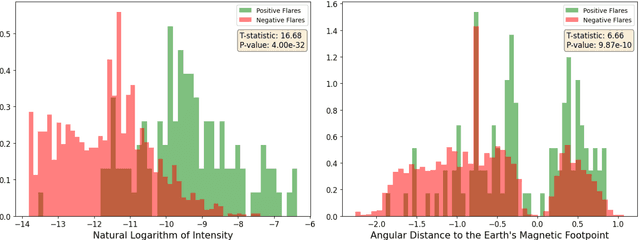
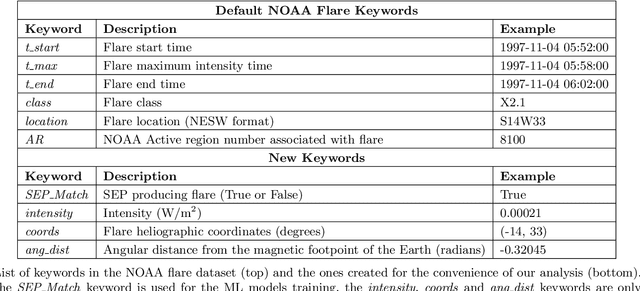
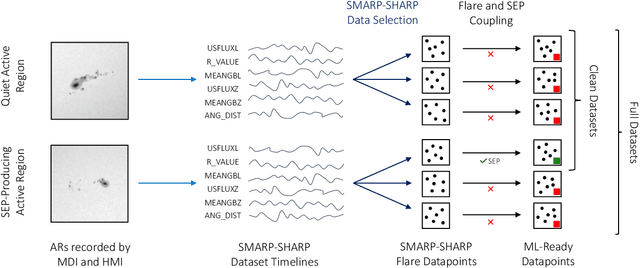
Prediction of the Solar Energetic Particle (SEP) events garner increasing interest as space missions extend beyond Earth's protective magnetosphere. These events, which are, in most cases, products of magnetic reconnection-driven processes during solar flares or fast coronal-mass-ejection-driven shock waves, pose significant radiation hazards to aviation, space-based electronics, and particularly, space exploration. In this work, we utilize the recently developed dataset that combines the Solar Dynamics Observatory/Helioseismic and Magnetic Imager's (SDO/HMI) Space weather HMI Active Region Patches (SHARP) and the Solar and Heliospheric Observatory/Michelson Doppler Imager's (SoHO/MDI) Space Weather MDI Active Region Patches (SMARP). We employ a suite of machine learning strategies, including Support Vector Machines (SVM) and regression models, to evaluate the predictive potential of this new data product for a forecast of post-solar flare SEP events. Our study indicates that despite the augmented volume of data, the prediction accuracy reaches 0.7 +- 0.1, which aligns with but does not exceed these published benchmarks. A linear SVM model with training and testing configurations that mimic an operational setting (positive-negative imbalance) reveals a slight increase (+ 0.04 +- 0.05) in the accuracy of a 14-hour SEP forecast compared to previous studies. This outcome emphasizes the imperative for more sophisticated, physics-informed models to better understand the underlying processes leading to SEP events.
Predicting the Emergence of Solar Active Regions Using Machine Learning
Feb 14, 2024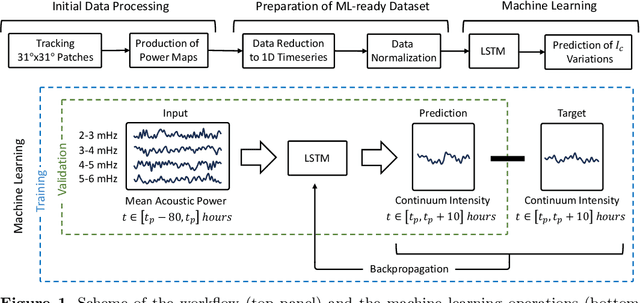
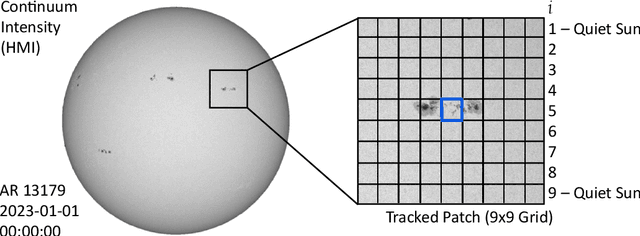
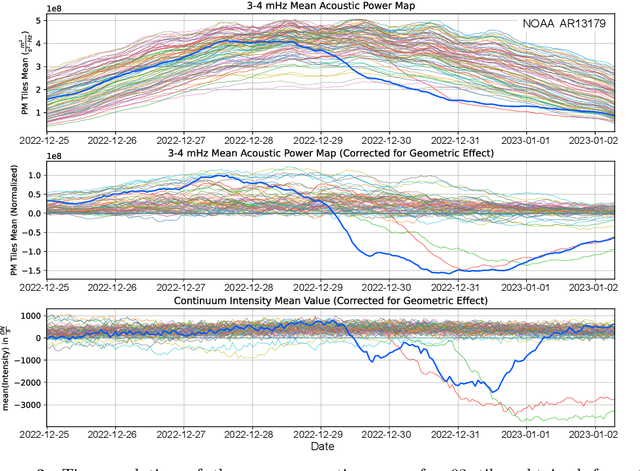
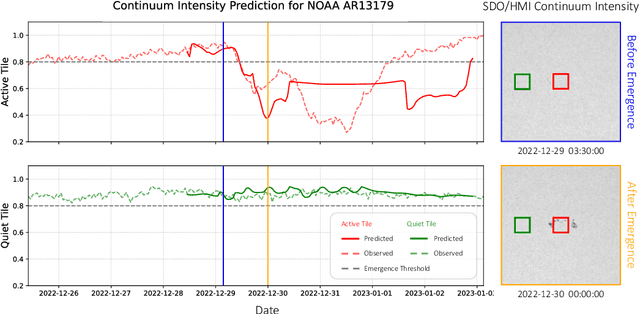
To create early warning capabilities for upcoming Space Weather disturbances, we have selected a dataset of 61 emerging active regions, which allows us to identify characteristic features in the evolution of acoustic power density to predict continuum intensity emergence. For our study, we have utilized Doppler shift and continuum intensity observations from the Helioseismic and Magnetic Imager (HMI) onboard the Solar Dynamics Observatory (SDO). The local tracking of 30.66 x 30.66-degree patches in the vicinity of active regions allowed us to trace the evolution of active regions starting from the pre-emergence state. We have developed a machine learning model to capture the acoustic power flux density variations associated with upcoming magnetic flux emergence. The trained Long Short-Term Memory (LSTM) model is able to predict 5 hours ahead whether, in a given area of the solar surface, continuum intensity values will decrease. The performed study allows us to investigate the potential of the machine learning approach to predict the emergence of active regions using acoustic power maps as input.
Using ROC and Unlabeled Data for Increasing Low-Shot Transfer Learning Classification Accuracy
Oct 01, 2020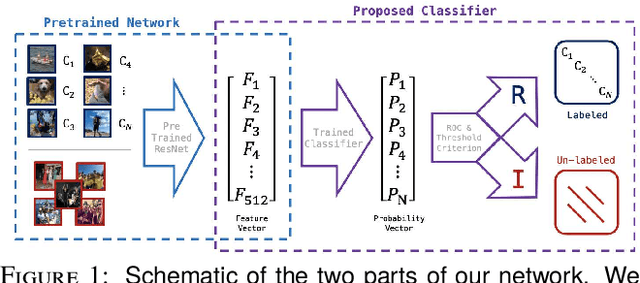
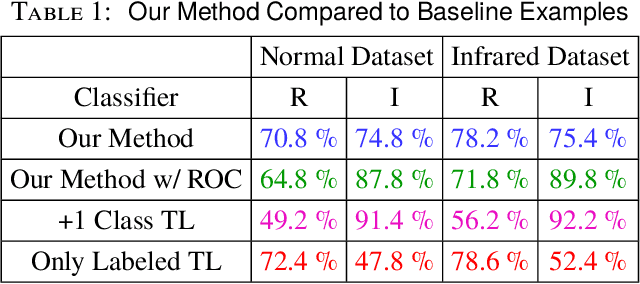
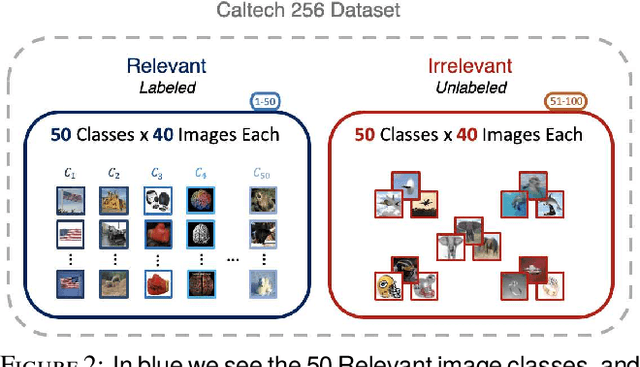
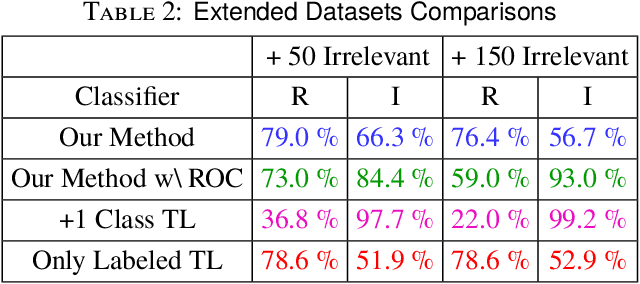
One of the most important characteristics of human visual intelligence is the ability to identify unknown objects. The capability to distinguish between a substance which a human mind has no previous experience of and a familiar object, is innate to every human. In everyday life, within seconds of seeing an "unknown" object, we are able to categorize it as such without any substantial effort. Convolutional Neural Networks, regardless of how they are trained (i.e. in a conventional manner or through transfer learning) can recognize only the classes that they are trained for. When using them for classification, any candidate image will be placed in one of the available classes. We propose a low-shot classifier which can serve as the top layer to any existing CNN that the feature extractor was already trained. Using a limited amount of labeled data for the type of images which need to be specifically classified along with unlabeled data for all other images, a unique target matrix and a Receiver Operator Curve (ROC) criterion, we are able to increase identification accuracy by up to 30% for the images that do not belong to any specific classes, while retaining the ability to identify images that belong to the specific classes of interest.