 Add to Chrome
 Add to Firefox
 Add to Edge
TRACE: TRajectory Attribution for Automated Context Engineering
Aug 10, 2026
Production AI agents fail when their context sources -- system prompts, knowledge bases, tool descriptions, and procedural skills -- contain errors or gaps. Current maintenance relies on manual log review and ad-hoc debugging, creating a scalability bottleneck as interaction volume grows. We present TRACE (TRajectory Attribution for Automated Context Engineering), an automated feedback loop that mines historical agent trajectories to diagnose and remediate context failures. Our key insight is that trajectories are rich with implicit dissatisfaction signals -- user corrections, rephrasing, abandonment cues -- that reveal precisely where context sources failed, without explicit feedback collection. Unlike model fine-tuning, TRACE operates on the context layer, enabling rapid iteration without retraining. We make four contributions: (1) a trajectory mining framework that systematically extracts diagnostic information from historical agent executions; (2) multi-component causal attribution that extends textual gradients from monolithic prompt optimization to heterogeneous context sources (skills, knowledge bases, tools, prompts); (3) exploratory verification, where agents actively read context sources to distinguish content gaps requiring CREATE from stale content requiring UPDATE, achieving 96% operation accuracy; and (4) a reusable simulation methodology and verifiable benchmark addressing the absence of open datasets for context debugging, with a six-category fault taxonomy, ground truth annotations, and a cross-layer verification protocol. On 60 dissatisfaction traces spanning three complexity tiers (up to 16 execution nodes), TRACE achieves 72.7% root cause attribution and 82% end-to-end fix effectiveness, showing that over 80% of context-layer failures can be automatically diagnosed and remediated by mining historical trajectories, an overlooked resource in production systems.

Outlier-Robust Multi-Model Fitting on Quantum Annealers
Apr 18, 2025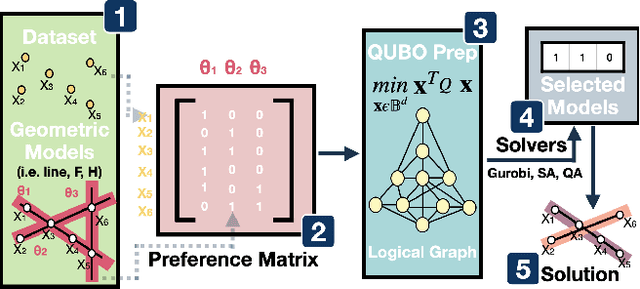
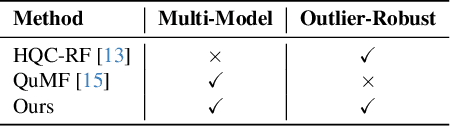
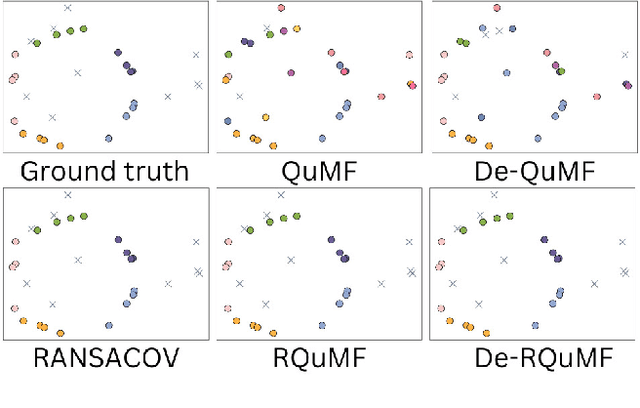
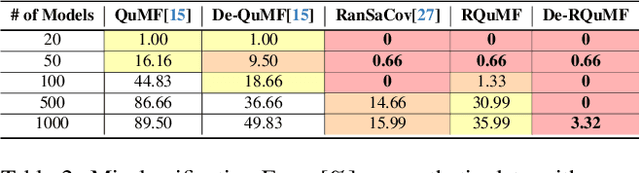
Multi-model fitting (MMF) presents a significant challenge in Computer Vision, particularly due to its combinatorial nature. While recent advancements in quantum computing offer promise for addressing NP-hard problems, existing quantum-based approaches for model fitting are either limited to a single model or consider multi-model scenarios within outlier-free datasets. This paper introduces a novel approach, the robust quantum multi-model fitting (R-QuMF) algorithm, designed to handle outliers effectively. Our method leverages the intrinsic capabilities of quantum hardware to tackle combinatorial challenges inherent in MMF tasks, and it does not require prior knowledge of the exact number of models, thereby enhancing its practical applicability. By formulating the problem as a maximum set coverage task for adiabatic quantum computers (AQC), R-QuMF outperforms existing quantum techniques, demonstrating superior performance across various synthetic and real-world 3D datasets. Our findings underscore the potential of quantum computing in addressing the complexities of MMF, especially in real-world scenarios with noisy and outlier-prone data.
A Three-Stage Self-Training Framework for Semi-Supervised Semantic Segmentation
Dec 01, 2020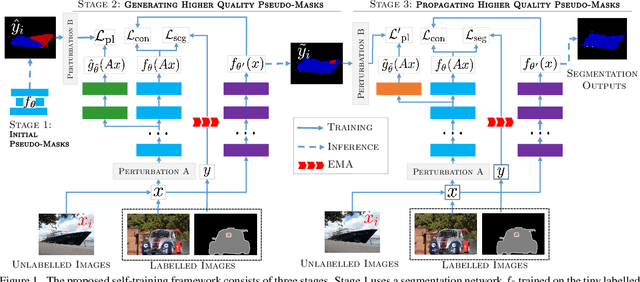
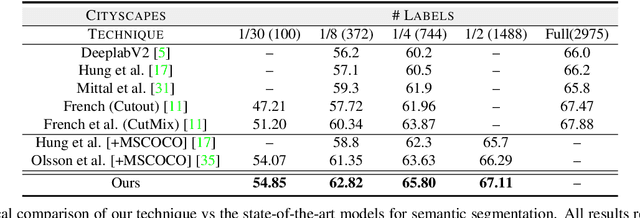
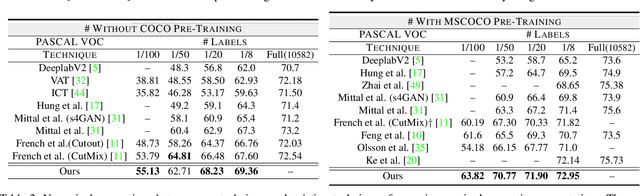
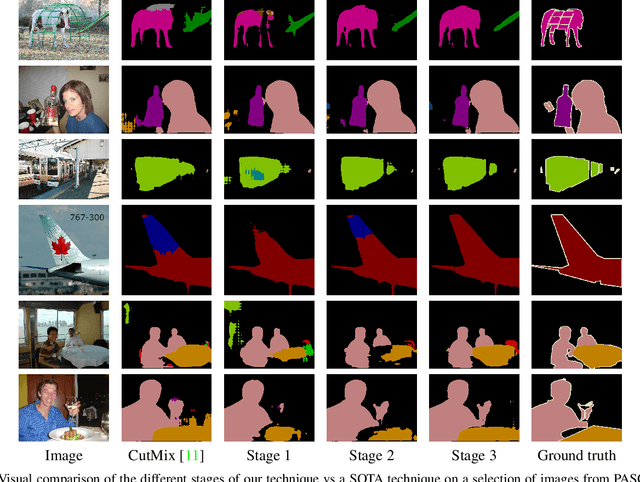
Semantic segmentation has been widely investigated in the community, in which the state of the art techniques are based on supervised models. Those models have reported unprecedented performance at the cost of requiring a large set of high quality segmentation masks. To obtain such annotations is highly expensive and time consuming, in particular, in semantic segmentation where pixel-level annotations are required. In this work, we address this problem by proposing a holistic solution framed as a three-stage self-training framework for semi-supervised semantic segmentation. The key idea of our technique is the extraction of the pseudo-masks statistical information to decrease uncertainty in the predicted probability whilst enforcing segmentation consistency in a multi-task fashion. We achieve this through a three-stage solution. Firstly, we train a segmentation network to produce rough pseudo-masks which predicted probability is highly uncertain. Secondly, we then decrease the uncertainty of the pseudo-masks using a multi-task model that enforces consistency whilst exploiting the rich statistical information of the data. We compare our approach with existing methods for semi-supervised semantic segmentation and demonstrate its state-of-the-art performance with extensive experiments.