 Add to Chrome
 Add to Firefox
 Add to Edge
EarthSpatialBench: Benchmarking Spatial Reasoning Capabilities of Multimodal LLMs on Earth Imagery
Feb 17, 2026
Benchmarking spatial reasoning in multimodal large language models (MLLMs) has attracted growing interest in computer vision due to its importance for embodied AI and other agentic systems that require precise interaction with the physical world. However, spatial reasoning on Earth imagery has lagged behind, as it uniquely involves grounding objects in georeferenced images and quantitatively reasoning about distances, directions, and topological relations using both visual cues and vector geometry coordinates (e.g., 2D bounding boxes, polylines, and polygons). Existing benchmarks for Earth imagery primarily focus on 2D spatial grounding, image captioning, and coarse spatial relations (e.g., simple directional or proximity cues). They lack support for quantitative direction and distance reasoning, systematic topological relations, and complex object geometries beyond bounding boxes. To fill this gap, we propose \textbf{EarthSpatialBench}, a comprehensive benchmark for evaluating spatial reasoning in MLLMs on Earth imagery. The benchmark contains over 325K question-answer pairs spanning: (1) qualitative and quantitative reasoning about spatial distance and direction; (2) systematic topological relations; (3) single-object queries, object-pair queries, and compositional aggregate group queries; and (4) object references expressed via textual descriptions, visual overlays, and explicit geometry coordinates, including 2D bounding boxes, polylines, and polygons. We conducted extensive experiments on both open-source and proprietary models to identify limitations in the spatial reasoning of MLLMs.

Enabling Quick, Accurate Crowdsourced Annotation for Elevation-Aware Flood Extent Mapping
Jul 31, 2024In order to assess damage and properly allocate relief efforts, mapping the extent of flood events is a necessary and important aspect of disaster management. In recent years, deep learning methods have evolved as an effective tool to quickly label high-resolution imagery and provide necessary flood extent mappings. These methods, though, require large amounts of annotated training data to create models that are accurate and robust to new flooded imagery. In this work, we provide FloodTrace, an application that enables effective crowdsourcing for flooded region annotation for machine learning training data, removing the requirement for annotation to be done solely by researchers. We accomplish this through two orthogonal methods within our application, informed by requirements from domain experts. First, we utilize elevation-guided annotation tools and 3D rendering to inform user annotation decisions with digital elevation model data, improving annotation accuracy. For this purpose, we provide a unique annotation method that uses topological data analysis to outperform the state-of-the-art elevation-guided annotation tool in efficiency. Second, we provide a framework for researchers to review aggregated crowdsourced annotations and correct inaccuracies using methods inspired by uncertainty visualization. We conducted a user study to confirm the application effectiveness in which 266 graduate students annotated high-resolution aerial imagery from Hurricane Matthew in North Carolina. Experimental results show the accuracy and efficiency benefits of our application apply even for untrained users. In addition, using our aggregation and correction framework, flood detection models trained on crowdsourced annotations were able to achieve performance equal to models trained on expert-labeled annotations, while requiring a fraction of the time on the part of the researcher.
EvaNet: Elevation-Guided Flood Extent Mapping on Earth Imagery
Apr 27, 2024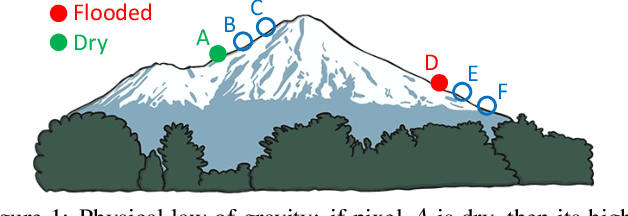
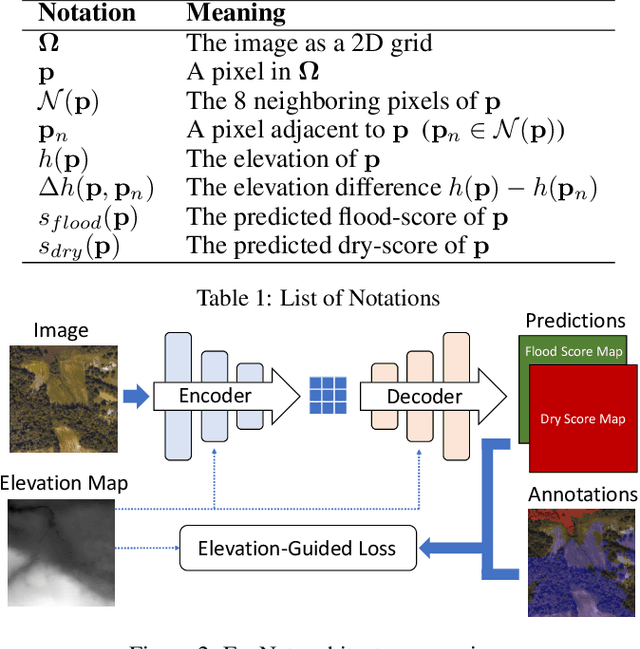
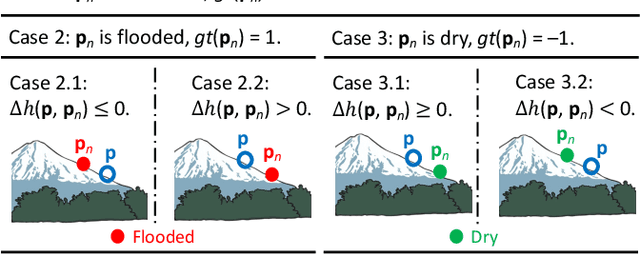
Accurate and timely mapping of flood extent from high-resolution satellite imagery plays a crucial role in disaster management such as damage assessment and relief activities. However, current state-of-the-art solutions are based on U-Net, which can-not segment the flood pixels accurately due to the ambiguous pixels (e.g., tree canopies, clouds) that prevent a direct judgement from only the spectral features. Thanks to the digital elevation model (DEM) data readily available from sources such as United States Geological Survey (USGS), this work explores the use of an elevation map to improve flood extent mapping. We propose, EvaNet, an elevation-guided segmentation model based on the encoder-decoder architecture with two novel techniques: (1) a loss function encoding the physical law of gravity that if a location is flooded (resp. dry), then its adjacent locations with a lower (resp. higher) elevation must also be flooded (resp. dry); (2) a new (de)convolution operation that integrates the elevation map by a location sensitive gating mechanism to regulate how much spectral features flow through adjacent layers. Extensive experiments show that EvaNet significantly outperforms the U-Net baselines, and works as a perfect drop-in replacement for U-Net in existing solutions to flood extent mapping.