 Add to Chrome
 Add to Firefox
 Add to Edge
A Controlled Study of Attention-Only Transformers
Jul 20, 2026
Feed-forward networks hold two thirds of a transformer's non-embedding parameters, yet the architecture has not received a necessity test that controls parameters, compute, and depth at once. We pretrain attention-only decoder transformers (Simple Attention Networks, SANs) against standard transformers matched separately for parameter count, training FLOPs, and depth (2 to 48 layers), for up to 105B tokens at 6M to 87M parameters. Deleting feed-forward layers in place is costly: the standard transformer leads by 0.47 nats at matched depth and 0.26 nats at matched FLOPs. Reallocating the freed budget into attention depth closes the gap: at matched parameters the difference is 0.006 nats (0.27 percent of loss), reproducible to one part in ten thousand across seed pairs, shrinking across 5B, 30B, and 105B budgets, and holding near 0.02 nats across a 29x size range. Three measurements localize the remaining gap to parametric recall: attention-only models are better on context-grounded answers and worse where knowledge must come from weights. Weight spectra show why: routing matrices (Q/K) crystallize early, content matrices accumulate rank slowly, and removing feed-forward layers relocates this accumulation to the attention output projection. QK-normalization, not feed-forward layers or residual gating, keeps 48-layer attention-only stacks trainable. The deficit concentrates on low-context query prediction and localizes there entirely by the largest budget. A pre-registered test confirms the account: it predicts a 0.02 to 0.05 nat gap on knowledge-dense web text; a matched pair trained on fineweb-edu measures 0.040. Within the tested regime, attention does the rest.

SoMoFormer: Multi-Person Pose Forecasting with Transformers
Aug 30, 2022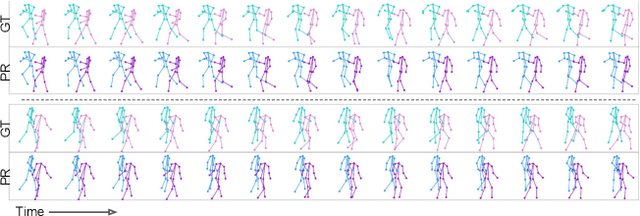
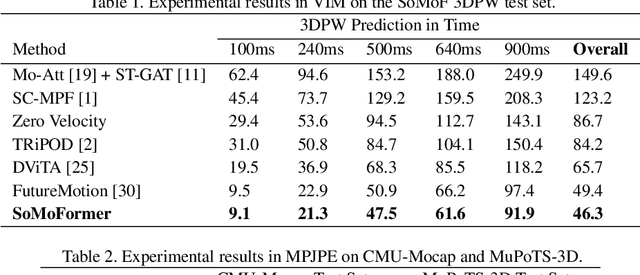
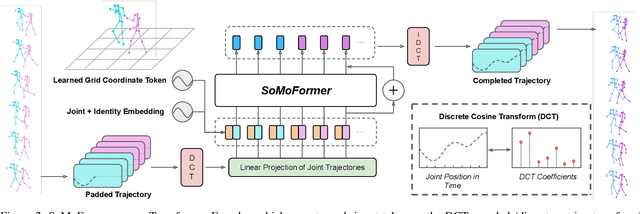
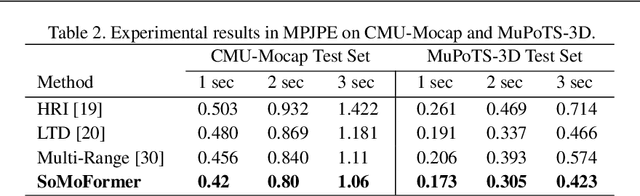
Human pose forecasting is a challenging problem involving complex human body motion and posture dynamics. In cases that there are multiple people in the environment, one's motion may also be influenced by the motion and dynamic movements of others. Although there are several previous works targeting the problem of multi-person dynamic pose forecasting, they often model the entire pose sequence as time series (ignoring the underlying relationship between joints) or only output the future pose sequence of one person at a time. In this paper, we present a new method, called Social Motion Transformer (SoMoFormer), for multi-person 3D pose forecasting. Our transformer architecture uniquely models human motion input as a joint sequence rather than a time sequence, allowing us to perform attention over joints while predicting an entire future motion sequence for each joint in parallel. We show that with this problem reformulation, SoMoFormer naturally extends to multi-person scenes by using the joints of all people in a scene as input queries. Using learned embeddings to denote the type of joint, person identity, and global position, our model learns the relationships between joints and between people, attending more strongly to joints from the same or nearby people. SoMoFormer outperforms state-of-the-art methods for long-term motion prediction on the SoMoF benchmark as well as the CMU-Mocap and MuPoTS-3D datasets. Code will be made available after publication.