 Add to Chrome
 Add to Firefox
 Add to Edge
PAC-Bayes Beyond Parameter Space: Behavioral Equivalence, Z-Information, and Exact Complexity Decomposition
Aug 11, 2026
PAC-Bayes theory provides generalization guarantees by controlling the Kullback--Leibler (KL) divergence between posterior and prior distributions over a chosen hypothesis representation. However, predictive risk depends only on the predictive behavior induced by a hypothesis, not on the particular internal realization that implements that behavior. In over-parameterized systems, many distinct configurations induce identical predictive behavior, yet the classical PAC-Bayes KL divergence does not distinguish uncertainty over predictive behavior from variation among behaviorally equivalent realizations. We show that this distinction induces an exact structural decomposition of classical PAC-Bayes complexity. We formalize behavioral equivalence through a measurable behavior map and use measure disintegration to decompose probability measures on the configuration space into a distribution over predictive behaviors and conditional distributions over behavioral fibers. This yields an exact decomposition of the classical PAC-Bayes KL divergence into a behavior-selection term and a realization-level term given by an expected conditional KL within fibers. We define Z-information as the negative of this realization-level contribution: the exact gap between the KL divergence and the complexity of uncertainty over predictive behavior alone. We further show that the behavior-selection term admits an exact variational characterization: it is the minimum KL divergence among all posteriors inducing the same distribution over predictive behaviors, attained by a canonical fiber-symmetrized representative. Finally, we show that symmetry, behavior-preserving directions, fiber geometry, and invariance under fiber-preserving perturbations arise naturally from the same behavior-map structure. Together, these results identify predictive behavior as the natural object of PAC-Bayes complexity.

On the Convergence of Continual Federated Learning Using Incrementally Aggregated Gradients
Nov 12, 2024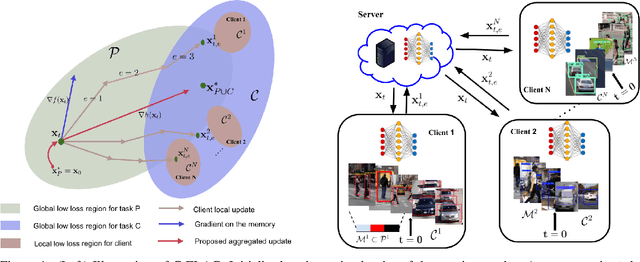
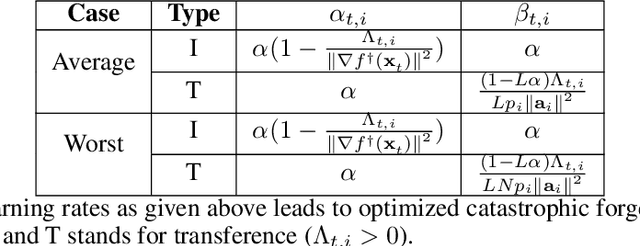
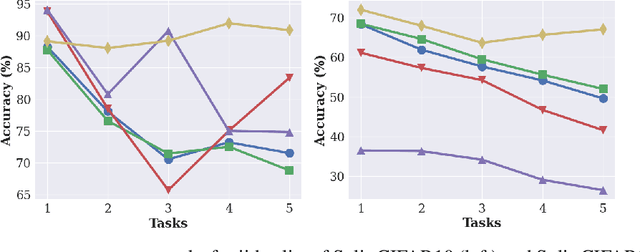
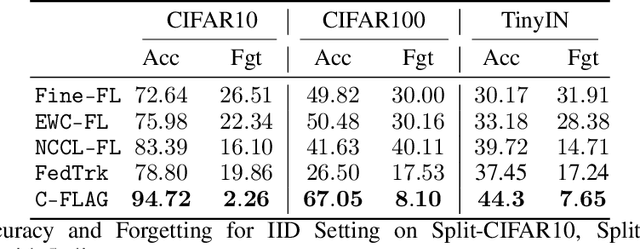
The holy grail of machine learning is to enable Continual Federated Learning (CFL) to enhance the efficiency, privacy, and scalability of AI systems while learning from streaming data. The primary challenge of a CFL system is to overcome global catastrophic forgetting, wherein the accuracy of the global model trained on new tasks declines on the old tasks. In this work, we propose Continual Federated Learning with Aggregated Gradients (C-FLAG), a novel replay-memory based federated strategy consisting of edge-based gradient updates on memory and aggregated gradients on the current data. We provide convergence analysis of the C-FLAG approach which addresses forgetting and bias while converging at a rate of $O(1/\sqrt{T})$ over $T$ communication rounds. We formulate an optimization sub-problem that minimizes catastrophic forgetting, translating CFL into an iterative algorithm with adaptive learning rates that ensure seamless learning across tasks. We empirically show that C-FLAG outperforms several state-of-the-art baselines on both task and class-incremental settings with respect to metrics such as accuracy and forgetting.