 Add to Chrome
 Add to Firefox
 Add to Edge
PAC-Bayes Beyond Parameter Space: Behavioral Equivalence, Z-Information, and Exact Complexity Decomposition
Aug 11, 2026
PAC-Bayes theory provides generalization guarantees by controlling the Kullback--Leibler (KL) divergence between posterior and prior distributions over a chosen hypothesis representation. However, predictive risk depends only on the predictive behavior induced by a hypothesis, not on the particular internal realization that implements that behavior. In over-parameterized systems, many distinct configurations induce identical predictive behavior, yet the classical PAC-Bayes KL divergence does not distinguish uncertainty over predictive behavior from variation among behaviorally equivalent realizations. We show that this distinction induces an exact structural decomposition of classical PAC-Bayes complexity. We formalize behavioral equivalence through a measurable behavior map and use measure disintegration to decompose probability measures on the configuration space into a distribution over predictive behaviors and conditional distributions over behavioral fibers. This yields an exact decomposition of the classical PAC-Bayes KL divergence into a behavior-selection term and a realization-level term given by an expected conditional KL within fibers. We define Z-information as the negative of this realization-level contribution: the exact gap between the KL divergence and the complexity of uncertainty over predictive behavior alone. We further show that the behavior-selection term admits an exact variational characterization: it is the minimum KL divergence among all posteriors inducing the same distribution over predictive behaviors, attained by a canonical fiber-symmetrized representative. Finally, we show that symmetry, behavior-preserving directions, fiber geometry, and invariance under fiber-preserving perturbations arise naturally from the same behavior-map structure. Together, these results identify predictive behavior as the natural object of PAC-Bayes complexity.

C-HDNet: A Fast Hyperdimensional Computing Based Method for Causal Effect Estimation from Networked Observational Data
Jan 27, 2025We consider the problem of estimating causal effects from observational data in the presence of network confounding. In this context, an individual's treatment assignment and outcomes may be affected by their neighbors within the network. We propose a novel matching technique which leverages hyperdimensional computing to model network information and improve predictive performance. We present results of extensive experiments which show that the proposed method outperforms or is competitive with the state-of-the-art methods for causal effect estimation from network data, including advanced computationally demanding deep learning methods. Further, our technique benefits from simplicity and speed, with roughly an order of magnitude lower runtime compared to state-of-the-art methods, while offering similar causal effect estimation error rates.
Causal Effect Estimation Using Random Hyperplane Tessellations
Apr 16, 2024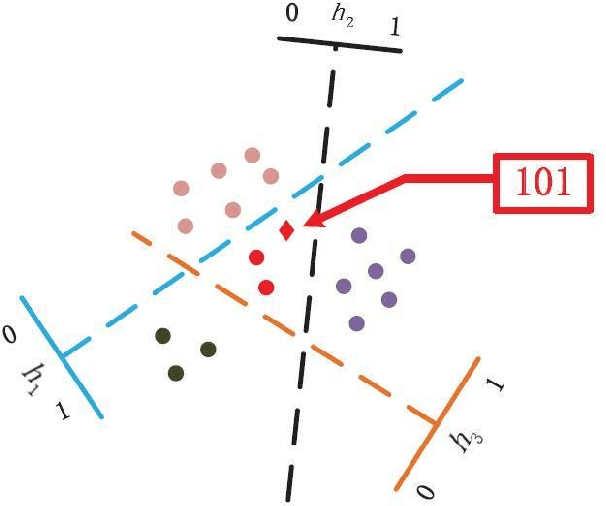
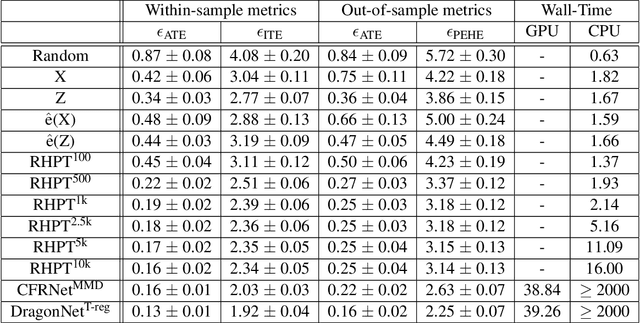
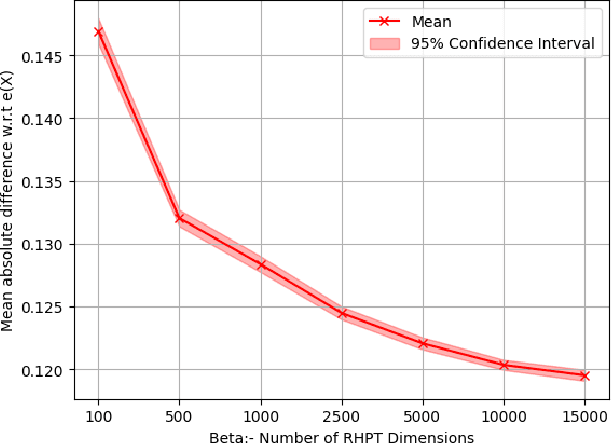
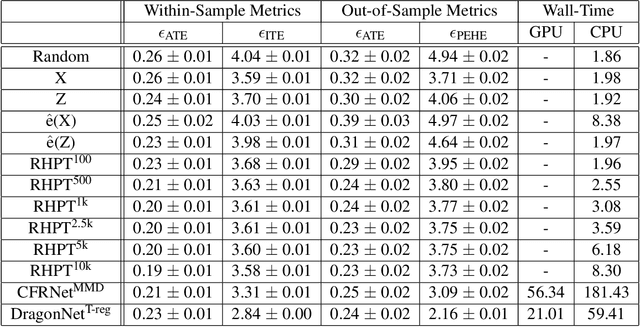
Matching is one of the simplest approaches for estimating causal effects from observational data. Matching techniques compare the observed outcomes across pairs of individuals with similar covariate values but different treatment statuses in order to estimate causal effects. However, traditional matching techniques are unreliable given high-dimensional covariates due to the infamous curse of dimensionality. To overcome this challenge, we propose a simple, fast, yet highly effective approach to matching using Random Hyperplane Tessellations (RHPT). First, we prove that the RHPT representation is an approximate balancing score -- thus maintaining the strong ignorability assumption -- and provide empirical evidence for this claim. Second, we report results of extensive experiments showing that matching using RHPT outperforms traditional matching techniques and is competitive with state-of-the-art deep learning methods for causal effect estimation. In addition, RHPT avoids the need for computationally expensive training of deep neural networks.