 Add to Chrome
 Add to Firefox
 Add to Edge
Curve-Induced Dynamical Systems on Riemannian Manifolds and Lie Groups
Mar 05, 2026
Deploying robots in household environments requires safe, adaptable, and interpretable behaviors that respect the geometric structure of tasks. Often represented on Lie groups and Riemannian manifolds, this includes poses on SE(3) or symmetric positive definite matrices encoding stiffness or damping matrices. In this context, dynamical system-based approaches offer a natural framework for generating such behavior, providing stability and convergence while remaining responsive to changes in the environment. We introduce Curve-induced Dynamical systems on Smooth Manifolds (CDSM), a real-time framework for constructing dynamical systems directly on Riemannian manifolds and Lie groups. The proposed approach constructs a nominal curve on the manifold, and generates a dynamical system which combines a tangential component that drives motion along the curve and a normal component that attracts the state toward the curve. We provide a stability analysis of the resulting dynamical system and validate the method quantitatively. On an S2 benchmark, CDSM demonstrates improved trajectory accuracy, reduced path deviation, and faster generation and query times compared to state-of-the-art methods. Finally, we demonstrate the practical applicability of the framework on both a robotic manipulator, where poses on SE(3) and damping matrices on SPD(n) are adapted online, and a mobile manipulator.

Pushing Through Clutter With Movability Awareness of Blocking Obstacles
Feb 27, 2025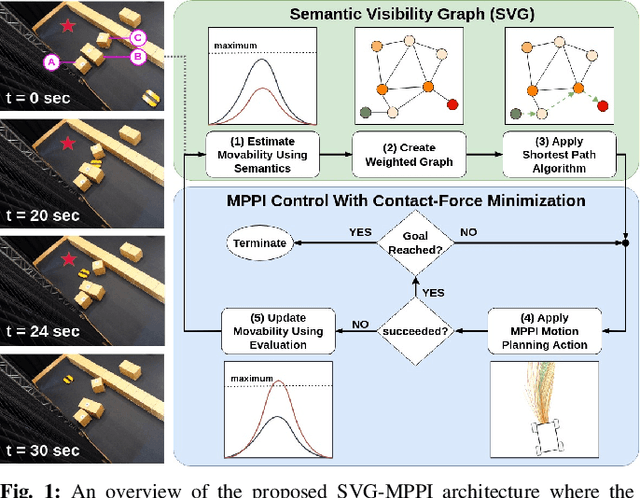
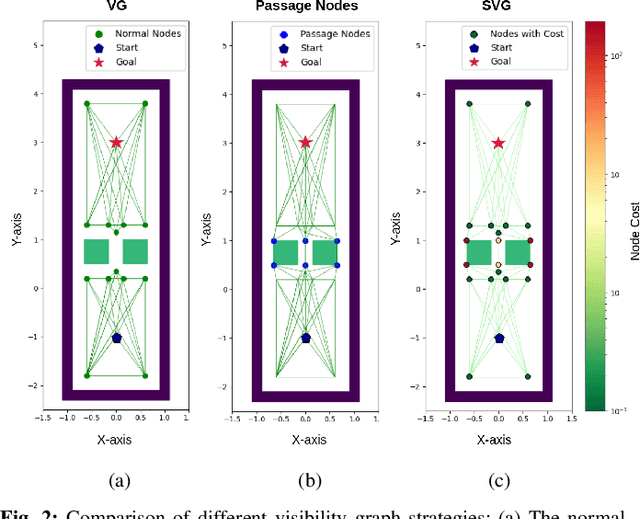
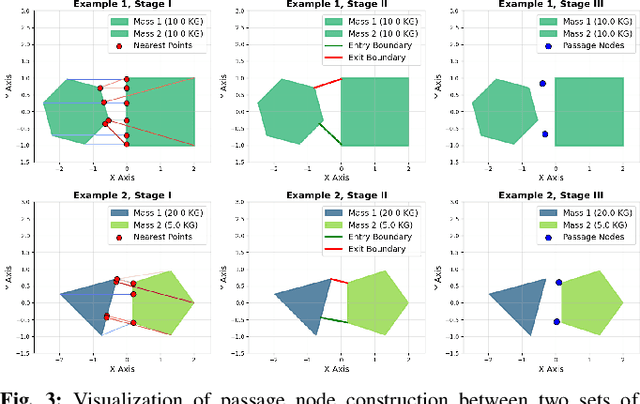
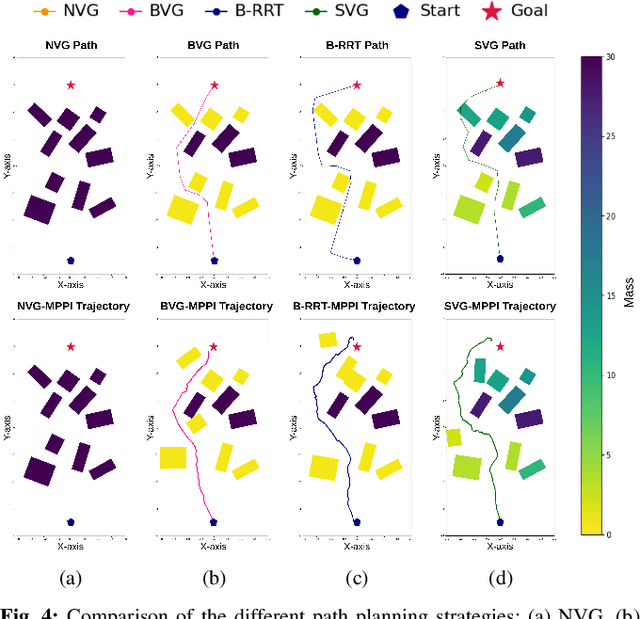
Navigation Among Movable Obstacles (NAMO) poses a challenge for traditional path-planning methods when obstacles block the path, requiring push actions to reach the goal. We propose a framework that enables movability-aware planning to overcome this challenge without relying on explicit obstacle placement. Our framework integrates a global Semantic Visibility Graph and a local Model Predictive Path Integral (SVG-MPPI) approach to efficiently sample rollouts, taking into account the continuous range of obstacle movability. A physics engine is adopted to simulate the interaction result of the rollouts with the environment, and generate trajectories that minimize contact force. In qualitative and quantitative experiments, SVG-MPPI outperforms the existing paradigm that uses only binary movability for planning, achieving higher success rates with reduced cumulative contact forces. Our code is available at: https://github.com/tud-amr/SVG-MPPI
A Bayesian optimization framework for the automatic tuning of MPC-based shared controllers
Nov 02, 2023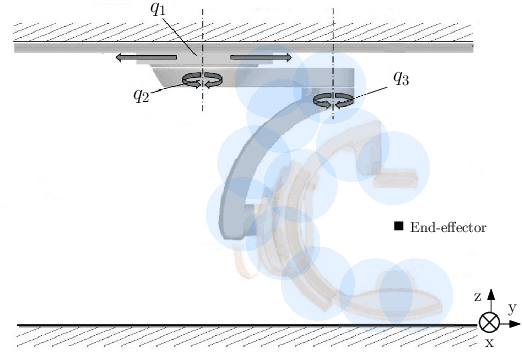
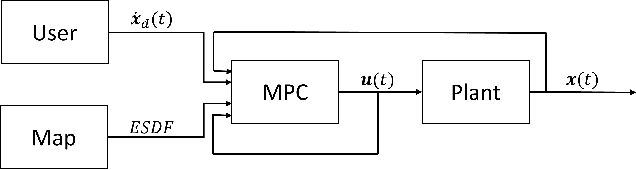

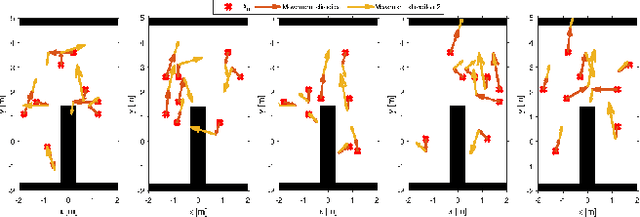
This paper presents a Bayesian optimization framework for the automatic tuning of shared controllers which are defined as a Model Predictive Control (MPC) problem. The proposed framework includes the design of performance metrics as well as the representation of user inputs for simulation-based optimization. The framework is applied to the optimization of a shared controller for an Image Guided Therapy robot. VR-based user experiments confirm the increase in performance of the automatically tuned MPC shared controller with respect to a hand-tuned baseline version as well as its generalization ability.
Multi-Robot Local Motion Planning Using Dynamic Optimization Fabrics
Oct 19, 2023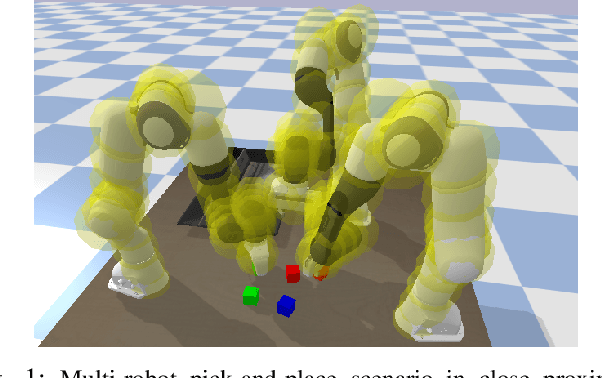
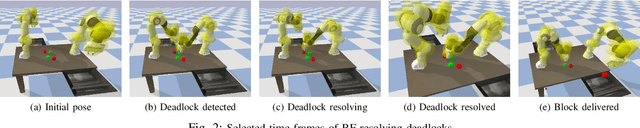
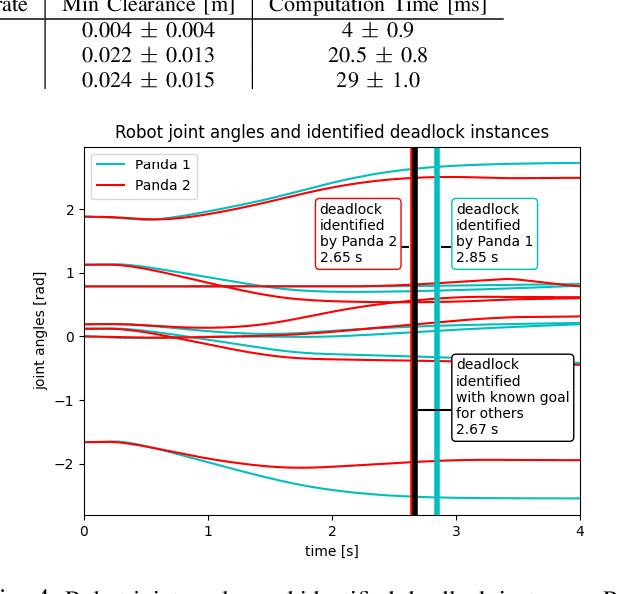
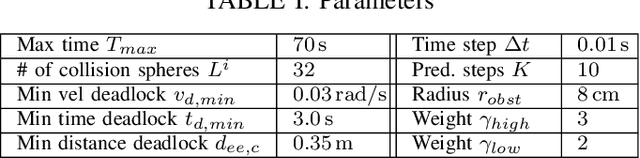
In this paper, we address the problem of real-time motion planning for multiple robotic manipulators that operate in close proximity. We build upon the concept of dynamic fabrics and extend them to multi-robot systems, referred to as Multi-Robot Dynamic Fabrics (MRDF). This geometric method enables a very high planning frequency for high-dimensional systems at the expense of being reactive and prone to deadlocks. To detect and resolve deadlocks, we propose Rollout Fabrics where MRDF are forward simulated in a decentralized manner. We validate the methods in simulated close-proximity pick-and-place scenarios with multiple manipulators, showing high success rates and real-time performance.