 Add to Chrome
 Add to Firefox
 Add to Edge
FUSE: Ensembling Verifiers with Zero Labeled Data
Apr 20, 2026
Verification of model outputs is rapidly emerging as a key primitive for both training and real-world deployment of large language models (LLMs). In practice, this often involves using imperfect LLM judges and reward models since ground truth acquisition can be time-consuming and expensive. We introduce Fully Unsupervised Score Ensembling (FUSE), a method for improving verification quality by ensembling verifiers without access to ground truth correctness labels. The key idea behind FUSE is to control conditional dependencies between verifiers in a manner that improves the unsupervised performance of a class of spectral algorithms from the ensembling literature. Despite requiring zero ground truth labels, FUSE typically matches or improves upon semi-supervised alternatives in test-time scaling experiments with diverse sets of generator models, verifiers, and benchmarks. In particular, we validate our method on both conventional academic benchmarks such as GPQA Diamond and on frontier, unsaturated benchmarks such as Humanity's Last Exam and IMO Shortlist questions.

Scalable Amortized GPLVMs for Single Cell Transcriptomics Data
May 06, 2024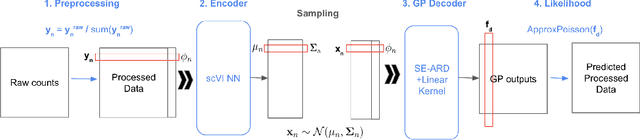
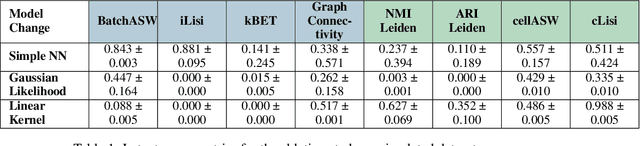
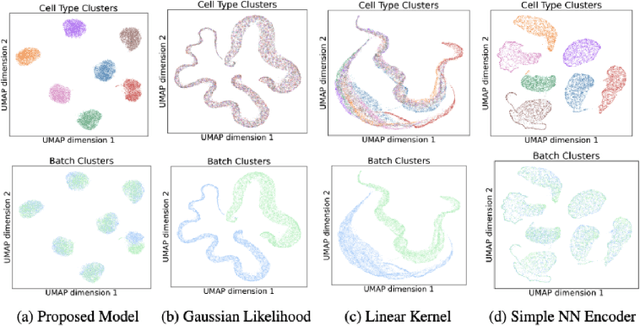
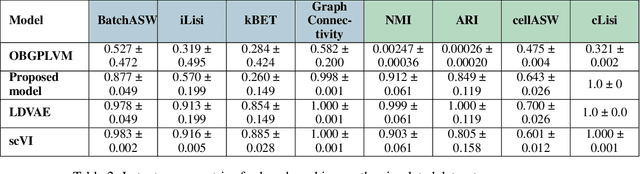
Dimensionality reduction is crucial for analyzing large-scale single-cell RNA-seq data. Gaussian Process Latent Variable Models (GPLVMs) offer an interpretable dimensionality reduction method, but current scalable models lack effectiveness in clustering cell types. We introduce an improved model, the amortized stochastic variational Bayesian GPLVM (BGPLVM), tailored for single-cell RNA-seq with specialized encoder, kernel, and likelihood designs. This model matches the performance of the leading single-cell variational inference (scVI) approach on synthetic and real-world COVID datasets and effectively incorporates cell-cycle and batch information to reveal more interpretable latent structures as we demonstrate on an innate immunity dataset.
Geodesic Mode Connectivity
Aug 24, 2023Mode connectivity is a phenomenon where trained models are connected by a path of low loss. We reframe this in the context of Information Geometry, where neural networks are studied as spaces of parameterized distributions with curved geometry. We hypothesize that shortest paths in these spaces, known as geodesics, correspond to mode-connecting paths in the loss landscape. We propose an algorithm to approximate geodesics and demonstrate that they achieve mode connectivity.