 Add to Chrome
 Add to Firefox
 Add to Edge
FUSE: Ensembling Verifiers with Zero Labeled Data
Apr 20, 2026
Verification of model outputs is rapidly emerging as a key primitive for both training and real-world deployment of large language models (LLMs). In practice, this often involves using imperfect LLM judges and reward models since ground truth acquisition can be time-consuming and expensive. We introduce Fully Unsupervised Score Ensembling (FUSE), a method for improving verification quality by ensembling verifiers without access to ground truth correctness labels. The key idea behind FUSE is to control conditional dependencies between verifiers in a manner that improves the unsupervised performance of a class of spectral algorithms from the ensembling literature. Despite requiring zero ground truth labels, FUSE typically matches or improves upon semi-supervised alternatives in test-time scaling experiments with diverse sets of generator models, verifiers, and benchmarks. In particular, we validate our method on both conventional academic benchmarks such as GPQA Diamond and on frontier, unsaturated benchmarks such as Humanity's Last Exam and IMO Shortlist questions.

Model-Agnostic Covariate-Assisted Inference on Partially Identified Causal Effects
Oct 12, 2023


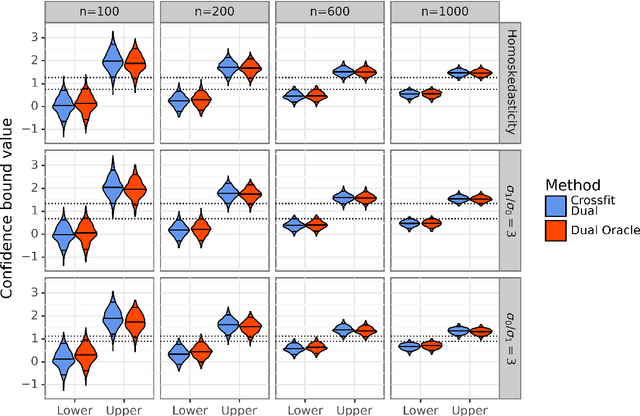
Many causal estimands are only partially identifiable since they depend on the unobservable joint distribution between potential outcomes. Stratification on pretreatment covariates can yield sharper partial identification bounds; however, unless the covariates are discrete with relatively small support, this approach typically requires consistent estimation of the conditional distributions of the potential outcomes given the covariates. Thus, existing approaches may fail under model misspecification or if consistency assumptions are violated. In this study, we propose a unified and model-agnostic inferential approach for a wide class of partially identified estimands, based on duality theory for optimal transport problems. In randomized experiments, our approach can wrap around any estimates of the conditional distributions and provide uniformly valid inference, even if the initial estimates are arbitrarily inaccurate. Also, our approach is doubly robust in observational studies. Notably, this property allows analysts to use the multiplier bootstrap to select covariates and models without sacrificing validity even if the true model is not included. Furthermore, if the conditional distributions are estimated at semiparametric rates, our approach matches the performance of an oracle with perfect knowledge of the outcome model. Finally, we propose an efficient computational framework, enabling implementation on many practical problems in causal inference.