 Add to Chrome
 Add to Firefox
 Add to Edge
Scaling Inherently Interpretable Language Models
Aug 06, 2026
Interpretability is often treated as a tax on capability: language models are trained as opaque systems, then explained after the fact, with methods whose reliability is difficult to establish. In this work, we challenge this premise. Rather than reverse-engineering a model, we make interpretability a constraint of the training pipeline, optimized alongside the language modeling objective. Across three orders of magnitude of compute, on both autoregressive and diffusion language models, interpretability scales with capability rather than against it. Surprisingly, model representations become more disentangled and aligned with human-understandable concepts with scale. We instantiate the training-time recipe with Steerling-8B, a diffusion language model with a causal attention mask. For any group of generated tokens, Steerling-8B attributes the output to relevant input tokens, human-understandable concepts, and training data. This enables closed-loop intervention: diagnose an output through its concept or feature attribution, retrieve similar training data, and correct the behavior through concept steering without retraining. Steerling-8B remains competitive with open peer models trained on substantially 2-16x more compute, suggesting a different scaling paradigm: interpretability can be designed into training, and it improves with scale.

Physics-guided spatiotemporal neural models for fuel density prediction
Jul 08, 2026This paper presents a physics-guided machine learning (PGML) framework for fuel density prediction, integrating physics constraints and domain knowledge into deep learning models to enhance model accuracy and stability. We explore three deep learning architectures -- ConvLSTM, Adaptive Fourier Neural Operator (AFNONet), and Video Vision Transformer (ViViT) -- to model the spatiotemporal evolution of fuel density. Our approach incorporates differentiable physics-informed terms in the loss function, including a mass-conserving fuel transport term and a rate-of-spread estimation. Experimental results, averaged across multiple independent trials, demonstrate that the proposed PGML framework outperforms purely data-driven baselines without physics constraints in both accuracy and stability. This framework enables computationally efficient, physically plausible fire forecasting to support adaptive prescribed burn management.
Indoor Distance Estimation using LSTMs over WLAN Network
Mar 31, 2020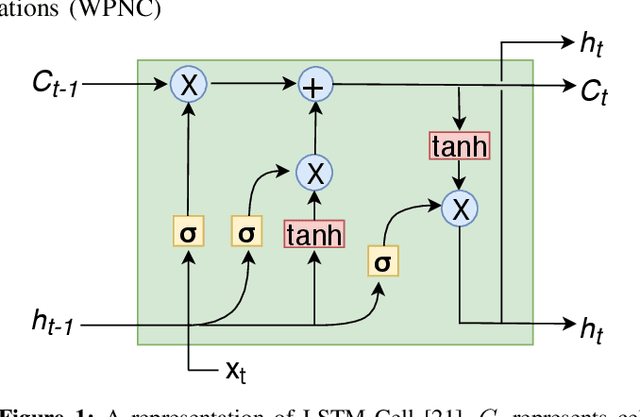
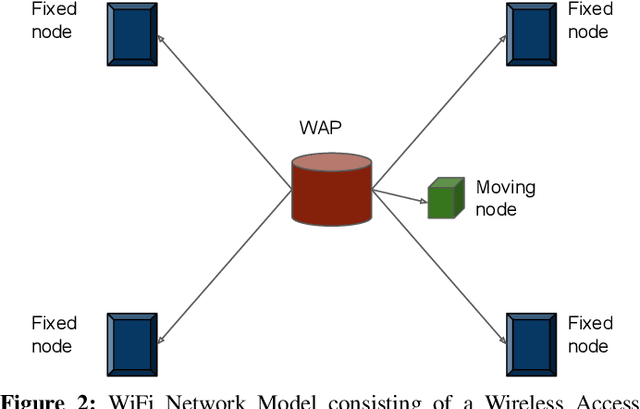
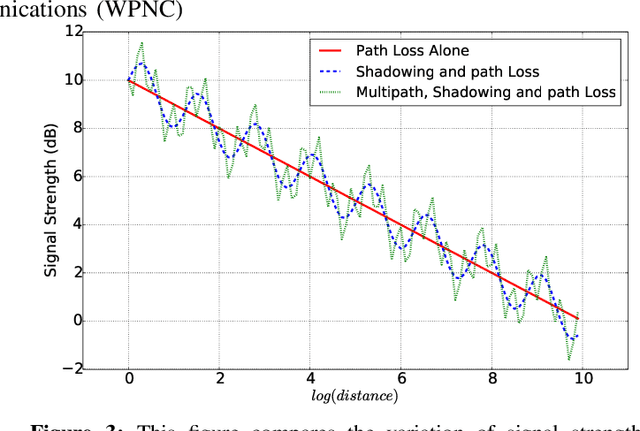
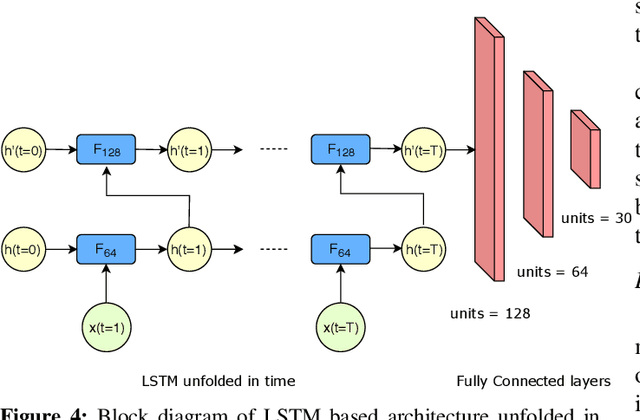
The Global Navigation Satellite Systems (GNSS) like GPS suffer from accuracy degradation and are almost unavailable in indoor environments. Indoor positioning systems (IPS) based on WiFi signals have been gaining popularity. However, owing to the strong spatial and temporal variations of wireless communication channels in the indoor environment, the achieved accuracy of existing IPS is around several tens of centimeters. We present the detailed design and implementation of a self-adaptive WiFi-based indoor distance estimation system using LSTMs. The system is novel in its method of estimating with high accuracy the distance of an object by overcoming possible causes of channel variations and is self-adaptive to the changing environmental and surrounding conditions. The proposed design has been developed and physically realized over a WiFi network consisting of ESP8266 (NodeMCU) devices. The experiment were conducted in a real indoor environment while changing the surroundings in order to establish the adaptability of the system. We introduce and compare different architectures for this task based on LSTMs, CNNs, and fully connected networks (FCNs). We show that the LSTM based model performs better among all the above-mentioned architectures by achieving an accuracy of 5.85 cm with a confidence interval of 93% on the scale of (4.14 m * 2.86 m). To the best of our knowledge, the proposed method outperforms other methods reported in the literature by a significant margin.