 Add to Chrome
 Add to Firefox
 Add to Edge
Securing Self-supervised Data Curation for Foundation Models Robustness
Jun 08, 2026
Self-supervised data curation provides a pathway to scaling and improving the generalization capabilities of machine learning models. By leveraging self-supervised learning (SSL) for data curation, the demand for massive training datasets required by foundation models can be effectively met. SSL greatly alleviates the costs associated with annotation and manual dataset curation while minimizing the need for human oversight. However, the integrity of SSL-curated datasets must be rigorously checked, as reliance on anonymous and unvetted external sources can substantially increase the risk of data poisoning. In this paper, we propose a Poisoned Data Detector (PDD), an active defense mechanism designed to ensure the integrity of SSL-curated datasets prior to foundation model training. PDDs are designed using a combination of the pretrained ImageBind model and traditional classifiers, including Random Forest (RF), k-Nearest Neighbors (KNN), Naive Bayes (NB), and Support Vector Machines (SVM). We rigorously evaluated PDDs using 176,200 images from three diverse datasets and three different adversarial attacks encompassing both in-distribution and out-of-distribution scenarios. Notably, SVM-PDD achieves superior performance for both in-distribution (Set3-Set5) and out-of-distribution (TrueFace and 140K RealFace) datasets. Our design demonstrates strong scalability and enables the rapid integration of new adversarial attack detectors through an ensemble approach.

EMMA: Extracting Multiple physical parameters from Multimodal Data
May 21, 2026We introduce EMMA, a physics-informed multimodal framework that recovers all identifiable dynamical parameters of a system directly from raw video, audio, and image-based time-series observations. Unlike prior video-only approaches that struggle with occluded states, hidden actuation inputs, or assumptions about known initial conditions and coordinate frames, EMMA performs joint inference of explicit parameters, implicit dynamical components, and calibration invariants within a unified continuous-time model. EMMA leverages a Liquid Time-Constant (LTC) network to learn latent dynamics from heterogeneous modalities while a physics-constrained loss enforces consistency with the governing differential equations. A unified feature pipeline enables consistent alignment across video trajectories, acoustic signatures, and chart-derived measurements, allowing EMMA to estimate parameters under forced, implicit, and multivariate dynamics without requiring segmentation masks, differentiable rendering, or specialized sensors. Across 100+ scenarios including five standard dynamical benchmarks (75 Delfys videos), real-world rover and quadrotor systems with hidden inputs, and simulation-chart case studies spanning biological and chaotic systems, EMMA delivers robust multi-parameter recovery and significantly outperforms existing single-modality and equation-discovery baselines. Our results establish EMMA as a general, scalable solution for physics-consistent model extraction from opportunistic multimodal data. Code and data are available at: https://github.com/ImpactLabASU/EMMA-CVPR2026
Human Knowledge Integrated Multi-modal Learning for Single Source Domain Generalization
Mar 12, 2026Generalizing image classification across domains remains challenging in critical tasks such as fundus image-based diabetic retinopathy (DR) grading and resting-state fMRI seizure onset zone (SOZ) detection. When domains differ in unknown causal factors, achieving cross-domain generalization is difficult, and there is no established methodology to objectively assess such differences without direct metadata or protocol-level information from data collectors, which is typically inaccessible. We first introduce domain conformal bounds (DCB), a theoretical framework to evaluate whether domains diverge in unknown causal factors. Building on this, we propose GenEval, a multimodal Vision Language Models (VLM) approach that combines foundational models (e.g., MedGemma-4B) with human knowledge via Low-Rank Adaptation (LoRA) to bridge causal gaps and enhance single-source domain generalization (SDG). Across eight DR and two SOZ datasets, GenEval achieves superior SDG performance, with average accuracy of 69.2% (DR) and 81% (SOZ), outperforming the strongest baselines by 9.4% and 1.8%, respectively.
Robust Vision Systems for Connected and Autonomous Vehicles: Security Challenges and Attack Vectors
Feb 11, 2026This article investigates the robustness of vision systems in Connected and Autonomous Vehicles (CAVs), which is critical for developing Level-5 autonomous driving capabilities. Safe and reliable CAV navigation undeniably depends on robust vision systems that enable accurate detection of objects, lane markings, and traffic signage. We analyze the key sensors and vision components essential for CAV navigation to derive a reference architecture for CAV vision system (CAVVS). This reference architecture provides a basis for identifying potential attack surfaces of CAVVS. Subsequently, we elaborate on identified attack vectors targeting each attack surface, rigorously evaluating their implications for confidentiality, integrity, and availability (CIA). Our study provides a comprehensive understanding of attack vector dynamics in vision systems, which is crucial for formulating robust security measures that can uphold the principles of the CIA triad.
Dynamic Hand Gesture Recognition for Robot Manipulator Tasks
Jan 19, 2026This paper proposes a novel approach to recognizing dynamic hand gestures facilitating seamless interaction between humans and robots. Here, each robot manipulator task is assigned a specific gesture. There may be several such tasks, hence, several gestures. These gestures may be prone to several dynamic variations. All such variations for different gestures shown to the robot are accurately recognized in real-time using the proposed unsupervised model based on the Gaussian Mixture model. The accuracy during training and real-time testing prove the efficacy of this methodology.
XAI-MeD: Explainable Knowledge Guided Neuro-Symbolic Framework for Domain Generalization and Rare Class Detection in Medical Imaging
Jan 05, 2026Explainability domain generalization and rare class reliability are critical challenges in medical AI where deep models often fail under real world distribution shifts and exhibit bias against infrequent clinical conditions This paper introduces XAIMeD an explainable medical AI framework that integrates clinically accurate expert knowledge into deep learning through a unified neuro symbolic architecture XAIMeD is designed to improve robustness under distribution shift enhance rare class sensitivity and deliver transparent clinically aligned interpretations The framework encodes clinical expertise as logical connectives over atomic medical propositions transforming them into machine checkable class specific rules Their diagnostic utility is quantified through weighted feature satisfaction scores enabling a symbolic reasoning branch that complements neural predictions A confidence weighted fusion integrates symbolic and deep outputs while a Hunt inspired adaptive routing mechanism guided by Entropy Imbalance Gain EIG and Rare Class Gini mitigates class imbalance high intra class variability and uncertainty We evaluate XAIMeD across diverse modalities on four challenging tasks i Seizure Onset Zone SOZ localization from rs fMRI ii Diabetic Retinopathy grading across 6 multicenter datasets demonstrate substantial performance improvements including 6 percent gains in cross domain generalization and a 10 percent improved rare class F1 score far outperforming state of the art deep learning baselines Ablation studies confirm that the clinically grounded symbolic components act as effective regularizers ensuring robustness to distribution shifts XAIMeD thus provides a principled clinically faithful and interpretable approach to multimodal medical AI.
Enabling Physical AI at the Edge: Hardware-Accelerated Recovery of System Dynamics
Dec 29, 2025Physical AI at the edge -- enabling autonomous systems to understand and predict real-world dynamics in real time -- requires hardware-efficient learning and inference. Model recovery (MR), which identifies governing equations from sensor data, is a key primitive for safe and explainable monitoring in mission-critical autonomous systems operating under strict latency, compute, and power constraints. However, state-of-the-art MR methods (e.g., EMILY and PINN+SR) rely on Neural ODE formulations that require iterative solvers and are difficult to accelerate efficiently on edge hardware. We present \textbf{MERINDA} (Model Recovery in Reconfigurable Dynamic Architecture), an FPGA-accelerated MR framework designed to make physical AI practical on resource-constrained devices. MERINDA replaces expensive Neural ODE components with a hardware-friendly formulation that combines (i) GRU-based discretized dynamics, (ii) dense inverse-ODE layers, (iii) sparsity-driven dropout, and (iv) lightweight ODE solvers. The resulting computation is structured for streaming parallelism, enabling critical kernels to be fully parallelized on the FPGA. Across four benchmark nonlinear dynamical systems, MERINDA delivers substantial gains over GPU implementations: \textbf{114$\times$ lower energy} (434~J vs.\ 49{,}375~J), \textbf{28$\times$ smaller memory footprint} (214~MB vs.\ 6{,}118~MB), and \textbf{1.68$\times$ faster training}, while matching state-of-the-art model-recovery accuracy. These results demonstrate that MERINDA can bring accurate, explainable MR to the edge for real-time monitoring of autonomous systems.
NEURO-GUARD: Neuro-Symbolic Generalization and Unbiased Adaptive Routing for Diagnostics -- Explainable Medical AI
Dec 20, 2025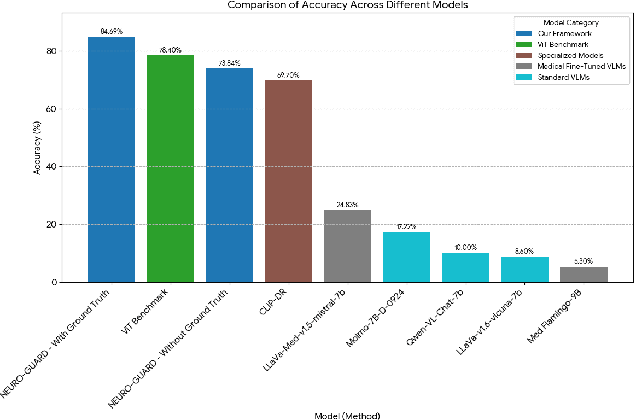
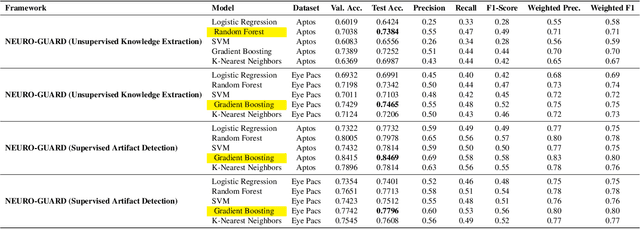
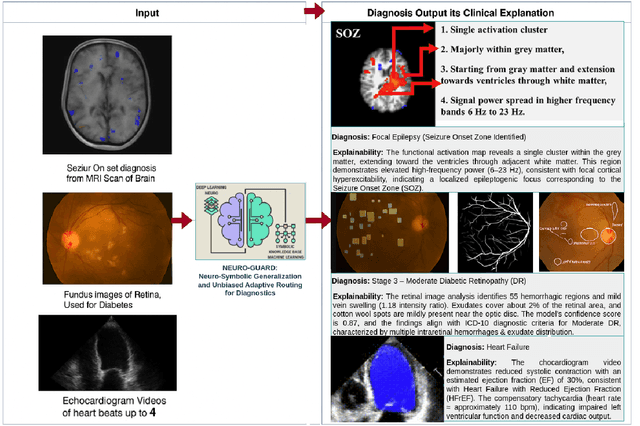
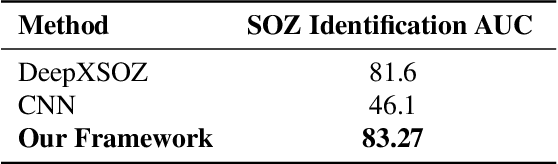
Accurate yet interpretable image-based diagnosis remains a central challenge in medical AI, particularly in settings characterized by limited data, subtle visual cues, and high-stakes clinical decision-making. Most existing vision models rely on purely data-driven learning and produce black-box predictions with limited interpretability and poor cross-domain generalization, hindering their real-world clinical adoption. We present NEURO-GUARD, a novel knowledge-guided vision framework that integrates Vision Transformers (ViTs) with language-driven reasoning to improve performance, transparency, and domain robustness. NEURO-GUARD employs a retrieval-augmented generation (RAG) mechanism for self-verification, in which a large language model (LLM) iteratively generates, evaluates, and refines feature-extraction code for medical images. By grounding this process in clinical guidelines and expert knowledge, the framework progressively enhances feature detection and classification beyond purely data-driven baselines. Extensive experiments on diabetic retinopathy classification across four benchmark datasets APTOS, EyePACS, Messidor-1, and Messidor-2 demonstrate that NEURO-GUARD improves accuracy by 6.2% over a ViT-only baseline (84.69% vs. 78.4%) and achieves a 5% gain in domain generalization. Additional evaluations on MRI-based seizure detection further confirm its cross-domain robustness, consistently outperforming existing methods. Overall, NEURO-GUARD bridges symbolic medical reasoning with subsymbolic visual learning, enabling interpretable, knowledge-aware, and generalizable medical image diagnosis while achieving state-of-the-art performance across multiple datasets.
MedXAI: A Retrieval-Augmented and Self-Verifying Framework for Knowledge-Guided Medical Image Analysis
Dec 10, 2025Accurate and interpretable image-based diagnosis remains a fundamental challenge in medical AI, particularly under domain shifts and rare-class conditions. Deep learning models often struggle with real-world distribution changes, exhibit bias against infrequent pathologies, and lack the transparency required for deployment in safety-critical clinical environments. We introduce MedXAI (An Explainable Framework for Medical Imaging Classification), a unified expert knowledge based framework that integrates deep vision models with clinician-derived expert knowledge to improve generalization, reduce rare-class bias, and provide human-understandable explanations by localizing the relevant diagnostic features rather than relying on technical post-hoc methods (e.g., Saliency Maps, LIME). We evaluate MedXAI across heterogeneous modalities on two challenging tasks: (i) Seizure Onset Zone localization from resting-state fMRI, and (ii) Diabetic Retinopathy grading. Ex periments on ten multicenter datasets show consistent gains, including a 3% improvement in cross-domain generalization and a 10% improvmnet in F1 score of rare class, substantially outperforming strong deep learning baselines. Ablations confirm that the symbolic components act as effective clinical priors and regularizers, improving robustness under distribution shift. MedXAI delivers clinically aligned explanations while achieving superior in-domain and cross-domain performance, particularly for rare diseases in multimodal medical AI.
Generating customized prompts for Zero-Shot Rare Event Medical Image Classification using LLM
Jan 27, 2025Rare events, due to their infrequent occurrences, do not have much data, and hence deep learning techniques fail in estimating the distribution for such data. Open-vocabulary models represent an innovative approach to image classification. Unlike traditional models, these models classify images into any set of categories specified with natural language prompts during inference. These prompts usually comprise manually crafted templates (e.g., 'a photo of a {}') that are filled in with the names of each category. This paper introduces a simple yet effective method for generating highly accurate and contextually descriptive prompts containing discriminative characteristics. Rare event detection, especially in medicine, is more challenging due to low inter-class and high intra-class variability. To address these, we propose a novel approach that uses domain-specific expert knowledge on rare events to generate customized and contextually relevant prompts, which are then used by large language models for image classification. Our zero-shot, privacy-preserving method enhances rare event classification without additional training, outperforming state-of-the-art techniques.