 Add to Chrome
 Add to Firefox
 Add to Edge
XAI-MeD: Explainable Knowledge Guided Neuro-Symbolic Framework for Domain Generalization and Rare Class Detection in Medical Imaging
Jan 05, 2026
Explainability domain generalization and rare class reliability are critical challenges in medical AI where deep models often fail under real world distribution shifts and exhibit bias against infrequent clinical conditions This paper introduces XAIMeD an explainable medical AI framework that integrates clinically accurate expert knowledge into deep learning through a unified neuro symbolic architecture XAIMeD is designed to improve robustness under distribution shift enhance rare class sensitivity and deliver transparent clinically aligned interpretations The framework encodes clinical expertise as logical connectives over atomic medical propositions transforming them into machine checkable class specific rules Their diagnostic utility is quantified through weighted feature satisfaction scores enabling a symbolic reasoning branch that complements neural predictions A confidence weighted fusion integrates symbolic and deep outputs while a Hunt inspired adaptive routing mechanism guided by Entropy Imbalance Gain EIG and Rare Class Gini mitigates class imbalance high intra class variability and uncertainty We evaluate XAIMeD across diverse modalities on four challenging tasks i Seizure Onset Zone SOZ localization from rs fMRI ii Diabetic Retinopathy grading across 6 multicenter datasets demonstrate substantial performance improvements including 6 percent gains in cross domain generalization and a 10 percent improved rare class F1 score far outperforming state of the art deep learning baselines Ablation studies confirm that the clinically grounded symbolic components act as effective regularizers ensuring robustness to distribution shifts XAIMeD thus provides a principled clinically faithful and interpretable approach to multimodal medical AI.

NEURO-GUARD: Neuro-Symbolic Generalization and Unbiased Adaptive Routing for Diagnostics -- Explainable Medical AI
Dec 20, 2025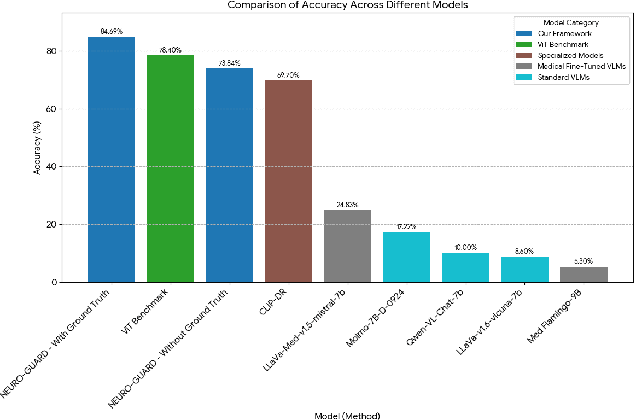
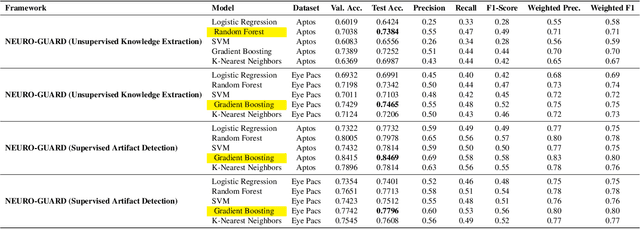
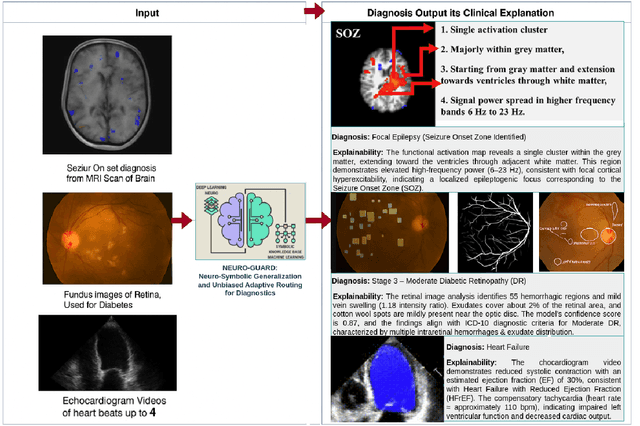
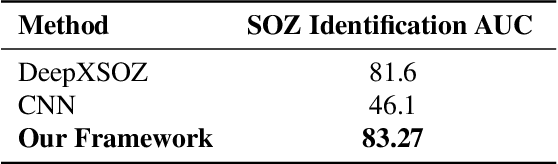
Accurate yet interpretable image-based diagnosis remains a central challenge in medical AI, particularly in settings characterized by limited data, subtle visual cues, and high-stakes clinical decision-making. Most existing vision models rely on purely data-driven learning and produce black-box predictions with limited interpretability and poor cross-domain generalization, hindering their real-world clinical adoption. We present NEURO-GUARD, a novel knowledge-guided vision framework that integrates Vision Transformers (ViTs) with language-driven reasoning to improve performance, transparency, and domain robustness. NEURO-GUARD employs a retrieval-augmented generation (RAG) mechanism for self-verification, in which a large language model (LLM) iteratively generates, evaluates, and refines feature-extraction code for medical images. By grounding this process in clinical guidelines and expert knowledge, the framework progressively enhances feature detection and classification beyond purely data-driven baselines. Extensive experiments on diabetic retinopathy classification across four benchmark datasets APTOS, EyePACS, Messidor-1, and Messidor-2 demonstrate that NEURO-GUARD improves accuracy by 6.2% over a ViT-only baseline (84.69% vs. 78.4%) and achieves a 5% gain in domain generalization. Additional evaluations on MRI-based seizure detection further confirm its cross-domain robustness, consistently outperforming existing methods. Overall, NEURO-GUARD bridges symbolic medical reasoning with subsymbolic visual learning, enabling interpretable, knowledge-aware, and generalizable medical image diagnosis while achieving state-of-the-art performance across multiple datasets.
Accelerated Digital Twin Learning for Edge AI: A Comparison of FPGA and Mobile GPU
Dec 13, 2025Digital twins (DTs) can enable precision healthcare by continually learning a mathematical representation of patient-specific dynamics. However, mission critical healthcare applications require fast, resource-efficient DT learning, which is often infeasible with existing model recovery (MR) techniques due to their reliance on iterative solvers and high compute/memory demands. In this paper, we present a general DT learning framework that is amenable to acceleration on reconfigurable hardware such as FPGAs, enabling substantial speedup and energy efficiency. We compare our FPGA-based implementation with a multi-processing implementation in mobile GPU, which is a popular choice for AI in edge devices. Further, we compare both edge AI implementations with cloud GPU baseline. Specifically, our FPGA implementation achieves an 8.8x improvement in \text{performance-per-watt} for the MR task, a 28.5x reduction in DRAM footprint, and a 1.67x runtime speedup compared to cloud GPU baselines. On the other hand, mobile GPU achieves 2x better performance per watts but has 2x increase in runtime and 10x more DRAM footprint than FPGA. We show the usage of this technique in DT guided synthetic data generation for Type 1 Diabetes and proactive coronary artery disease detection.
MedXAI: A Retrieval-Augmented and Self-Verifying Framework for Knowledge-Guided Medical Image Analysis
Dec 10, 2025Accurate and interpretable image-based diagnosis remains a fundamental challenge in medical AI, particularly under domain shifts and rare-class conditions. Deep learning models often struggle with real-world distribution changes, exhibit bias against infrequent pathologies, and lack the transparency required for deployment in safety-critical clinical environments. We introduce MedXAI (An Explainable Framework for Medical Imaging Classification), a unified expert knowledge based framework that integrates deep vision models with clinician-derived expert knowledge to improve generalization, reduce rare-class bias, and provide human-understandable explanations by localizing the relevant diagnostic features rather than relying on technical post-hoc methods (e.g., Saliency Maps, LIME). We evaluate MedXAI across heterogeneous modalities on two challenging tasks: (i) Seizure Onset Zone localization from resting-state fMRI, and (ii) Diabetic Retinopathy grading. Ex periments on ten multicenter datasets show consistent gains, including a 3% improvement in cross-domain generalization and a 10% improvmnet in F1 score of rare class, substantially outperforming strong deep learning baselines. Ablations confirm that the symbolic components act as effective clinical priors and regularizers, improving robustness under distribution shift. MedXAI delivers clinically aligned explanations while achieving superior in-domain and cross-domain performance, particularly for rare diseases in multimodal medical AI.