 Add to Chrome
 Add to Firefox
 Add to Edge
HybridCodec: Modeling Discrete and Continuous Representations for Efficient Speech Language Models
Jun 26, 2026
Discrete audio representations have become increasingly popular for building multimodal text-audio systems and integrating audio capabilities into Large Language Models (LLMs). However, numerous studies report performance degradation on various downstream tasks due to information loss during discretization. To address this, we propose a novel approach combining temporally compressed discrete tokens with dimensionality-reduced continuous residuals. Our framework consists of a hybridized discrete-continuous focal modulation codec and a hybrid Transformer. This architecture performs autoregressive inference in the discrete domain, coupled with non-autoregressive prediction and continuous residual upsampling. Experimental results show that our approach significantly improves the retention of speaker characteristics compared to discrete-only methods, while simultaneously reducing the number of required autoregressive steps.
* Accepted

Data-Driven Decoding of Russell's Circumplex Model of Affect
Jun 15, 2026Affective computing increasingly relies on deep learning to represent emotions, yet latent spaces often remain opaque, high-dimensional black boxes. This paper investigates whether Transformers' embeddings recover the geometric regularities of Russell's circumplex model. We unify two complementary experiments testing the hypothesis that, after training models on text and speech, their resulting latent spaces encode a topology consistent with valence-arousal and reproduce human-like neighborhood relations. Specifically, we evaluate deep representations extracted from Transformer-based text (RoBERTa) and speech (wav2vec 2.0) encoders, along with a multimodal Transformer fusion architecture, across naturalistic datasets like MSP-Podcast and controlled LLM-generated stimuli. Our analysis reveals that multimodal fusion of text and audio yields perfect topological alignment with Russell's primary emotion ordering. Furthermore, in a zero-shot setting using generic text embeddings, projected fine-grained emotion terms fall close to their established human-mapped coordinates. Our contribution is a novel, data-driven framework for validating emotion models, demonstrating that Russell's circumplex structure is intrinsically encoded in the embeddings of these modalities rather than being solely an artifact of human labeling, thereby bridging the gap between psychological theory and representation learning.
From Tokens to Faces: Investigating Discrete Speech Representations for 3D Facial Animation
Jun 11, 2026The choice of speech representation is critical in speech-driven 3D facial animation. Representations differ in what they encode: SSL features emphasize segmental and semantic cues, neural codecs yield latents optimized for acoustic reconstruction, and ASR-style objectives produce label-based spaces. We evaluate four speech representation families for 3D facial synthesis, comparing their facial reconstruction quality across two facial decoders using objective metrics and a perceptual evaluation. We additionally conduct probing analyses that relate tokenized representations to phonetic units and to articulatory deformations. We found that encoding phonetic classes is beneficial for accurate facial animation prediction on both semantic and label-based representations with comparable facial animation quality. From the latter, we introduce an Audio Visual Text-to-Speech (AVTTS) pipeline that leverages, as a shared space, discrete representations to decode speech and 3D facial motion.
The Equalizer: Introducing Shape-Gain Decomposition in Neural Audio Codecs
Feb 17, 2026Neural audio codecs (NACs) typically encode the short-term energy (gain) and normalized structure (shape) of speech/audio signals jointly within the same latent space. As a result, they are poorly robust to a global variation of the input signal level in the sense that such variation has strong influence on the embedding vectors at the output of the encoder and their quantization. This methodology is inherently inefficient, leading to codebook redundancy and suboptimal bitrate-distortion performance. To address these limitations, we propose to introduce shape-gain decomposition, widely used in classical speech/audio coding, into the NAC framework. The principle of the proposed Equalizer methodology is to decompose the input signal -- before the NAC encoder -- into gain and normalized shape vector on a short-term basis. The shape vector is processed by the NAC, while the gain is quantized with scalar quantization and transmitted separately. The output (decoded) signal is reconstructed from the normalized output of the NAC and the quantized gain. Our experiments conducted on speech signals show that this general methodology, easily applicable to any NAC, enables a substantial gain in bitrate-distortion performance, as well as a massive reduction in complexity.
Residual Tokens Enhance Masked Autoencoders for Speech Modeling
Jan 27, 2026Recent speech modeling relies on explicit attributes such as pitch, content, and speaker identity, but these alone cannot capture the full richness of natural speech. We introduce RT-MAE, a novel masked autoencoder framework that augments the supervised attributes-based modeling with unsupervised residual trainable tokens, designed to encode the information not explained by explicit labeled factors (e.g., timbre variations, noise, emotion etc). Experiments show that RT-MAE improves reconstruction quality, preserving content and speaker similarity while enhancing expressivity. We further demonstrate its applicability to speech enhancement, removing noise at inference while maintaining controllability and naturalness.
Bringing Interpretability to Neural Audio Codecs
Jun 04, 2025The advent of neural audio codecs has increased in popularity due to their potential for efficiently modeling audio with transformers. Such advanced codecs represent audio from a highly continuous waveform to low-sampled discrete units. In contrast to semantic units, acoustic units may lack interpretability because their training objectives primarily focus on reconstruction performance. This paper proposes a two-step approach to explore the encoding of speech information within the codec tokens. The primary goal of the analysis stage is to gain deeper insight into how speech attributes such as content, identity, and pitch are encoded. The synthesis stage then trains an AnCoGen network for post-hoc explanation of codecs to extract speech attributes from the respective tokens directly.
AnCoGen: Analysis, Control and Generation of Speech with a Masked Autoencoder
Jan 09, 2025This article introduces AnCoGen, a novel method that leverages a masked autoencoder to unify the analysis, control, and generation of speech signals within a single model. AnCoGen can analyze speech by estimating key attributes, such as speaker identity, pitch, content, loudness, signal-to-noise ratio, and clarity index. In addition, it can generate speech from these attributes and allow precise control of the synthesized speech by modifying them. Extensive experiments demonstrated the effectiveness of AnCoGen across speech analysis-resynthesis, pitch estimation, pitch modification, and speech enhancement.
A vector quantized masked autoencoder for audiovisual speech emotion recognition
May 05, 2023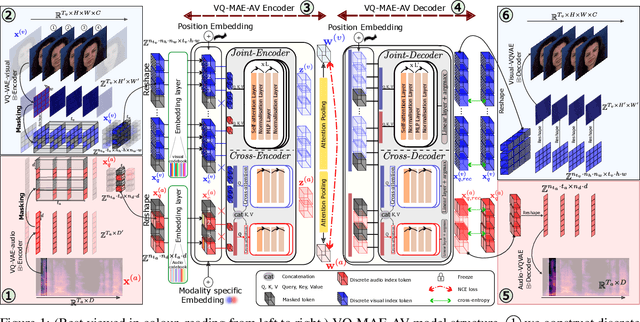
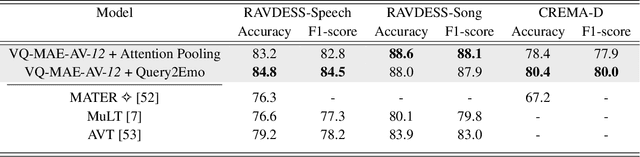
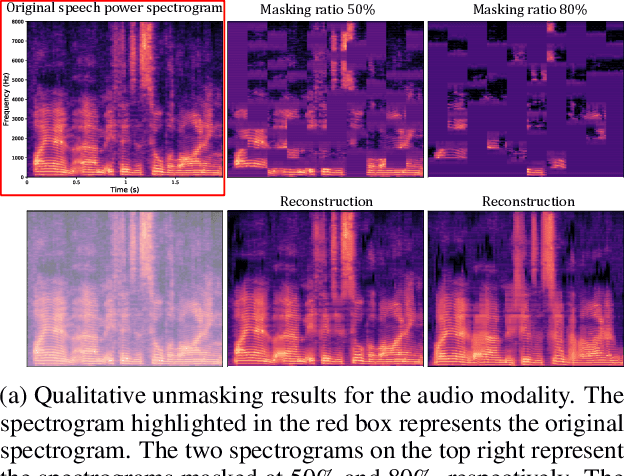
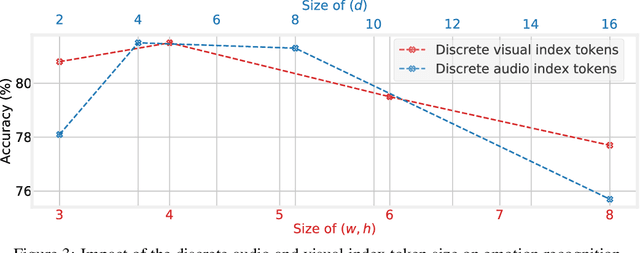
While fully-supervised models have been shown to be effective for audiovisual speech emotion recognition (SER), the limited availability of labeled data remains a major challenge in the field. To address this issue, self-supervised learning approaches, such as masked autoencoders (MAEs), have gained popularity as potential solutions. In this paper, we propose the VQ-MAE-AV model, a vector quantized MAE specifically designed for audiovisual speech self-supervised representation learning. Unlike existing multimodal MAEs that rely on the processing of the raw audiovisual speech data, the proposed method employs a self-supervised paradigm based on discrete audio and visual speech representations learned by two pre-trained vector quantized variational autoencoders. Experimental results show that the proposed approach, which is pre-trained on the VoxCeleb2 database and fine-tuned on standard emotional audiovisual speech datasets, outperforms the state-of-the-art audiovisual SER methods.
A Multimodal Dynamical Variational Autoencoder for Audiovisual Speech Representation Learning
May 05, 2023In this paper, we present a multimodal \textit{and} dynamical VAE (MDVAE) applied to unsupervised audio-visual speech representation learning. The latent space is structured to dissociate the latent dynamical factors that are shared between the modalities from those that are specific to each modality. A static latent variable is also introduced to encode the information that is constant over time within an audiovisual speech sequence. The model is trained in an unsupervised manner on an audiovisual emotional speech dataset, in two stages. In the first stage, a vector quantized VAE (VQ-VAE) is learned independently for each modality, without temporal modeling. The second stage consists in learning the MDVAE model on the intermediate representation of the VQ-VAEs before quantization. The disentanglement between static versus dynamical and modality-specific versus modality-common information occurs during this second training stage. Extensive experiments are conducted to investigate how audiovisual speech latent factors are encoded in the latent space of MDVAE. These experiments include manipulating audiovisual speech, audiovisual facial image denoising, and audiovisual speech emotion recognition. The results show that MDVAE effectively combines the audio and visual information in its latent space. They also show that the learned static representation of audiovisual speech can be used for emotion recognition with few labeled data, and with better accuracy compared with unimodal baselines and a state-of-the-art supervised model based on an audiovisual transformer architecture.
A vector quantized masked autoencoder for speech emotion recognition
Apr 21, 2023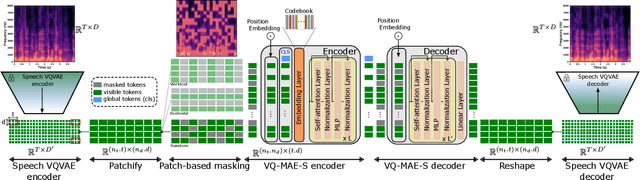
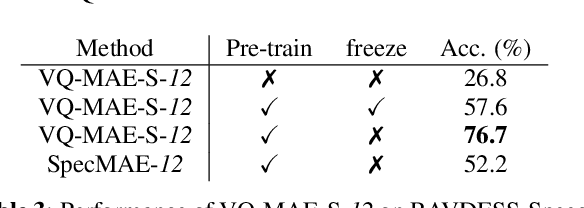
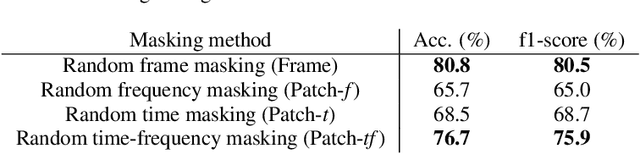

Recent years have seen remarkable progress in speech emotion recognition (SER), thanks to advances in deep learning techniques. However, the limited availability of labeled data remains a significant challenge in the field. Self-supervised learning has recently emerged as a promising solution to address this challenge. In this paper, we propose the vector quantized masked autoencoder for speech (VQ-MAE-S), a self-supervised model that is fine-tuned to recognize emotions from speech signals. The VQ-MAE-S model is based on a masked autoencoder (MAE) that operates in the discrete latent space of a vector-quantized variational autoencoder. Experimental results show that the proposed VQ-MAE-S model, pre-trained on the VoxCeleb2 dataset and fine-tuned on emotional speech data, outperforms an MAE working on the raw spectrogram representation and other state-of-the-art methods in SER.