 Add to Chrome
 Add to Firefox
 Add to Edge
ConvApparel: A Benchmark Dataset and Validation Framework for User Simulators in Conversational Recommenders
Feb 18, 2026
The promise of LLM-based user simulators to improve conversational AI is hindered by a critical "realism gap," leading to systems that are optimized for simulated interactions, but may fail to perform well in the real world. We introduce ConvApparel, a new dataset of human-AI conversations designed to address this gap. Its unique dual-agent data collection protocol -- using both "good" and "bad" recommenders -- enables counterfactual validation by capturing a wide spectrum of user experiences, enriched with first-person annotations of user satisfaction. We propose a comprehensive validation framework that combines statistical alignment, a human-likeness score, and counterfactual validation to test for generalization. Our experiments reveal a significant realism gap across all simulators. However, the framework also shows that data-driven simulators outperform a prompted baseline, particularly in counterfactual validation where they adapt more realistically to unseen behaviors, suggesting they embody more robust, if imperfect, user models.

TAPAS: Two-pass Approximate Adaptive Sampling for Softmax
Jul 14, 2017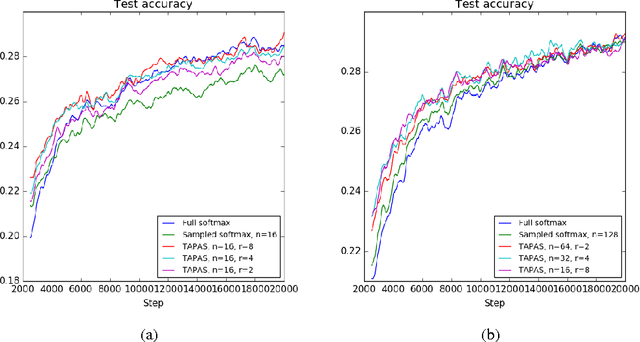
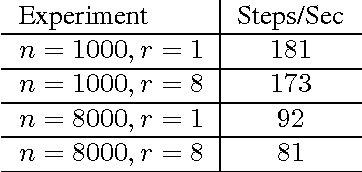
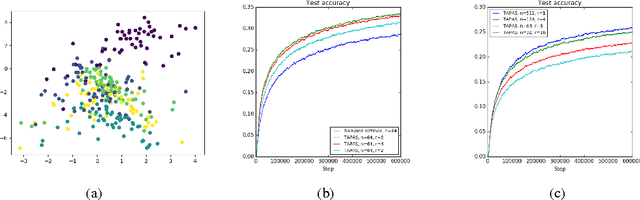
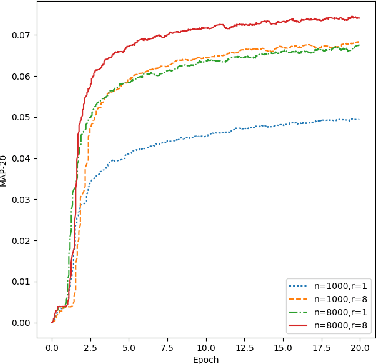
TAPAS is a novel adaptive sampling method for the softmax model. It uses a two pass sampling strategy where the examples used to approximate the gradient of the partition function are first sampled according to a squashed population distribution and then resampled adaptively using the context and current model. We describe an efficient distributed implementation of TAPAS. We show, on both synthetic data and a large real dataset, that TAPAS has low computational overhead and works well for minimizing the rank loss for multi-class classification problems with a very large label space.