 Add to Chrome
 Add to Firefox
 Add to Edge
LLM Retrieval for Stable and Predictable Ad Recommendations
May 21, 2026
Traditional ads recommendation systems have primarily focused on optimizing for prediction accuracy of click or conversion events using canonical metrics such as recall or normalized discounted cumulative gain (NDCG). With the hyper-growth of ads inventory and liquidity with generative AI technologies, the prediction stability and predictability is becoming increasingly critical. Intuitively, prediction stability and predictability can be defined to quantify system robustness with respect to minor/noisy input (ads, creatives) perturbations, the lack of which could lead to advertiser perceivable problems such as repeatability, cold start and under-exploration. In this paper, we introduce a new evaluation framework for quantifying stability and predictability of an ads recommender system, and present an online validated semantic candidate generation framework powered by fine-tuned Large Language Models (LLMs) that showed significant improvement along these metrics by fundamentally improving the semantic-awareness of the system. The approach extracts hierarchical semantic attributes from ad creatives to obtain LLM representations, which serve as the foundation for graph-based expansion, ensuring the retrieved candidates encapsulate semantic variants of an ad, guaranteeing that small creative variants from the advertiser yield consistent and explainable delivery results to the user. We tested this LLM ads retrieval framework in a large-scale industrial ads recommendation system, demonstrating significant improvements across offline and online A/B experiments, showcasing gains in both predictability and traditional performance metrics. Although evaluated in the ads stack, this is a general framework that can be applied broadly to any large-scale recommendation and retrieval systems facing similar scaling and predictability challenges.

mmID: High-Resolution mmWave Imaging for Human Identification
Feb 01, 2024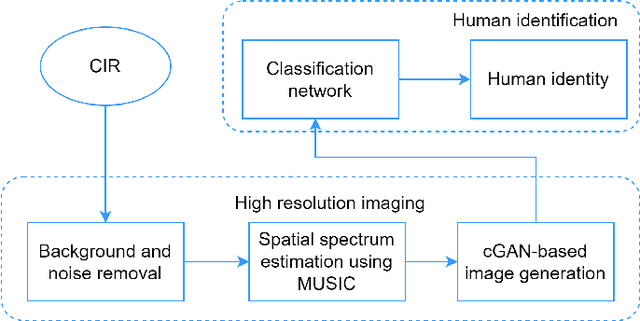
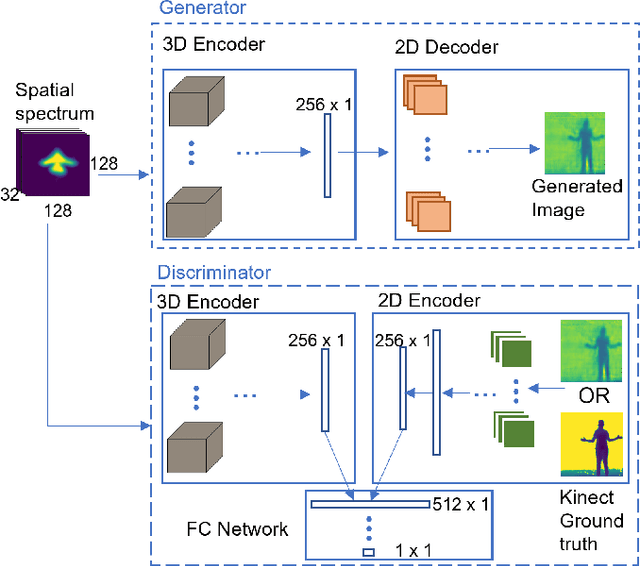
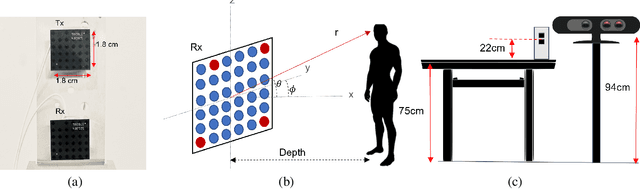
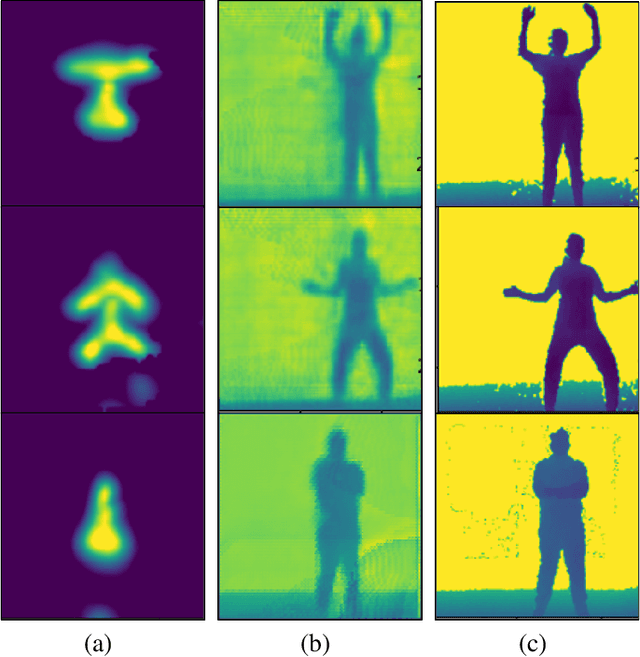
Achieving accurate human identification through RF imaging has been a persistent challenge, primarily attributed to the limited aperture size and its consequent impact on imaging resolution. The existing imaging solution enables tasks such as pose estimation, activity recognition, and human tracking based on deep neural networks by estimating skeleton joints. In contrast to estimating joints, this paper proposes to improve imaging resolution by estimating the human figure as a whole using conditional generative adversarial networks (cGAN). In order to reduce training complexity, we use an estimated spatial spectrum using the MUltiple SIgnal Classification (MUSIC) algorithm as input to the cGAN. Our system generates environmentally independent, high-resolution images that can extract unique physical features useful for human identification. We use a simple convolution layers-based classification network to obtain the final identification result. From the experimental results, we show that resolution of the image produced by our trained generator is high enough to enable human identification. Our finding indicates high-resolution accuracy with 5% mean silhouette difference to the Kinect device. Extensive experiments in different environments on multiple testers demonstrate that our system can achieve 93% overall test accuracy in unseen environments for static human target identification.