 Add to Chrome
 Add to Firefox
 Add to Edge
Virtual Traffic Lights for Multi-Robot Navigation: Decentralized Planning with Centralized Conflict Resolution
Nov 11, 2025
We present a hybrid multi-robot coordination framework that combines decentralized path planning with centralized conflict resolution. In our approach, each robot autonomously plans its path and shares this information with a centralized node. The centralized system detects potential conflicts and allows only one of the conflicting robots to proceed at a time, instructing others to stop outside the conflicting area to avoid deadlocks. Unlike traditional centralized planning methods, our system does not dictate robot paths but instead provides stop commands, functioning as a virtual traffic light. In simulation experiments with multiple robots, our approach increased the success rate of robots reaching their goals while reducing deadlocks. Furthermore, we successfully validated the system in real-world experiments with two quadruped robots and separately with wheeled Duckiebots.

Audio-Visual Traffic Light State Detection for Urban Robots
Apr 30, 2024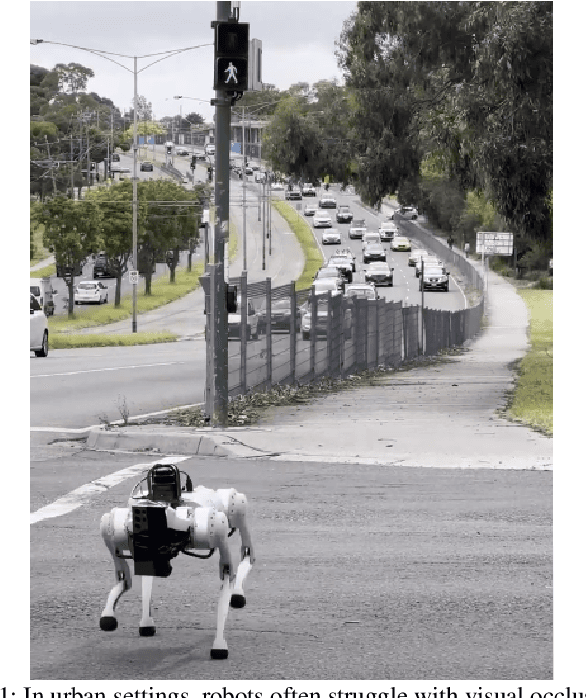
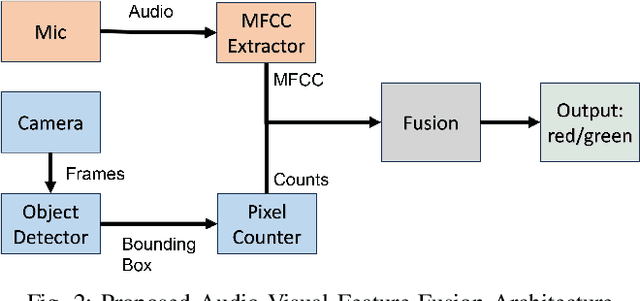
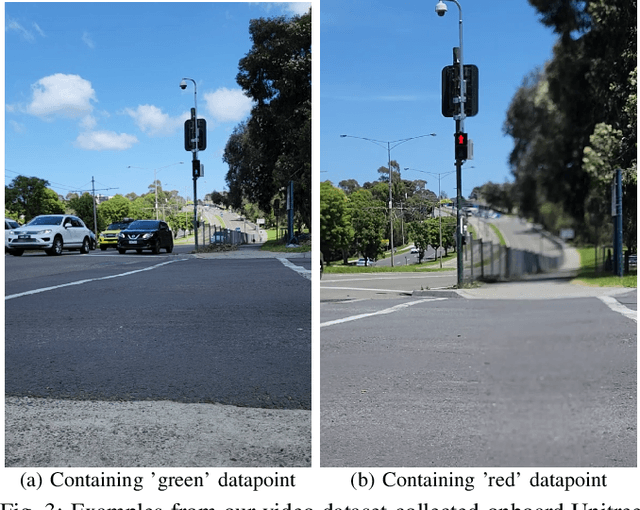
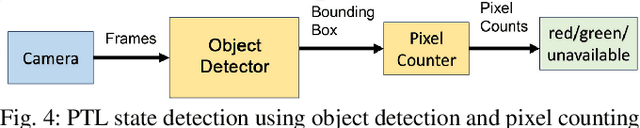
We present a multimodal traffic light state detection using vision and sound, from the viewpoint of a quadruped robot navigating in urban settings. This is a challenging problem because of the visual occlusions and noise from robot locomotion. Our method combines features from raw audio with the ratios of red and green pixels within bounding boxes, identified by established vision-based detectors. The fusion method aggregates features across multiple frames in a given timeframe, increasing robustness and adaptability. Results show that our approach effectively addresses the challenge of visual occlusion and surpasses the performance of single-modality solutions when the robot is in motion. This study serves as a proof of concept, highlighting the significant, yet often overlooked, potential of multi-modal perception in robotics.