 Add to Chrome
 Add to Firefox
 Add to Edge
Where Does Social Reasoning Come From? Capability Provenance in Language Models
Jun 17, 2026
We use training-data attribution as an interpretable tool for capability discovery, mapping which regions of the pretraining corpus support social-reasoning versus STEM-reasoning in OLMo3-7B. Training-data attribution measures how strongly each training document influences a model's predictions on a benchmark, but document-level scores are too noisy to identify which corpus regions support which capabilities, and prior work has emphasized factual knowledge rather than reasoning. We compute gradient-based attribution (TrackStar via Bergson) over a working set drawn from the de-duplicated Dolma3 mix, aggregate influence across WebOrganizer's 24-format x 24-topic taxonomy (576 bins), and contrast benchmark pairs in a 2x2 design that varies domain (social vs. STEM) and capability type (reasoning vs. knowledge): SocialIQA and MMLU Social Sciences against ARC-Challenge and MMLU STEM. Social and STEM reasoning draw on qualitatively distinct corpus regions, and the contrast is sharper at the reasoning level than at the knowledge level. Targeted machine unlearning provides partial causal validation: forgetting high-attribution topic bins (e.g., Literature for SocialIQA) degrades the aligned benchmark more than within-bin random baselines, and we open-source all code, sampling manifests, the bin-level influence matrix, and unlearning checkpoints.

Data-efficient End-to-end Information Extraction for Statistical Legal Analysis
Nov 03, 2022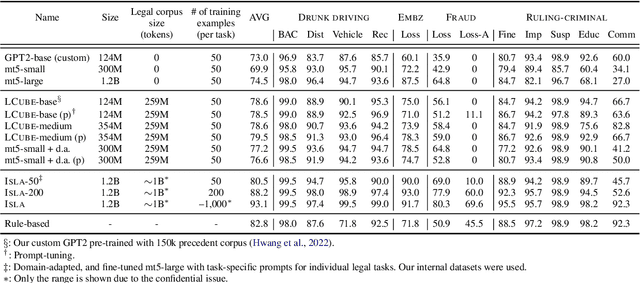
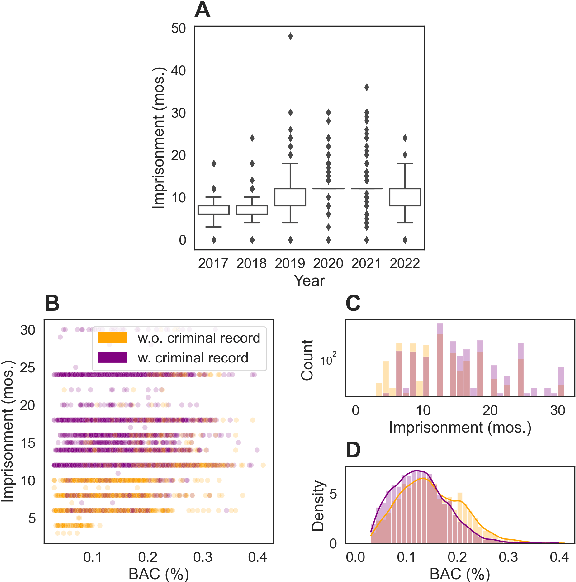
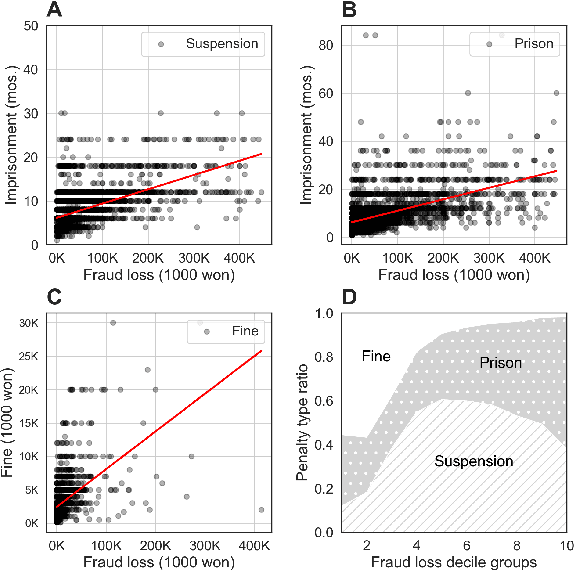

Legal practitioners often face a vast amount of documents. Lawyers, for instance, search for appropriate precedents favorable to their clients, while the number of legal precedents is ever-growing. Although legal search engines can assist finding individual target documents and narrowing down the number of candidates, retrieved information is often presented as unstructured text and users have to examine each document thoroughly which could lead to information overloading. This also makes their statistical analysis challenging. Here, we present an end-to-end information extraction (IE) system for legal documents. By formulating IE as a generation task, our system can be easily applied to various tasks without domain-specific engineering effort. The experimental results of four IE tasks on Korean precedents shows that our IE system can achieve competent scores (-2.3 on average) compared to the rule-based baseline with as few as 50 training examples per task and higher score (+5.4 on average) with 200 examples. Finally, our statistical analysis on two case categories--drunk driving and fraud--with 35k precedents reveals the resulting structured information from our IE system faithfully reflects the macroscopic features of Korean legal system.