 Add to Chrome
 Add to Firefox
 Add to Edge
No One Wins in Nuclear War: A Social Simulation of Military Decision-making
Aug 03, 2026
WOPR is a social-simulation environment for studying how organizations make high-stakes decisions, built on a deterministic, replay-validated rules engine and using wargames as the vehicle. We instantiate it first with the published card game Nuclear War, traced against its published rules. We start with military decision-making because of its safety implications and because it needs further study, but the design is not specific to it: the decision-point contract that exposes the engine to agents is reusable across verifiable rule systems. Existing social-simulation work emphasizes persona fidelity and synthetic opinion, but lacks a verifiable rules engine with replay-checkable mechanics and private-channel negotiation. WOPR supplies that engine, and its contract makes every strategic choice an explicit agent decision. The method is agnostic to social-simulation frameworks; we adopt Concordia as the default harness for driving the game. On the same engine, WOPR layers a four-rung press ladder from silence to private single-recipient channels with structured commitments, and instantiates each faction as a collective command-and-control system rather than a single agent. We make all code, example configurations, and replay data publicly available at https://github.com/eilab-gt/wopr.

Where Does Social Reasoning Come From? Capability Provenance in Language Models
Jun 17, 2026We use training-data attribution as an interpretable tool for capability discovery, mapping which regions of the pretraining corpus support social-reasoning versus STEM-reasoning in OLMo3-7B. Training-data attribution measures how strongly each training document influences a model's predictions on a benchmark, but document-level scores are too noisy to identify which corpus regions support which capabilities, and prior work has emphasized factual knowledge rather than reasoning. We compute gradient-based attribution (TrackStar via Bergson) over a working set drawn from the de-duplicated Dolma3 mix, aggregate influence across WebOrganizer's 24-format x 24-topic taxonomy (576 bins), and contrast benchmark pairs in a 2x2 design that varies domain (social vs. STEM) and capability type (reasoning vs. knowledge): SocialIQA and MMLU Social Sciences against ARC-Challenge and MMLU STEM. Social and STEM reasoning draw on qualitatively distinct corpus regions, and the contrast is sharper at the reasoning level than at the knowledge level. Targeted machine unlearning provides partial causal validation: forgetting high-attribution topic bins (e.g., Literature for SocialIQA) degrades the aligned benchmark more than within-bin random baselines, and we open-source all code, sampling manifests, the bin-level influence matrix, and unlearning checkpoints.
Trust by Design: Skill Profiles for Transparent, Cost-Aware LLM Routing
Feb 02, 2026How should Large Language Model (LLM) practitioners select the right model for a task without wasting money? We introduce BELLA (Budget-Efficient LLM Selection via Automated skill-profiling), a framework that recommends optimal LLM selection for tasks through interpretable skill-based model selection. Standard benchmarks report aggregate metrics that obscure which specific capabilities a task requires and whether a cheaper model could suffice. BELLA addresses this gap through three stages: (1) decomposing LLM outputs and extract the granular skills required by using critic-based profiling, (2) clustering skills into structured capability matrices, and (3) multi-objective optimization to select the right models to maximize performance while respecting budget constraints. BELLA provides natural-language rationale for recommendations, providing transparency that current black-box routing systems lack. We describe the framework architecture, situate it within the landscape of LLM routing and evaluation, and discuss its application to financial reasoning as a representative domain exhibiting diverse skill requirements and cost-variation across models. Our framework enables practitioners to make principled and cost-performance trade-offs for deploying LLMs.
FinForge: Semi-Synthetic Financial Benchmark Generation
Jan 11, 2026Evaluating Language Models (LMs) in specialized, high-stakes domains such as finance remains a significant challenge due to the scarcity of open, high-quality, and domain-specific datasets. Existing general-purpose benchmarks provide broad coverage but lack the depth and domain fidelity needed to assess LMs' capabilities for real-world financial reasoning, which requires both conceptual understanding and quantitative rigor. To address this gap, we introduce FinForge, a scalable, semi-synthetic pipeline for constructing finance-specific evaluation benchmarks through a hybrid of expert-guided data curation and controlled LM-based synthesis. FinForge combines manual and programmatic corpus construction from authoritative financial sources with structured question generation and validation using Gemini 2.5 Flash. To demonstrate the pipeline's efficacy, we produce FinForge-5k, a snapshot benchmark comprising over 5,000 human-validated question-answer pairs across 11 finance subdomains, derived from a curated corpus of 100,000 verified documents totaling 143M tokens. Evaluation of state-of-the-art open-source and closed-source models on FinForge-5k reveals significant differences in financial reasoning, with leading models achieving accuracy levels near 80%. These findings underscore the framework's utility for diagnosing current model limitations and guiding future improvements in financial domain competence. All code and data are available at https://github.com/gtfintechlab/FinForge.
UnfoldML: Cost-Aware and Uncertainty-Based Dynamic 2D Prediction for Multi-Stage Classification
Oct 28, 2022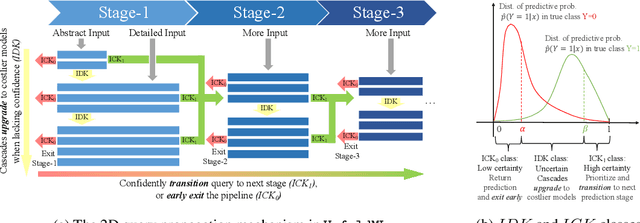

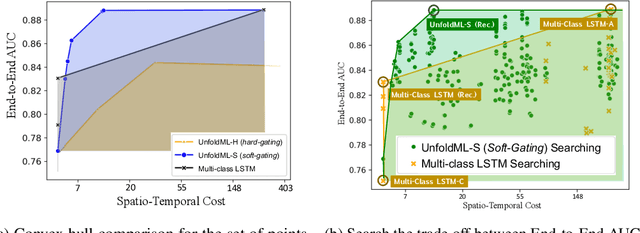

Machine Learning (ML) research has focused on maximizing the accuracy of predictive tasks. ML models, however, are increasingly more complex, resource intensive, and costlier to deploy in resource-constrained environments. These issues are exacerbated for prediction tasks with sequential classification on progressively transitioned stages with ''happens-before'' relation between them.We argue that it is possible to ''unfold'' a monolithic single multi-class classifier, typically trained for all stages using all data, into a series of single-stage classifiers. Each single-stage classifier can be cascaded gradually from cheaper to more expensive binary classifiers that are trained using only the necessary data modalities or features required for that stage. UnfoldML is a cost-aware and uncertainty-based dynamic 2D prediction pipeline for multi-stage classification that enables (1) navigation of the accuracy/cost tradeoff space, (2) reducing the spatio-temporal cost of inference by orders of magnitude, and (3) early prediction on proceeding stages. UnfoldML achieves orders of magnitude better cost in clinical settings, while detecting multi-stage disease development in real time. It achieves within 0.1% accuracy from the highest-performing multi-class baseline, while saving close to 20X on spatio-temporal cost of inference and earlier (3.5hrs) disease onset prediction. We also show that UnfoldML generalizes to image classification, where it can predict different level of labels (from coarse to fine) given different level of abstractions of a image, saving close to 5X cost with as little as 0.4% accuracy reduction.