 Add to Chrome
 Add to Firefox
 Add to Edge
MOSAIC: Modular Scalable Autonomy for Intelligent Coordination of Heterogeneous Robotic Teams
Jan 30, 2026
Mobile robots have become indispensable for exploring hostile environments, such as in space or disaster relief scenarios, but often remain limited to teleoperation by a human operator. This restricts the deployment scale and requires near-continuous low-latency communication between the operator and the robot. We present MOSAIC: a scalable autonomy framework for multi-robot scientific exploration using a unified mission abstraction based on Points of Interest (POIs) and multiple layers of autonomy, enabling supervision by a single operator. The framework dynamically allocates exploration and measurement tasks based on each robot's capabilities, leveraging team-level redundancy and specialization to enable continuous operation. We validated the framework in a space-analog field experiment emulating a lunar prospecting scenario, involving a heterogeneous team of five robots and a single operator. Despite the complete failure of one robot during the mission, the team completed 82.3% of assigned tasks at an Autonomy Ratio of 86%, while the operator workload remained at only 78.2%. These results demonstrate that the proposed framework enables robust, scalable multi-robot scientific exploration with limited operator intervention. We further derive practical lessons learned in robot interoperability, networking architecture, team composition, and operator workload management to inform future multi-robot exploration missions.

LAURON VI: A Six-Legged Robot for Dynamic Walking
Aug 11, 2025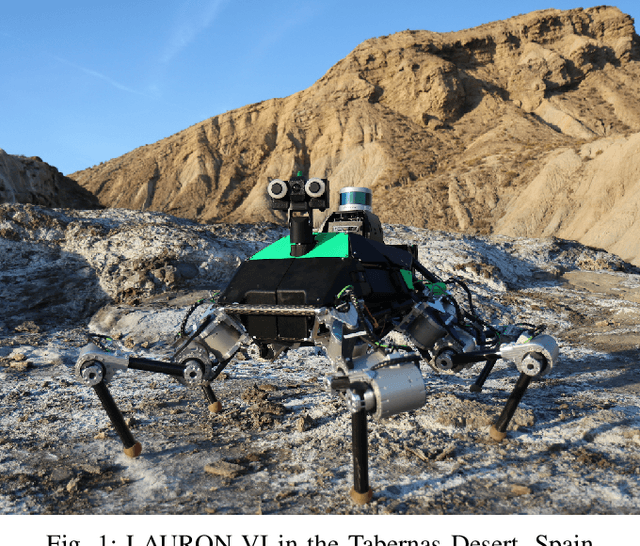
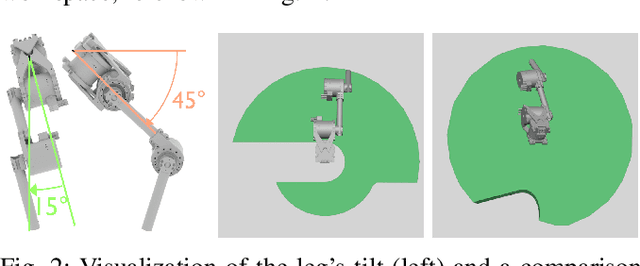
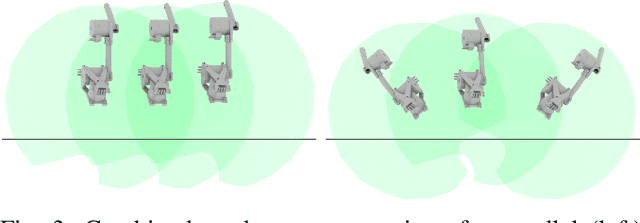
Legged locomotion enables robotic systems to traverse extremely challenging terrains. In many real-world scenarios, the terrain is not that difficult and these mixed terrain types introduce the need for flexible use of different walking strategies to achieve mission goals in a fast, reliable, and energy-efficient way. Six-legged robots have a high degree of flexibility and inherent stability that aids them in traversing even some of the most difficult terrains, such as collapsed buildings. However, their lack of fast walking gaits for easier surfaces is one reason why they are not commonly applied in these scenarios. This work presents LAURON VI, a six-legged robot platform for research on dynamic walking gaits as well as on autonomy for complex field missions. The robot's 18 series elastic joint actuators offer high-frequency interfaces for Cartesian impedance and pure torque control. We have designed, implemented, and compared three control approaches: kinematic-based, model-predictive, and reinforcement-learned controllers. The robot hardware and the different control approaches were extensively tested in a lab environment as well as on a Mars analog mission. The introduction of fast locomotion strategies for LAURON VI makes six-legged robots vastly more suitable for a wide range of real-world applications.