 Add to Chrome
 Add to Firefox
 Add to Edge
FedAdaVR: Adaptive Variance Reduction for Robust Federated Learning under Limited Client Participation
Jan 29, 2026
Federated learning (FL) encounters substantial challenges due to heterogeneity, leading to gradient noise, client drift, and partial client participation errors, the last of which is the most pervasive but remains insufficiently addressed in current literature. In this paper, we propose FedAdaVR, a novel FL algorithm aimed at solving heterogeneity issues caused by sporadic client participation by incorporating an adaptive optimiser with a variance reduction technique. This method takes advantage of the most recent stored updates from clients, even when they are absent from the current training round, thereby emulating their presence. Furthermore, we propose FedAdaVR-Quant, which stores client updates in quantised form, significantly reducing the memory requirements (by 50%, 75%, and 87.5%) of FedAdaVR while maintaining equivalent model performance. We analyse the convergence behaviour of FedAdaVR under general nonconvex conditions and prove that our proposed algorithm can eliminate partial client participation error. Extensive experiments conducted on multiple datasets, under both independent and identically distributed (IID) and non-IID settings, demonstrate that FedAdaVR consistently outperforms state-of-the-art baseline methods.

FedOAED: Federated On-Device Autoencoder Denoiser for Heterogeneous Data under Limited Client Availability
Dec 19, 2025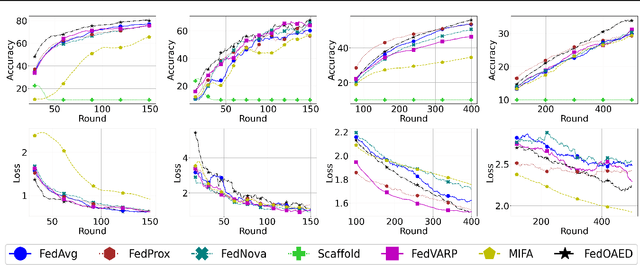
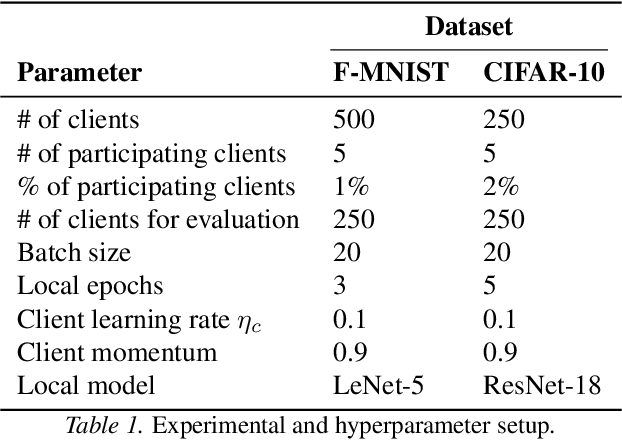
Over the last few decades, machine learning (ML) and deep learning (DL) solutions have demonstrated their potential across many applications by leveraging large amounts of high-quality data. However, strict data-sharing regulations such as the General Data Protection Regulation (GDPR) and the Health Insurance Portability and Accountability Act (HIPAA) have prevented many data-driven applications from being realised. Federated Learning (FL), in which raw data never leaves local devices, has shown promise in overcoming these limitations. Although FL has grown rapidly in recent years, it still struggles with heterogeneity, which produces gradient noise, client-drift, and increased variance from partial client participation. In this paper, we propose FedOAED, a novel federated learning algorithm designed to mitigate client-drift arising from multiple local training updates and the variance induced by partial client participation. FedOAED incorporates an on-device autoencoder denoiser on the client side to mitigate client-drift and variance resulting from heterogeneous data under limited client availability. Experiments on multiple vision datasets under Non-IID settings demonstrate that FedOAED consistently outperforms state-of-the-art baselines.