 Add to Chrome
 Add to Firefox
 Add to Edge
A 3D Reconstruction Benchmark for Asset Inspection
Mar 18, 2026
Asset management requires accurate 3D models to inform the maintenance, repair, and assessment of buildings, maritime vessels, and other key structures as they age. These downstream applications rely on high-fidelity models produced from aerial surveys in close proximity to the asset, enabling operators to locate and characterise deterioration or damage and plan repairs. Captured images typically have high overlap between adjacent camera poses, sufficient detail at millimetre scale, and challenging visual appearances such as reflections and transparency. However, existing 3D reconstruction datasets lack examples of these conditions, making it difficult to benchmark methods for this task. We present a new dataset with ground truth depth maps, camera poses, and mesh models of three synthetic scenes with simulated inspection trajectories and varying levels of surface condition on non-Lambertian scene content. We evaluate state-of-the-art reconstruction methods on this dataset. Our results demonstrate that current approaches struggle significantly with the dense capture trajectories and complex surface conditions inherent to this domain, exposing a critical scalability gap and pointing toward new research directions for deployable 3D reconstruction in asset inspection. Project page: https://roboticimaging.org/Projects/asset-inspection-dataset/

Adapting CNNs for Fisheye Cameras without Retraining
Apr 12, 2024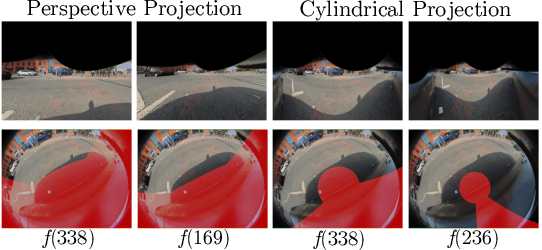
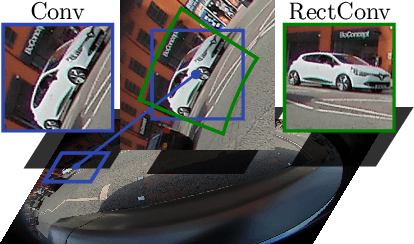
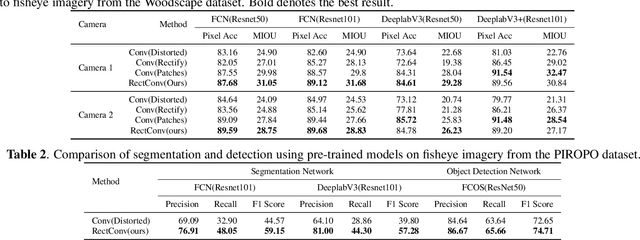
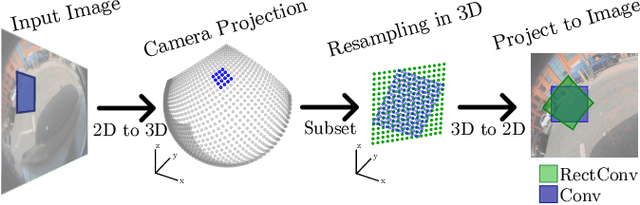
The majority of image processing approaches assume images are in or can be rectified to a perspective projection. However, in many applications it is beneficial to use non conventional cameras, such as fisheye cameras, that have a larger field of view (FOV). The issue arises that these large-FOV images can't be rectified to a perspective projection without significant cropping of the original image. To address this issue we propose Rectified Convolutions (RectConv); a new approach for adapting pre-trained convolutional networks to operate with new non-perspective images, without any retraining. Replacing the convolutional layers of the network with RectConv layers allows the network to see both rectified patches and the entire FOV. We demonstrate RectConv adapting multiple pre-trained networks to perform segmentation and detection on fisheye imagery from two publicly available datasets. Our approach requires no additional data or training, and operates directly on the native image as captured from the camera. We believe this work is a step toward adapting the vast resources available for perspective images to operate across a broad range of camera geometries.
NOCaL: Calibration-Free Semi-Supervised Learning of Odometry and Camera Intrinsics
Oct 18, 2022


There are a multitude of emerging imaging technologies that could benefit robotics. However the need for bespoke models, calibration and low-level processing represents a key barrier to their adoption. In this work we present NOCaL, Neural odometry and Calibration using Light fields, a semi-supervised learning architecture capable of interpreting previously unseen cameras without calibration. NOCaL learns to estimate camera parameters, relative pose, and scene appearance. It employs a scene-rendering hypernetwork pretrained on a large number of existing cameras and scenes, and adapts to previously unseen cameras using a small supervised training set to enforce metric scale. We demonstrate NOCaL on rendered and captured imagery using conventional cameras, demonstrating calibration-free odometry and novel view synthesis. This work represents a key step toward automating the interpretation of general camera geometries and emerging imaging technologies.