 Add to Chrome
 Add to Firefox
 Add to Edge
Decoder-Guided Lossy Contour Coding Via Anchor Refinement
Jul 29, 2026
Object contours serve as compact structural priors for many receiver-side vision tasks such as image super-resolution, edge-conditioned generation, and machine vision. When such tasks are deployed over a bandwidth-limited channel, the sender transmits the high-quality object contour as structural side information to guide reconstruction at the receiver, while-to save bandwidth-only a low-quality reference such as a downsampled image or base-layer reconstruction is delivered. As a result, the decoder can already extract a coarse contour from this reference at no transmission cost, creating an encoder-decoder asymmetry: the fine contour must be coded and sent, yet a free coarse version is available at the decoder. This asymmetry is ignored by existing contour codecs such as JBIG2 and chain coding, which are lossless, symmetric, and offer no rate-distortion control, leading to high bitrates. In this paper, we propose a coarse-to-fine contour coding framework that models a high-quality contour as a structured geometric refinement of the decoder-available coarse contour. The encoder extracts ordered anchors along the fine contour and performs adaptive anchor skipping under a distortion constraint. The decoder then reconstructs the contour by using the coarse prior to guide anchor connectivity. This formulation enables lossy contour compression with an explicit rate-distortion trade-off. Experiments show 54.5%-66.9% bitrate reduction over methods without decoder-side guidance, and up to 5 times savings over JBIG2, while preserving high geometric accuracy.

Kimi K3: Open Frontier Intelligence
Jul 27, 2026We introduce Kimi K3, a 2.8T parameter Mixture-of-Experts model with 104 billion activated parameters, native vision capabilities, and a 1-million-token context window. Kimi K3 is built on Kimi Delta Attention and Attention Residuals, which improve information flow across sequence length and model depth. Together with Stable LatentMoE, which effectively activates 16 of 896 routed experts per token, and refined training and data recipes, these advances yield an approximately 2.5x improvement in overall scaling efficiency over Kimi K2. Post-training highlights reinforcement learning across general, agentic, and coding domains and multiple reasoning-effort levels, enabling compositional generalization and robust long-horizon execution. At 2.8T scale, Kimi K3 is supported by infrastructure advances in multiple areas: algorithm-system co-design for KDA, perfectly balanced expert-parallel training with efficient memory management, million-token agentic RL with persistent rollout and sandbox states, and deployment innovations. Extensive evaluations show that Kimi K3 achieves frontier-level performance across long-horizon coding, agentic, knowledge, reasoning, and vision tasks. While its overall performance still trails the most powerful proprietary models, namely Claude Fable 5 and GPT-5.6 Sol, Kimi K3 consistently outperforms other open and proprietary models evaluated in our suite. We release the full Kimi K3 model weights to facilitate future research and accelerate the broader deployment and adoption of frontier intelligence.
Reverse Back Propagation to Make Full Use of Derivative
Feb 13, 2022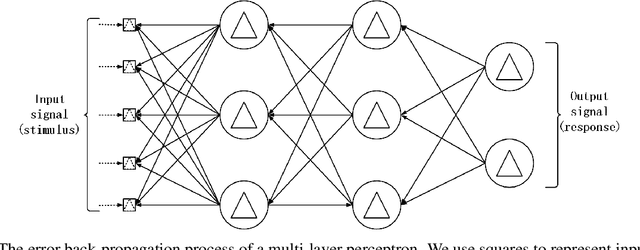
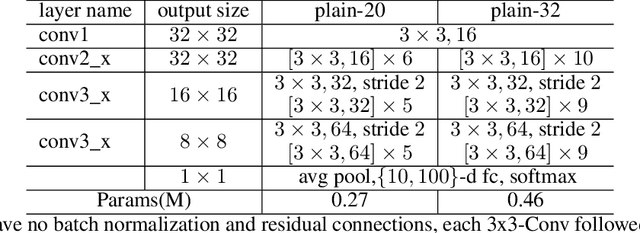
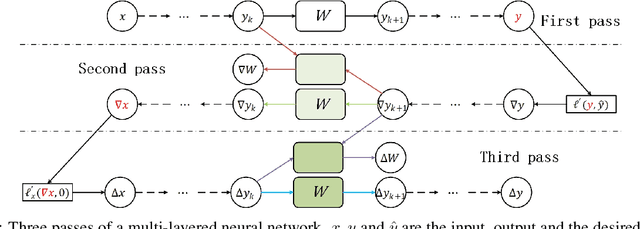
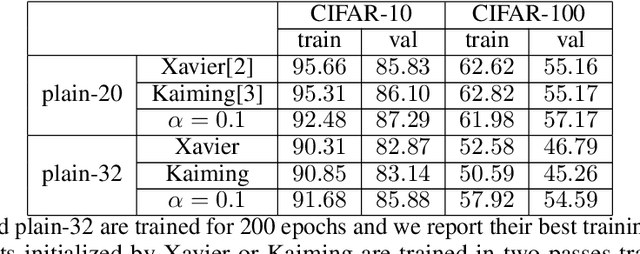
The development of the back-propagation algorithm represents a landmark in neural networks. We provide an approach that conducts the back-propagation again to reverse the traditional back-propagation process to optimize the input loss at the input end of a neural network for better effects without extra costs during the inference time. Then we further analyzed its principles and advantages and disadvantages, reformulated the weight initialization strategy for our method. And experiments on MNIST, CIFAR10, and CIFAR100 convinced our approaches could adapt to a larger range of learning rate and learn better than vanilla back-propagation.
Learning Granularity-Aware Convolutional Neural Network for Fine-Grained Visual Classification
Mar 04, 2021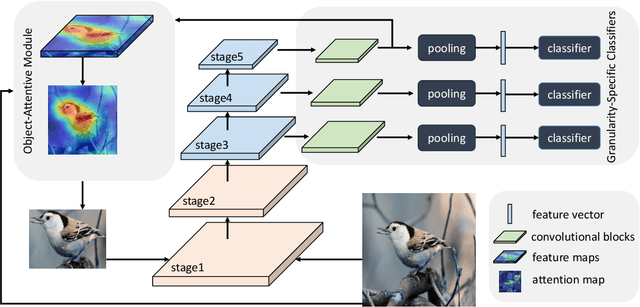
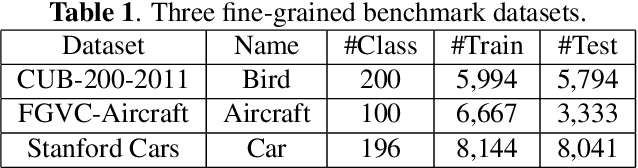
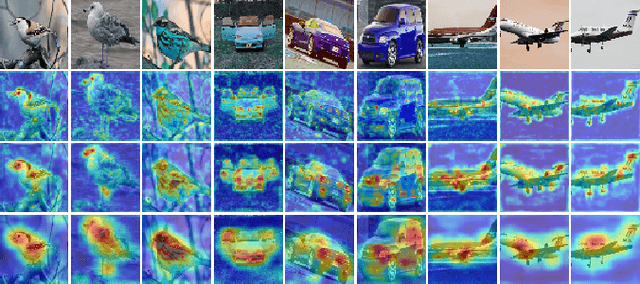
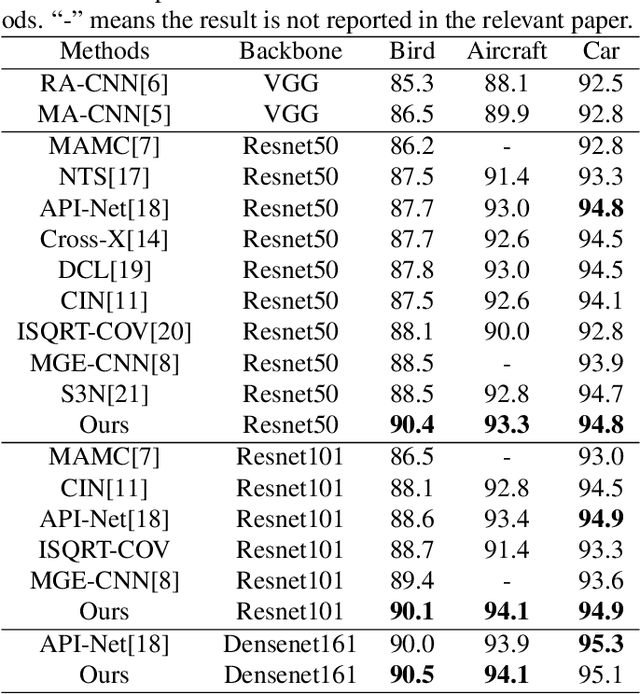
Locating discriminative parts plays a key role in fine-grained visual classification due to the high similarities between different objects. Recent works based on convolutional neural networks utilize the feature maps taken from the last convolutional layer to mine discriminative regions. However, the last convolutional layer tends to focus on the whole object due to the large receptive field, which leads to a reduced ability to spot the differences. To address this issue, we propose a novel Granularity-Aware Convolutional Neural Network (GA-CNN) that progressively explores discriminative features. Specifically, GA-CNN utilizes the differences of the receptive fields at different layers to learn multi-granularity features, and it exploits larger granularity information based on the smaller granularity information found at the previous stages. To further boost the performance, we introduce an object-attentive module that can effectively localize the object given a raw image. GA-CNN does not need bounding boxes/part annotations and can be trained end-to-end. Extensive experimental results show that our approach achieves state-of-the-art performances on three benchmark datasets.
Feature Boosting, Suppression, and Diversification for Fine-Grained Visual Classification
Mar 04, 2021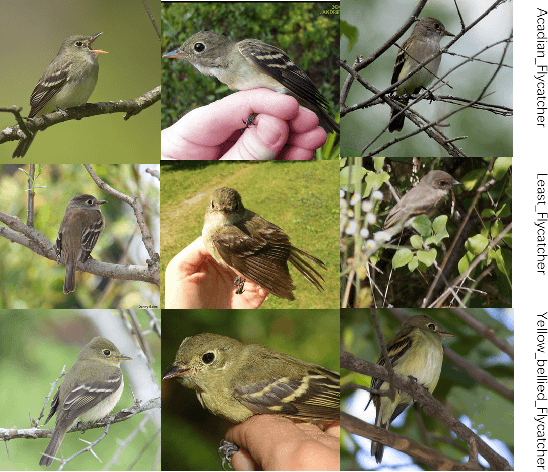
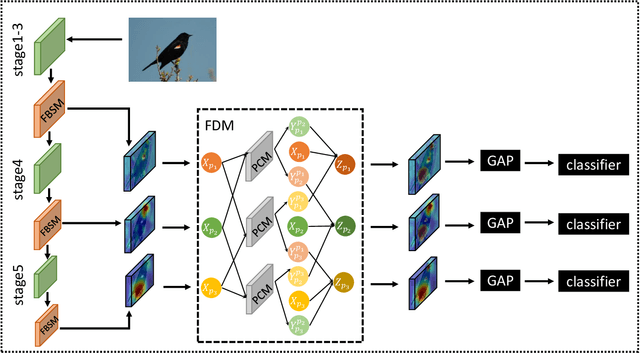
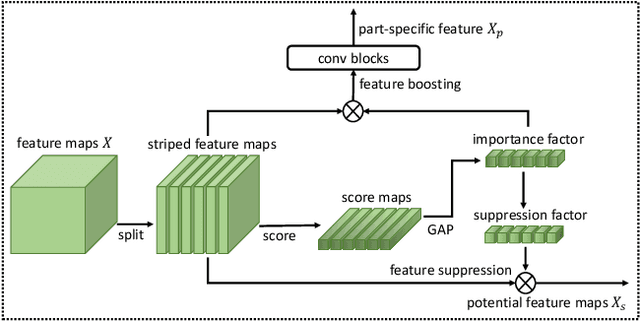
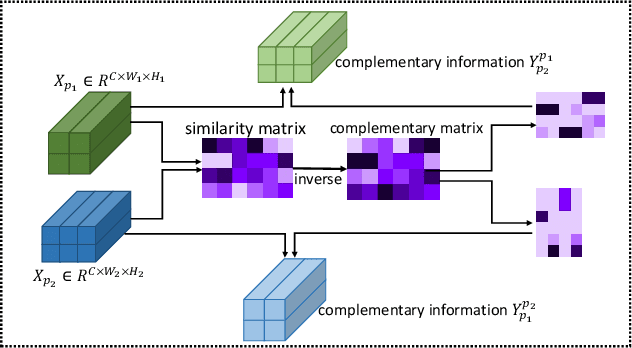
Learning feature representation from discriminative local regions plays a key role in fine-grained visual classification. Employing attention mechanisms to extract part features has become a trend. However, there are two major limitations in these methods: First, they often focus on the most salient part while neglecting other inconspicuous but distinguishable parts. Second, they treat different part features in isolation while neglecting their relationships. To handle these limitations, we propose to locate multiple different distinguishable parts and explore their relationships in an explicit way. In this pursuit, we introduce two lightweight modules that can be easily plugged into existing convolutional neural networks. On one hand, we introduce a feature boosting and suppression module that boosts the most salient part of feature maps to obtain a part-specific representation and suppresses it to force the following network to mine other potential parts. On the other hand, we introduce a feature diversification module that learns semantically complementary information from the correlated part-specific representations. Our method does not need bounding boxes/part annotations and can be trained end-to-end. Extensive experimental results show that our method achieves state-of-the-art performances on several benchmark fine-grained datasets.