 Add to Chrome
 Add to Firefox
 Add to Edge
Active Inference for Micro-Gesture Recognition: EFE-Guided Temporal Sampling and Adaptive Learning
Mar 08, 2026
Micro-gestures are subtle and transient movements triggered by unconscious neural and emotional activities, holding great potential for human-computer interaction and clinical monitoring. However, their low amplitude, short duration, and strong inter-subject variability make existing deep models prone to degradation under low-sample, noisy, and cross-subject conditions. This paper presents an active inference-based framework for micro-gesture recognition, featuring Expected Free Energy (EFE)-guided temporal sampling and uncertainty-aware adaptive learning. The model actively selects the most discriminative temporal segments under EFE guidance, enabling dynamic observation and information gain maximization. Meanwhile, sample weighting driven by predictive uncertainty mitigates the effects of label noise and distribution shift. Experiments on the SMG dataset demonstrate the effectiveness of the proposed method, achieving consistent improvements across multiple mainstream backbones. Ablation studies confirm that both the EFE-guided observation and the adaptive learning mechanism are crucial to the performance gains. This work offers an interpretable and scalable paradigm for temporal behavior modeling under low-resource and noisy conditions, with broad applicability to wearable sensing, HCI, and clinical emotion monitoring.

Active Multimodal Distillation for Few-shot Action Recognition
Jun 16, 2025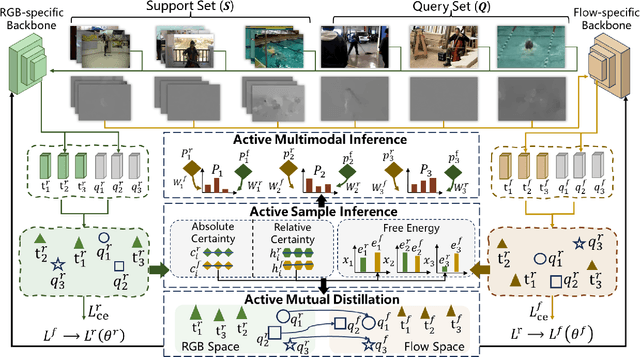
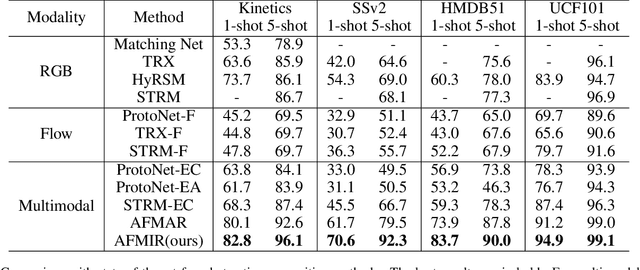
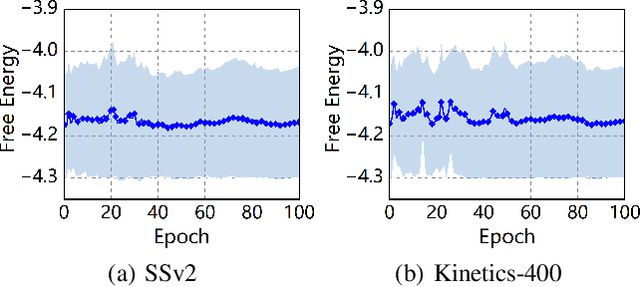
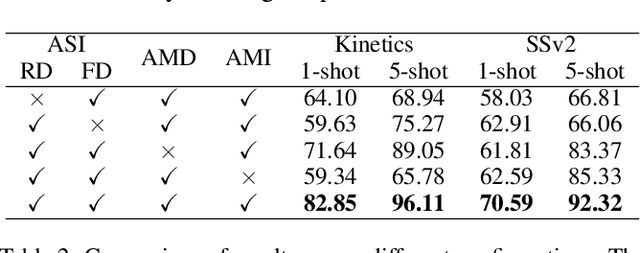
Owing to its rapid progress and broad application prospects, few-shot action recognition has attracted considerable interest. However, current methods are predominantly based on limited single-modal data, which does not fully exploit the potential of multimodal information. This paper presents a novel framework that actively identifies reliable modalities for each sample using task-specific contextual cues, thus significantly improving recognition performance. Our framework integrates an Active Sample Inference (ASI) module, which utilizes active inference to predict reliable modalities based on posterior distributions and subsequently organizes them accordingly. Unlike reinforcement learning, active inference replaces rewards with evidence-based preferences, making more stable predictions. Additionally, we introduce an active mutual distillation module that enhances the representation learning of less reliable modalities by transferring knowledge from more reliable ones. Adaptive multimodal inference is employed during the meta-test to assign higher weights to reliable modalities. Extensive experiments across multiple benchmarks demonstrate that our method significantly outperforms existing approaches.