 Add to Chrome
 Add to Firefox
 Add to Edge
Projection Guided Personalized Federated Learning for Low Dose CT Denoising
Mar 12, 2026
Low-dose CT (LDCT) reduces radiation exposure but introduces protocol-dependent noise and artifacts that vary across institutions. While federated learning enables collaborative training without centralizing patient data, existing methods personalize in image space, making it difficult to separate scanner noise from patient anatomy. We propose ProFed (Projection Guided Personalized Federated Learning), a framework that complements the image space approach by performing dual-level personalization in the projection space, where noise originates during CT measurements before reconstruction combines protocol and anatomy effects. ProFed introduces: (i) anatomy-aware and protocol-aware networks that personalize CT reconstruction to patient and scanner-specific features, (ii) multi-constraint projection losses that enforce consistency with CT measurements, and (iii) uncertainty-guided selective aggregation that weights clients by prediction confidence. Extensive experiments on the Mayo Clinic 2016 dataset demonstrate that ProFed achieves 42.56 dB PSNR with CNN backbones and 44.83 dB with Transformers, outperforming 11 federated learning baselines, including the physics-informed SCAN-PhysFed by +1.42 dB.

The Next Layer: Augmenting Foundation Models with Structure-Preserving and Attention-Guided Learning for Local Patches to Global Context Awareness in Computational Pathology
Aug 27, 2025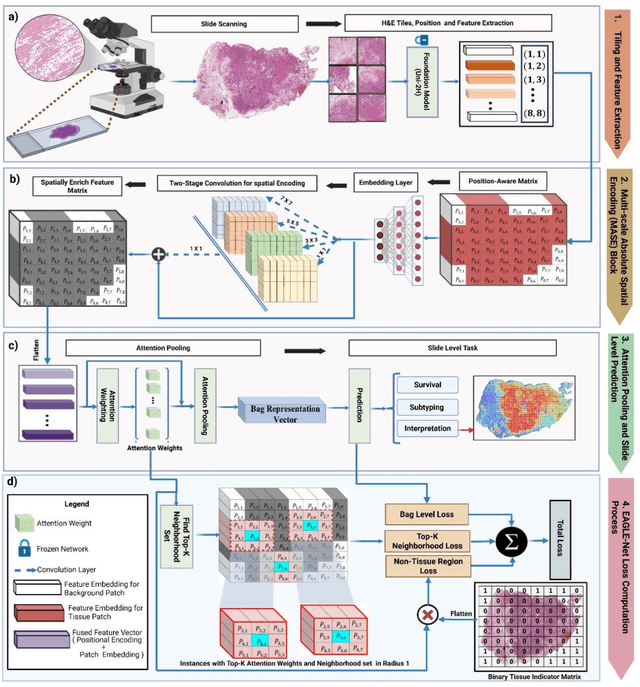
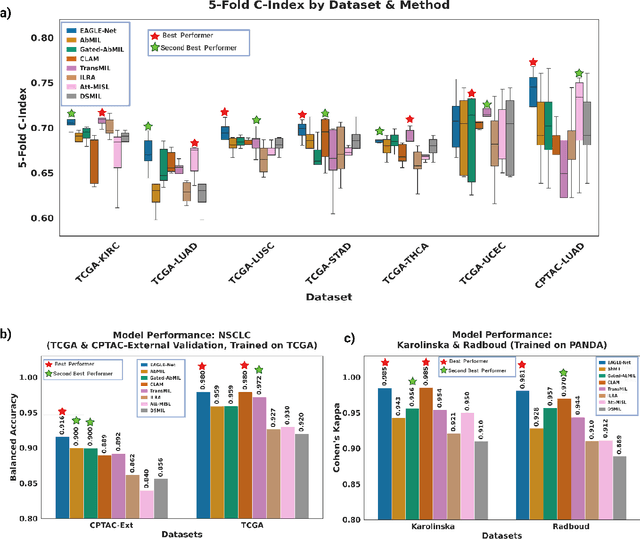
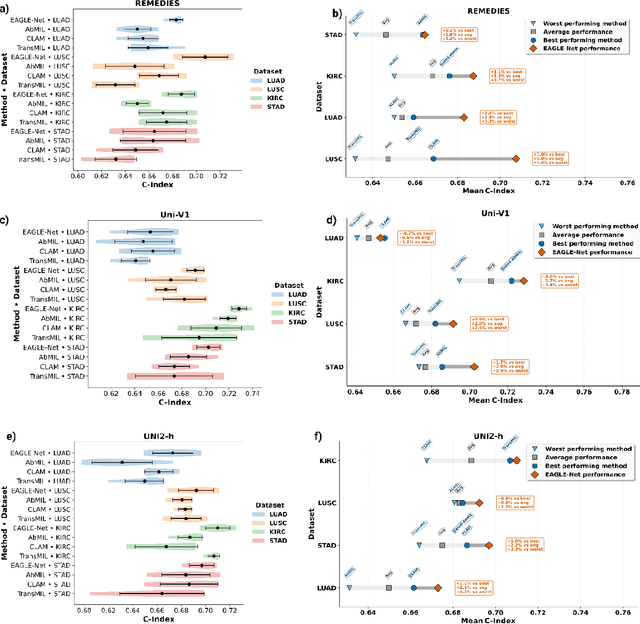
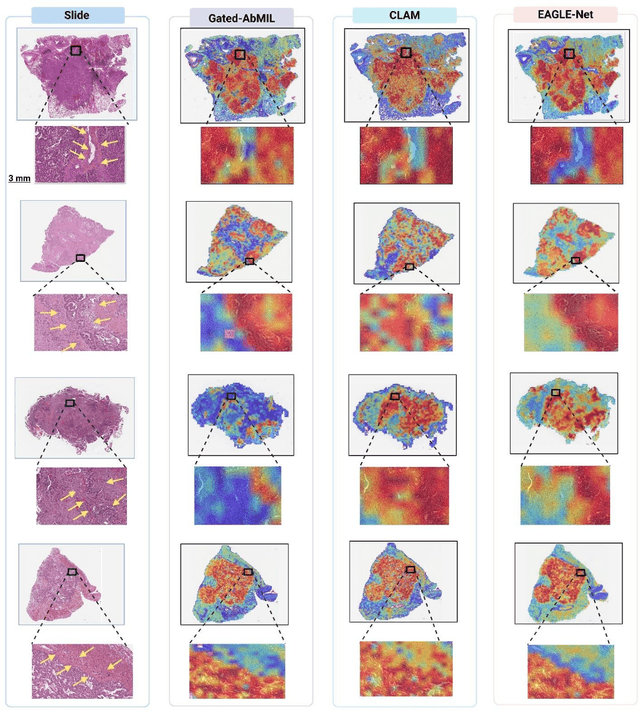
Foundation models have recently emerged as powerful feature extractors in computational pathology, yet they typically omit mechanisms for leveraging the global spatial structure of tissues and the local contextual relationships among diagnostically relevant regions - key elements for understanding the tumor microenvironment. Multiple instance learning (MIL) remains an essential next step following foundation model, designing a framework to aggregate patch-level features into slide-level predictions. We present EAGLE-Net, a structure-preserving, attention-guided MIL architecture designed to augment prediction and interpretability. EAGLE-Net integrates multi-scale absolute spatial encoding to capture global tissue architecture, a top-K neighborhood-aware loss to focus attention on local microenvironments, and background suppression loss to minimize false positives. We benchmarked EAGLE-Net on large pan-cancer datasets, including three cancer types for classification (10,260 slides) and seven cancer types for survival prediction (4,172 slides), using three distinct histology foundation backbones (REMEDIES, Uni-V1, Uni2-h). Across tasks, EAGLE-Net achieved up to 3% higher classification accuracy and the top concordance indices in 6 of 7 cancer types, producing smooth, biologically coherent attention maps that aligned with expert annotations and highlighted invasive fronts, necrosis, and immune infiltration. These results position EAGLE-Net as a generalizable, interpretable framework that complements foundation models, enabling improved biomarker discovery, prognostic modeling, and clinical decision support